Pharmacophore an International Research Journal
Artificial intelligence is increasingly used to represent molecules, predict properties, generate candidates, infer biological states, plan syntheses, and coordinate experimental tools. These capabilities have encouraged the broader idea of a pharmaceutical world model: a computational system intended to represent relevant scientific states, anticipate how interventions alter those states over time, and support reasoning about downstream consequences. However, the evidentiary conditions under which such a system could be treated as a scientific instrument remain unresolved. This state-of-the-art review critically examines the frontier of pharmaceutical world-model architectures, representational commitments, reasoning capabilities, validation practices, failure modes, and readiness boundaries. The review uses a claim-centred analytical framework that distinguishes component capability from integrated simulation, retrospective benchmark performance from prospective experimental confirmation, association from causality, model confidence from calibrated uncertainty, and molecular plausibility from therapeutic relevance. The principal synthesis is a proposed scientific-instrument test requiring explicit representation of state, intervention, temporal transition, causal assumptions, uncertainty, applicability, and measurable biological consequences. Existing foundation, multimodal, generative, perturbational, planning, and agentic systems provide important components of this architecture, and selected prospective studies demonstrate that model outputs can contribute to experimentally testable hypotheses. Nevertheless, the available evidence does not establish a general, intervention-faithful, causally reliable, independently reproducible, and routinely qualified pharmaceutical world model. Important limitations include narrow task definitions, benchmark leakage, limited transportability, incomplete uncertainty evaluation, selective reporting of successful hypotheses, and weak linkage to downstream development decisions. Pharmaceutical world models may become scientific instruments only through intended-use qualification, prospective consequence-based testing, cross-site reproduction, transparent failure reporting, and continuing re-evaluation under distributional and workflow change.
Introduction
Artificial intelligence now contributes to target identification, molecular representation, property prediction, candidate generation, synthesis planning, and other activities distributed across pharmaceutical research. At the same time, contemporary drug-design systems increasingly combine learned representations with medicinal-chemistry knowledge, search procedures, and iterative experimental workflows. This breadth has stimulated expectations that computational models could progress from narrow predictors toward systems that represent scientific environments and anticipate the consequences of proposed interventions. Yet broad application coverage, architectural sophistication, and technical novelty do not by themselves demonstrate that a model functions as a reliable scientific instrument or produces decision-relevant pharmaceutical impact [1-3].
The distinction matters because pharmaceutical data are not neutral observations of a stable world. Chemical and biological datasets are shaped by assay selection, measurement error, historical research priorities, missing negative results, scaffold redundancy, inconsistent endpoints, and experimental context. Large datasets may therefore remain unsuitable for causal inference, temporal simulation, mechanistic explanation, or transport to new chemical and biological settings. A system trained on such evidence can reproduce patterns within the available record without adequately representing the processes that generated those patterns or the consequences of acting beyond the record [4].
The term world model is consequently at risk of becoming an expansive label for systems that perform fundamentally different functions. A molecular generator may produce chemically plausible structures without representing biological state transitions. A foundation model may transfer across tasks without encoding interventions or counterfactuals. A tool-using agent may execute searches and calculations without possessing a faithful internal model of pharmaceutical mechanisms. A dynamic cellular model may infer trajectories while remaining unable to establish causal effects. These capabilities are scientifically valuable, but collapsing them into a single category obscures differences among representation, prediction, generation, planning, simulation, explanation, and experimental validation.
This review asks whether pharmaceutical world models can become scientific instruments and, more specifically, what would have to be demonstrated before that description is scientifically defensible. Its contribution is evaluative rather than celebratory. First, it proposes an operational definition that separates world models from large predictors, generators, and agents. Second, it organizes current architectures according to their treatment of state, intervention, time, causality, uncertainty, and consequences. Third, it distinguishes simulation, reasoning, planning, tool use, and hypothesis generation as related but non-equivalent capabilities. Finally, it proposes scientific-instrument criteria and readiness boundaries that connect computational claims to prospective biological evidence, reproducibility, intended use, and continuing qualification. These constructs are review-derived conceptual syntheses and are not presented as empirically validated standards.
State-of-the-Art Review Scope and Analytical Framework
The evidentiary frontier for this review was fixed at 26 July 2026. A state-of-the-art design was used because the central question concerns a rapidly developing technological frontier rather than the pooled effect of a standardized intervention. The review therefore emphasizes current architectures, conceptual commitments, evaluation practices, and readiness boundaries. Its analytical process follows the core logic of state-of-the-art knowledge synthesis: define the purpose and frontier, identify evidence capable of supporting the planned claims, chart the relevant constructs, compare convergent and divergent findings, and produce an explanatory interpretation rather than a publication-by-publication summary [5].
The review scope was organized around seven linked questions: how the technological frontier should be delimited; what qualifies as a scientific world model; how state, intervention, time, causality, and uncertainty are represented; what simulation, reasoning, planning, and hypothesis-generation capabilities have been demonstrated; how models are validated against biological consequences; which failure modes prevent scientific-instrument use; and which research directions could increase readiness. The review design was matched to these purposes by combining architecture classification, evidence-maturity assessment, critical appraisal, gap analysis, and interpretive synthesis. This approach treats methodological transparency as a condition of credibility while recognizing that heterogeneous computational and experimental studies cannot be reduced to a single pooled estimate [6].
Eligible evidence had to contribute directly to a planned claim about pharmaceutical artificial intelligence, world-model components, biological-state modeling, chemical planning, prospective hypothesis testing, uncertainty, reproducibility, predictive validity, or future infrastructure. Evidence was appraised according to claim fit, methodological transparency, validation setting, reproducibility concerns, risk of overstatement, and the distance between the reported task and pharmaceutical decision relevance. Absence of reported information was treated as an evidentiary limitation rather than filled through inference. This proportionate approach preserves the distinction between a transparent state-of-the-art review and a systematic effectiveness review while retaining explicit eligibility, appraisal, extraction, and synthesis procedures [7]. Table 1 organizes the evidence, constructs, and interpretation boundaries needed to develop state-of-the-art review scope and analytical framework within the article’s central argument.
Table 1. Evidence domains, core questions, scientific requirements, and interpretation boundaries for State-of-the-art review scope and analytical framework
|
Evidence domain |
Eligible evidence or method |
Reported capability or claim |
Strength of support |
Reproducibility or bias concern |
Unresolved gap |
|
Review-method evidence |
State-of-the-art, narrative-synthesis, and transparent-review methodology |
A technological frontier can be examined through explicit scope, eligibility, coding, appraisal, and interpretive synthesis |
Strong for methodological organization; indirect for pharmaceutical performance |
Search terminology, database coverage, and reviewer judgement may affect inclusion and interpretation |
No universally accepted reporting standard exists specifically for pharmaceutical world-model reviews |
|
Pharmaceutical AI landscape |
Critical reviews of machine learning across discovery and development |
Artificial intelligence contributes to multiple pharmaceutical tasks and can reorganize design workflows |
Strong for breadth of application; variable for demonstrated downstream impact |
Positive-result emphasis, heterogeneous tasks, and inconsistent definitions of success |
Limited evidence connecting broad AI adoption to reproducible pharmaceutical decision improvement |
|
Architecture evidence |
Foundation models, multimodal systems, generative models, neural–symbolic planning, and agentic systems |
Current systems provide reusable representations, integration mechanisms, generation, planning, or tool coordination |
Moderate to strong for individual components |
Architectural comparisons often use different datasets, tasks, and evaluation criteria |
No reviewed architecture demonstrates all required world-model commitments in one qualified system |
|
State and transition evidence |
Perturbation models, dynamic cellular models, temporal representation learning, and causal-representation methods |
Models can represent biological variation, infer transitions, or predict selected responses to interventions |
Moderate within defined datasets and biological contexts |
Observational trajectories may be mistaken for causal mechanisms; transport across assays and laboratories is uncertain |
Integrated state, dose, time, context, and counterfactual modeling remains incomplete |
|
Capability evidence |
Molecular generation, synthesis planning, tool-augmented reasoning, autonomous chemistry, and prospective discovery studies |
Systems can generate hypotheses, prioritize candidates, plan actions, and execute bounded workflows |
Strong for selected bounded demonstrations; limited for generalization |
Successful outputs may depend on retrieval, memorization, filtering, external tools, or unreported human intervention |
Faithful simulation and mechanism-sensitive reasoning are rarely tested directly |
|
Validation evidence |
Benchmarks, external datasets, prospective synthesis, biological assays, mechanistic follow-up, and independent reproduction |
Validation can range from retrospective task performance to experimentally confirmed consequences |
Strong evidence that validation setting changes the meaning of performance |
Leakage, scaffold similarity, endpoint mismatch, selective reporting, and weak comparator design |
Few studies provide preregistered, blinded, cross-site, decision-impact validation |
|
Scientific-instrument readiness |
Reproducibility standards, uncertainty evaluation, predictive-validity analysis, and sociotechnical risk assessment |
Scientific use requires traceability, calibration, applicability assessment, reproducibility, consequence relevance, and intended-use control |
Strong conceptual support; limited direct qualification evidence for integrated world models |
Technical repeatability can be confused with predictive validity or operational readiness |
No general pharmaceutical world model has established routine, monitored scientific-instrument status |
Definitions and Architectures of Scientific World Models
Current architecture families provide complementary but incomplete foundations for pharmaceutical world models. Generalist foundation models contribute transferable pretrained representations; multimodal systems provide mechanisms for aligning heterogeneous biomedical observations; and hybrid neural–symbolic systems connect learned knowledge to explicit search or planning procedures [8-10]. These elements matter because a scientific world model must do more than compress data. It must maintain a representation of the relevant environment, distinguish observations from interventions, update state through time, and expose consequences in forms that can be compared with experiments. The proposed definition in this review is therefore narrower than the common use of foundation model, generative model, or agent: a pharmaceutical world model is an intervention-conditioned computational representation of scientifically relevant states and transitions that produces testable consequence distributions together with explicit uncertainty and applicability boundaries.
Generative biological models illustrate both the promise and incompleteness of this definition. Protein language models can learn statistical and functional constraints sufficiently well to propose sequences that retain experimentally measurable activity across multiple protein families [11]. Such results show that generative pretraining can capture biologically meaningful structure rather than merely reproduce literal training examples. However, sequence-level functionality does not establish therapeutic suitability, organism-level effects, manufacturability, safety, exposure, or comparative clinical value. A protein generator may therefore supply hypotheses or components to a pharmaceutical world model without itself representing the broader world in which those proteins act.
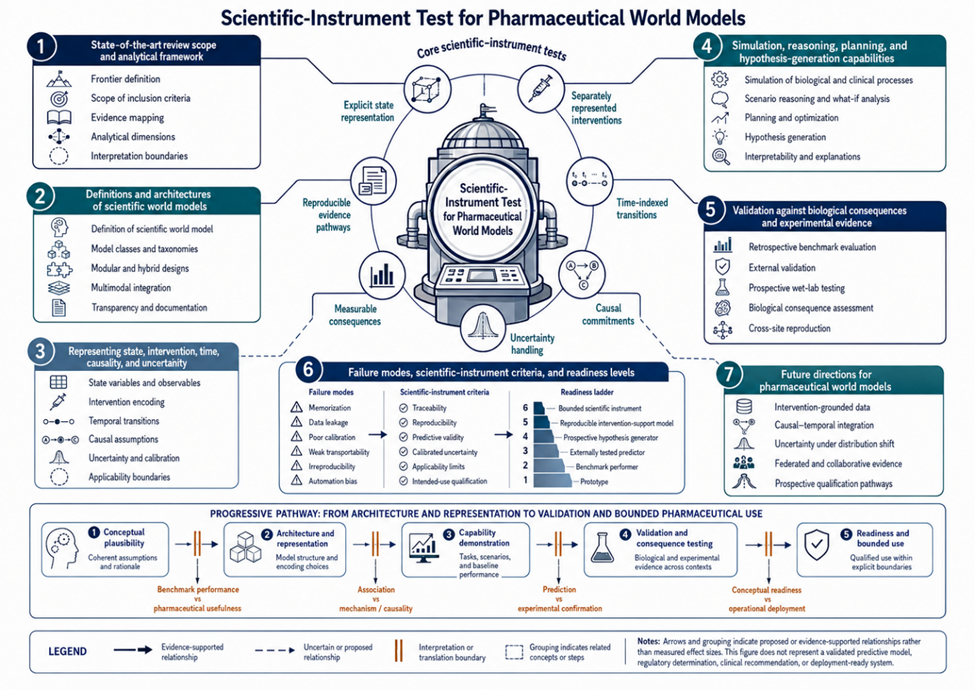
Architecturally, the proposed scientific-instrument test contains six connected commitments. First, the system must define an explicit state comprising the chemical, biological, experimental, and contextual variables relevant to its intended use. Second, it must encode interventions separately from observations so that a compound, dose, schedule, combination, or experimental manipulation is not treated as another passive feature. Third, it must contain a transition model that relates current state and intervention to future state over an appropriate time scale. Fourth, any causal or counterfactual claim must be linked to stated assumptions rather than inferred from predictive performance alone. Fifth, outputs must include calibrated uncertainty, applicability assessment, and the option to abstain. Sixth, predicted consequences must be mapped to measurable experimental outcomes capable of updating, challenging, or invalidating the model. Figure 1 presents the scientific-instrument test for pharmaceutical world models, showing how the article’s key components and boundaries are connected within definitions and architectures of scientific world models.
|
|
|
Figure 1. Scientific-Instrument Test for Pharmaceutical World Models. |
The figure is an original conceptual synthesis that organizes the article’s central contribution across state-of-the-art review scope and analytical framework, definitions and architectures of scientific world models, representing state, intervention, time, causality, and uncertainty, representing state, simulation, reasoning, planning, and hypothesis-generation capabilities, hypothesis-generation capabilities. Arrows and grouping indicate proposed or evidence-supported relationships rather than measured effect sizes. The figure does not represent a validated predictive model, regulatory determination, clinical recommendation, or deployment-ready system.
The test deliberately separates internal architecture from evidentiary qualification. A foundation model may supply a reusable state encoder, but transfer across tasks does not establish intervention fidelity [8]. A multimodal system may align structures, images, omics, and text, but alignment does not guarantee that the fused representation corresponds to a causally coherent biological state [9]. A neural–symbolic planner may conduct explicit search through possible chemical actions, but planning success does not establish that biological outcomes have been simulated [10]. Likewise, a generative protein model may produce functional sequences without representing the downstream pharmaceutical environment in which function becomes benefit, toxicity, resistance, or failure [11]. Pharmaceutical world models should therefore be classified by the commitments they demonstrably implement, not by scale, interface fluency, or branding. Under the proposed taxonomy, most current architectures are best interpreted as partial world-model components whose scientific value depends on how they are integrated, validated, and bounded for a specified use.
Representing State, Intervention, Time, Causality, and Uncertainty
A pharmaceutical world model requires an explicit account of state: the variables considered sufficient to describe the scientific situation relevant to an intended decision. Depending on the task, state may include molecular structure, target conformation, gene expression, cellular phenotype, tissue context, exposure, dose, prior treatment, and experimental conditions. Perturbation-response models demonstrate that latent cellular representations can be conditioned on interventions and used to predict changes across selected cellular contexts [12]. This capability is closer to world modeling than ordinary classification because it relates a represented state to a proposed action and an expected response. Nevertheless, a transcriptomic response remains only one projection of biological state. Unmeasured signaling, metabolism, spatial organization, assay conditions, and cellular history can alter the consequences of the same intervention. State adequacy must therefore be evaluated against the intended scientific use rather than inferred from the dimensionality or apparent richness of the representation.
Time is equally fundamental because pharmaceutical interventions act through processes with different delays, durations, and reversibility. Dynamical single-cell models can infer transient trajectories and directionality from molecular observations, extending analysis beyond static clustering and steady-state assumptions [13]. Such models provide useful representations of evolving biological systems, but an inferred trajectory is not automatically a measured transition law. Temporal predictions may depend on sampling density, model assumptions, unobserved variables, and the correspondence between molecular change and function. A pharmaceutical world model should therefore specify its temporal resolution, transition horizon, memory assumptions, and treatment of path dependence. It should also distinguish immediate molecular engagement, delayed cellular adaptation, tissue-level response, organismal exposure, and longer-term resistance or toxicity, because success at one time scale does not validate predictions at another.
Causality determines whether a model can support questions about what would happen under an intervention rather than merely what tends to co-occur in observed data. Causal representation learning provides a conceptual basis for separating stable generative factors, interventions, and counterfactual structure from correlations that may change across environments [14]. In pharmaceutical science, this distinction is critical because the same molecular signature may arise from different mechanisms, and the same intervention may produce different effects across disease states or treatment histories. Causal claims require explicit assumptions about confounding, measurement, intervention assignment, and the stability of relationships across contexts. A model may predict a response accurately without identifying the responsible mechanism, and it may describe an association without supporting a counterfactual comparison. Accordingly, causal interpretation should be limited to the intervention and context for which assumptions and experimental evidence are defensible.
Uncertainty completes the minimum representational framework. Molecular prediction studies show that uncertainty-estimation methods differ materially in how well they identify likely errors and that apparent confidence cannot be assumed to be calibrated [15]. For a pharmaceutical world model, uncertainty should be attached not only to final predictions but also to state estimation, intervention representation, transition dynamics, causal assumptions, and applicability. Aleatoric variation, model uncertainty, measurement error, missing modalities, and distribution shift may require different treatments. The system should communicate when evidence is insufficient, when a prediction depends strongly on assumptions, and when abstention or additional experimentation is preferable to action. Calibration must also be decision-specific: an uncertainty estimate adequate for prioritizing inexpensive assays may be inadequate for eliminating a candidate, changing a development program, or extrapolating to a new patient population.
Simulation, Reasoning, Planning, and Hypothesis-Generation Capabilities
Hypothesis generation is one of the clearest demonstrated capabilities at the current frontier. Generative modeling has contributed to the identification of kinase inhibitors that were synthesized and experimentally tested, providing evidence beyond virtual novelty or internal scoring [16]. The scientific value of this result lies in producing a proposition that could be challenged by experiment. However, successful generation does not show that the model simulated the full biological system. Candidate selection may reflect learned chemical patterns, target-specific predictors, optimization objectives, human filtering, or external calculations. A world-model claim would require the system to represent why the intervention should alter a relevant state, which downstream consequences are expected, how uncertainty propagates, and under which conditions the prediction should fail. Prospective molecular generation is therefore best treated as experimentally anchored hypothesis formation rather than automatic evidence of mechanistic simulation.
Prediction-led discovery similarly shows how computational systems can search large chemical spaces and prioritize hypotheses that differ from familiar compounds. Deep learning has been used to identify antibacterial candidates that proceeded to experimental evaluation, demonstrating that model-guided prioritization can produce biologically consequential findings [17]. This evidence is stronger than retrospective classification because the selected candidates encounter physical and biological tests not contained in a benchmark score. Yet the resulting capability remains conditional on the task definition, training labels, screening library, assay design, and follow-up strategy. Prediction can direct attention efficiently without representing the complete causal structure of bacterial response, resistance, host effects, or clinical exposure. The distinction between prioritization and simulation should therefore remain explicit even when prospective experiments succeed.
Reasoning claims require particular caution because fluent explanations and successful task completion can arise from several mechanisms. Chemistry language models augmented with calculators, databases, search systems, code execution, and specialist tools can solve bounded tasks more effectively than unaided language generation [18]. This architecture is scientifically useful because it externalizes operations that require precision and allows intermediate outputs to be inspected. Nevertheless, tool use does not establish that the language model possesses a faithful internal representation of chemistry. An answer may result from retrieval, pattern matching, decomposition, or correctly invoking an external program. Evaluation should therefore identify which component produced each result, whether intermediate claims are traceable, how errors propagate across tools, and whether the system can detect contradictions or invalid assumptions. Tool-augmented performance is evidence of orchestrated problem solving, not by itself evidence of mechanistic reasoning.
Planning extends this orchestration across multiple actions. Autonomous chemical systems have integrated literature retrieval, code, experimental planning, and laboratory interfaces to perform bounded research tasks [19]. Such demonstrations show that an agent can connect computational and physical operations, adapt a plan to intermediate information, and produce experimentally testable outputs. They do not yet establish a general pharmaceutical world model. The represented environment may be limited to available tools and encoded procedures; biological consequences may remain outside the planning loop; and human intervention may be difficult to separate from autonomous action. A rigorous capability taxonomy should therefore distinguish simulation of state transitions, reasoning over explicit scientific claims, planning of actions, execution through tools, and generation of hypotheses. These capabilities may be combined, but evidence for one should not be used as proof of the others.
Validation against Biological Consequences and Experimental Evidence
Validation begins with clarity about what a test can establish. Molecular benchmark suites standardize datasets, endpoints, and splits, enabling comparison among algorithms on defined prediction tasks [20]. They are valuable for detecting implementation errors, estimating relative performance, and studying representation choices. Their evidentiary reach is nevertheless limited. A benchmark evaluates behavior under a specified data-generating and partitioning scheme; it does not automatically test whether the model will support a future pharmaceutical decision. Benchmarks may omit intervention timing, assay variability, negative results, development constraints, and the downstream consequences that matter to drug discovery. A pharmaceutical world model should therefore not be considered validated merely because its components perform well on established datasets. Benchmark competence is an early validation layer, not a substitute for consequence-based evaluation.
Representation studies further demonstrate that apparent superiority depends on the task, training regime, data volume, and evaluation split. Comparative analysis of learned molecular representations shows that no single architecture dominates all property-prediction conditions and that conclusions can change with dataset and validation design [21]. This context dependence is important for world models because a representation useful for one endpoint may discard information essential to another. Internal validity requires careful split selection, appropriate baselines, control of leakage, and analysis of performance across chemical neighborhoods. External validity requires evidence that relevant relationships persist across new compounds, assays, targets, laboratories, and biological contexts. Model comparison should consequently be framed around intended use and failure conditions rather than a single aggregate ranking.
Prospective target-based studies provide a more demanding form of evidence. An AI-supported workflow using predicted structural information contributed to the discovery and experimental testing of a small-molecule inhibitor for a defined target [22]. This type of result demonstrates that computational representations and prioritization can be connected to laboratory evidence in a real discovery program. However, one successful target-specific application does not establish broad predictive validity. The result may depend on target tractability, structural quality, compound-selection choices, assay configuration, and expert intervention. Prospective validation should therefore report the complete decision pathway, including rejected hypotheses, failed compounds, model revisions, and the contribution of conventional methods. Without these denominators, the incremental value and reliability of the computational system remain difficult to estimate.
The strongest available validation examples connect model-guided prioritization to multiple layers of experimental consequence. Explainable deep learning has supported the discovery of an antibiotic structural class followed by biological testing and mechanistic investigation [23]. Such studies move beyond an isolated activity result by examining whether the predicted candidates produce coherent downstream effects. Even so, scientific-instrument qualification requires further evidence: independent reproduction, predeclared endpoints, comparison with expert and conventional baselines, calibration of prospective failure probabilities, and testing across settings that differ from model development. Validation should thus be organized as a ladder from retrospective performance to external prediction, prospective wet-laboratory testing, mechanism-sensitive intervention studies, cross-site reproduction, and decision impact. Advancement along this ladder is conditional, reversible, and specific to the intended pharmaceutical use.
Failure Modes, Scientific-Instrument Criteria, and Readiness Levels
A primary failure mode is mistaking chemical similarity recognition for general scientific prediction. Analysis of ligand-based benchmarks has shown that common evaluation designs can reward memorization or analogue recognition rather than extrapolation to genuinely new chemical space [24]. This problem is especially consequential for world-model claims because high performance may arise without learning transferable transition rules. Leakage can occur through duplicated compounds, shared scaffolds, correlated assay series, target-family overlap, or preprocessing decisions that preserve hidden information. Scientific-instrument evaluation should therefore include chemically and biologically meaningful holdouts, temporal separation where appropriate, adversarial checks, and explicit analysis of performance as distance from the training domain increases. A model that cannot identify its own extrapolations should not be trusted to simulate unfamiliar interventions.
Reproducibility is a second criterion, but it must be understood broadly. Life-science machine-learning standards emphasize transparent reporting of data provenance, preprocessing, code, model configuration, computational environment, and evaluation procedures [25]. For a pharmaceutical world model, reproducibility also requires versioned state definitions, intervention encodings, tool dependencies, prompts or policies, stochastic settings, and experimental interfaces. Independent investigators should be able to reconstruct not only the final output but the evidence path by which it was generated. Reproducibility does not mean that every biological experiment yields an identical value; it means that variation is characterized, procedures are traceable, and conclusions remain stable within prespecified tolerances. A result that cannot be independently reconstructed cannot support strong scientific-instrument claims.
A third failure mode arises from the sociotechnical setting in which models are interpreted and acted upon. Machine learning can produce unintended consequences even when technical performance appears acceptable, particularly when users overtrust outputs, workflow incentives reward speed over challenge, or responsibility becomes distributed across people and systems [26]. In pharmaceutical research, an apparently precise recommendation may suppress alternative hypotheses, narrow chemical exploration, or obscure uncertainty introduced by upstream data and tools. Instrument qualification must therefore include human responsibilities, escalation rules, challenge pathways, documentation of overrides, and safeguards against automation bias. The relevant unit of evaluation is not only the model but the model–data–tool–experiment–human system through which scientific decisions are made.
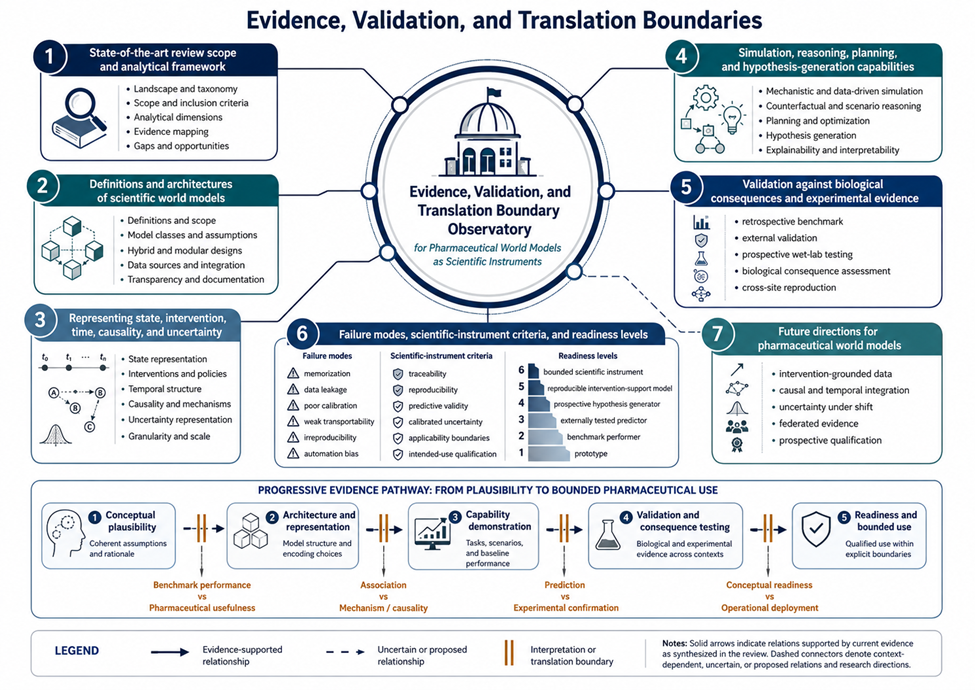
The proposed readiness framework treats predictive validity as the central bridge between technical performance and scientific use. Predictive validity concerns whether a model anticipates the downstream consequences relevant to an actual discovery or development decision, rather than merely fitting existing measurements [27]. Under this synthesis, readiness progresses qualitatively from a representational prototype, to a retrospective benchmark performer, an externally tested predictor, a prospective experimental hypothesis generator, a reproducible intervention-support model, a translational decision-support candidate, and finally a routinely monitored scientific instrument. These levels are proposed analytical categories, not validated regulatory classifications. Advancement requires evidence appropriate to the intended use, and failure at calibration, transportability, reproducibility, consequence relevance, or workflow integration can halt or reverse progression. Figure 2 presents the evidence, validation, and translation boundary observatory for can pharmaceutical world models become scientific instruments, showing how the article’s key components and boundaries are connected within failure modes, scientific-instrument criteria, and readiness levels.
|
|
|
Figure 2. Evidence, Validation, and Translation Boundaries |
The figure is an original conceptual synthesis that shows how claims move from conceptual plausibility through evaluation, uncertainty assessment, and bounded pharmaceutical use. Arrows and grouping indicate proposed or evidence-supported relationships rather than measured effect sizes. The figure does not represent a validated predictive model, regulatory determination, clinical recommendation, or deployment-ready system.
Future Directions for Pharmaceutical World Models
Future progress will depend partly on more transferable representations of biological state. Foundation models have begun to support predictions in network biology, multi-task analysis of single-cell multi-omics, and transcriptional representation across human cell types [28-30]. These systems may provide reusable encoders for cellular identity, regulatory context, and disease-associated variation. Their contribution to world modeling will remain limited, however, unless they are connected to explicit interventions, temporal transitions, causal assumptions, and consequence-based validation. Future architecture research should therefore prioritize modular integration rather than treating scale alone as the route to generality. A useful platform may combine specialized state encoders, mechanistic or learned transition components, uncertainty modules, and experimental interfaces while preserving traceability across modules.
Evidence diversity is another priority. Federated learning may enable institutions to develop or test molecular models across distributed proprietary datasets without centralizing all underlying records [31]. This could widen chemical, assay, target, and organizational coverage while preserving local control. Federated scale does not automatically improve validity: sites may use incompatible endpoints, assays, preprocessing rules, or patient and compound populations, and model updates may still reveal sensitive information. Collaborative world-model development should therefore include shared ontologies, harmonized endpoint definitions, site-level diagnostics, leakage assessment, privacy safeguards, and common external validation tasks. The objective should be distributed scientific challenge rather than merely distributed optimization.
Prospective evaluation should also move from selected demonstrations to structured research programs. Models should be locked before testing, their intended use and failure criteria specified, and their predictions compared with expert practice and conventional computational baselines. Full denominators are needed: proposed interventions, rejected candidates, failed experiments, abstentions, overrides, and model revisions should be recorded alongside successes. Uncertainty should be tested under chemical, biological, temporal, and laboratory shifts rather than only within familiar benchmarks [15]. Reproducibility packages should preserve model versions, data lineage, tool calls, experimental protocols, and human decisions so that independent groups can reconstruct the complete evidence path [25]. These practices would not guarantee translation, but they would make reliability and incremental scientific contribution assessable.
Finally, qualification should be organized around bounded intended uses. A system might be fit to prioritize compounds for a low-cost assay while remaining unfit to terminate a program, infer a mechanism, recommend a dose, or generalize to a new disease context. Each use should specify acceptable errors, required calibration, applicability boundaries, escalation rules, monitoring indicators, and requalification triggers. Predictive validity should be judged against the downstream consequence that matters for that use rather than against technical performance in isolation [27]. Table 2 organizes the evidence, constructs, and interpretation boundaries needed to develop future directions for pharmaceutical world models within the article’s central argument.
Table 2. Evaluation, implementation, and research priorities arising from Can Pharmaceutical World Models Become Scientific Instruments? A State-of-the-Art Review of Simulation
|
Approach or application |
Data and task context |
Evaluation practice |
Evidence maturity |
Translational limitation |
Review interpretation |
|
Foundation biological representations |
Network biology, single-cell multi-omics, transcriptional regulation, and protein sequences |
Transfer across held-out tasks, contexts, or biological labels |
Externally tested representational capability |
Interventions, longitudinal transitions, causal transport, and uncertainty under shift remain incomplete |
Promising state encoders, but not complete pharmaceutical world models |
|
Multimodal state construction |
Molecular structures, omics, imaging, phenotypes, assays, and scientific text |
Modality-specific and fused-task evaluation; missing-modality testing |
Emerging component-level evidence |
Alignment may combine incompatible measurements or conceal missing causal variables |
Multimodality increases observational coverage but does not guarantee coherent scientific state |
|
Perturbation-response modeling |
Cellular states under compounds, genetic changes, or environmental interventions |
Held-out perturbations, cell contexts, doses, and time points |
Moderate predictive maturity in bounded datasets |
Transport across laboratories, disease states, and intervention regimes is uncertain |
One of the most direct routes toward intervention-conditioned state prediction |
|
Temporal and causal transition modeling |
Longitudinal, dynamic, or perturbational biological data |
Trajectory prediction, intervention tests, counterfactual checks, and mechanism-sensitive validation |
Early and heterogeneous |
Observational directionality may be mistaken for causal mechanism |
Necessary for world-model status but requires stronger intervention-grounded evidence |
|
Generative molecular and protein design |
Candidate structures or sequences optimized for selected objectives |
Prospective synthesis, activity assays, functional characterization, and comparator analysis |
Prospective hypothesis-generation evidence exists |
Molecular novelty and activity do not establish developability, safety, exposure, or therapeutic value |
Demonstrates testable hypothesis generation rather than complete consequence simulation |
|
Tool-augmented and agentic research systems |
Literature, databases, code, synthesis planning, instruments, and laboratory procedures |
Task completion, traceability, error analysis, human-intervention accounting, and cross-site repetition |
Bounded workflow demonstrations |
Tool dependence, hidden errors, security, reproducibility, and weak biological consequence modeling |
Useful orchestration layer whose reasoning and autonomy claims require component-level testing |
|
Federated pharmaceutical learning |
Distributed institutional, proprietary, or sensitive datasets |
Cross-site performance, site-level calibration, privacy analysis, and common external tasks |
Early collaborative maturity |
Heterogeneous endpoints, governance, privacy leakage, and incentive alignment |
May increase evidence diversity if coupled to harmonized validation and transparent governance |
|
Intended-use scientific-instrument qualification |
Specific discovery or development decisions with defined consequences |
Prospective decision-impact testing, calibration, abstention, monitoring, and requalification |
Not established as a general routine capability |
No single model is suitable for all pharmaceutical uses or consequence levels |
Qualification should be use-specific, reversible, and continuously monitored rather than claimed from model scale |
Conclusion
Pharmaceutical world models can plausibly become scientific instruments, but only if the term is reserved for systems that do more than predict, generate, retrieve, or automate. The central contribution of this review is a proposed scientific-instrument test that requires an explicit state, a separately represented intervention, a time-indexed transition model, stated causal assumptions, calibrated uncertainty, applicability boundaries, measurable consequences, and a reproducible path from prediction to experimental challenge. Current foundation, multimodal, perturbational, generative, planning, and agentic systems provide important elements of this architecture, and prospective studies show that model-guided hypotheses can contribute to successful experiments. The evidence nevertheless remains fragmented, task-specific, and insufficient to establish a general, causally reliable, independently reproducible, and routinely qualified pharmaceutical world model. Benchmark performance must remain separate from usefulness, association from mechanism, prediction from experimental confirmation, and conceptual readiness from operational deployment. Progress will depend on intervention-grounded longitudinal data, transparent negative-result reporting, uncertainty testing under meaningful distribution shifts, preregistered prospective comparisons, independent cross-site reproduction, and qualification for bounded intended uses. The proposed taxonomy and readiness framework are interpretive tools for organizing this transition, not validated standards or claims of current deployment readiness.
Acknowledgments: None
Conflict of interest: None
Financial support: None
Ethics statement: None