Pharmacophore an International Research Journal
Individualized dosing is commonly framed as the selection of a dose that best predicts exposure, biomarker response, efficacy, or toxicity for a particular patient. That framing is incomplete when treatment decisions alter subsequent physiology, disease state, adherence, monitoring, and future treatment allocation. In such settings, the clinically relevant question is not merely what outcome is likely under the observed dose, but how the same patient might evolve under alternative feasible dose histories. This article proposes a causal dose twin: a conceptual treatment-simulation model that combines longitudinal causal structure, treatment-history representation, mechanistic pharmacokinetic–pharmacodynamic and disease models, sequential patient-state updating, and safety-constrained counterfactual comparison. The proposed architecture distinguishes prediction from causal estimation, observed response from treatment effect, prescribed dose from realized exposure, and model confidence from decision-relevant uncertainty. It treats patient heterogeneity as dynamic rather than fixed and represents disease progression, adherence, organ-function change, co-interventions, and monitoring as components that can alter both future response and future treatment. Counterfactual dose strategies are therefore evaluated as trajectories rather than isolated actions. The article further argues that validation must be matched to context of use and must include causal identification, state reconstruction, pharmacological adequacy, uncertainty calibration, transportability, safety behavior, and governance. The causal dose twin is presented as an original methodological synthesis, not as an empirically validated dosing system. Its usefulness is conditional on defensible causal assumptions, adequate longitudinal data, drug- and disease-specific mechanistic knowledge, clinically meaningful constraints, and accountable human authorization. The framework provides a research structure for moving individualized dosing beyond descriptive personalization toward bounded comparison of alternative treatment histories.
Introduction
Medical digital twins are increasingly described as computational representations that remain linked to an individual through repeated observations and can be used to simulate possible future states. Their scientific value, however, depends on more than personalization of input variables. A patient-specific model becomes relevant to dosing only when it can represent treatment history, update its internal state as new information arrives, and examine how alternative interventions could alter subsequent trajectories. A static profile, even when highly detailed, does not constitute a treatment simulator unless it has an explicit temporal structure, intervention semantics, and a defensible relationship between modeled actions and outcomes [1]. This distinction is particularly important in pharmaceutical science, where dose decisions influence exposure, response, toxicity, monitoring intensity, adherence, rescue treatment, organ function, and the next dose decision.
Patient heterogeneity also cannot be reduced to a set of baseline covariates appended to an otherwise uniform model. Biological systems are multiscale and dynamically coupled: molecular disposition, receptor signaling, tissue adaptation, disease progression, comorbidity, behavior, and clinical intervention can evolve at different rates and interact nonlinearly. A patient who initially resembles a reference population may later depart from it because of resistance, tolerance, declining organ function, intercurrent illness, treatment interruption, or changing disease burden. A useful causal twin must therefore represent heterogeneity as an evolving state rather than a permanent label and must permit uncertainty about which mechanisms dominate at a particular time [2]. The central challenge is not simply to increase model complexity, but to preserve clinically interpretable relationships between state, treatment, time, and outcome.
This challenge exposes a fundamental difference between personalized prediction and individualized treatment-effect estimation. A model may predict that a patient receiving a high dose will experience a particular outcome, yet that association does not reveal what would have happened to the same patient under a lower dose, a delayed dose, a treatment interruption, or a monitoring-contingent strategy. Estimating individualized treatment effects requires an explicit contrast between alternative interventions and depends on assumptions about treatment assignment, confounding, overlap, outcome definition, and the time horizon of interest [3]. Consequently, high predictive accuracy for observed outcomes cannot by itself establish that a model can compare dose strategies causally or that its preferred strategy would improve a clinically relevant outcome.
This article develops an original causal treatment-simulation model termed the causal dose twin. The contribution is conceptual and architectural rather than empirical. It organizes individualized dosing around five linked requirements: a clearly specified counterfactual dose estimand; a longitudinal causal structure that retains treatment history and time-varying confounding; a pharmacological and disease-state model that can be updated as the patient changes; a constrained simulator for comparing clinically feasible dose trajectories; and a validation and governance structure proportional to the consequence of use. The model is not proposed as an autonomous prescriber, a regulator-accepted methodology, or a universally applicable solution. Its purpose is to define what would have to be represented, tested, and governed before a patient-specific simulation could support credible comparison of alternative dose histories.
Why Individualized Dosing Requires Counterfactual Rather Than Descriptive Models
Model-informed precision dosing has established that population pharmacokinetic, pharmacodynamic, disease, and covariate information can be combined with patient observations to support dose individualization. Yet the existence of a model capable of producing a patient-specific estimate does not establish routine clinical value. Translation depends on data quality, workflow integration, model qualification, interpretability, stakeholder acceptance, and evidence that the resulting decision improves upon existing practice [4]. More fundamentally, many dosing tools remain descriptive in the sense that they estimate current parameters, forecast outcomes under a selected regimen, or identify a dose expected to reach a predefined exposure target. These functions can be useful, but they do not necessarily answer the counterfactual question that underlies treatment choice: how would this patient’s future differ under each clinically admissible dose strategy?
At the bedside, individualized dosing commonly combines a population model with current patient measurements to obtain a posterior estimate of exposure or response. This Bayesian structure is valuable because it allows prior pharmacological knowledge to be revised by observed concentrations, biomarkers, organ function, or treatment response [5]. However, posterior individualization and counterfactual identification are different operations. A posterior parameter estimate characterizes the patient within a model; it does not automatically establish the causal effect of changing treatment. If the measured state has already been altered by previous doses, clinical interventions, adherence, or selective monitoring, then the patient’s apparent response cannot be interpreted independently of the process that generated both the observations and the treatment history.
Digital-health measurements may make the patient record more temporally detailed, but greater data volume does not remove this inferential distinction. Repeated wearable measurements, laboratory values, electronic administration records, home monitoring, and patient-reported information can enable more responsive dosing, yet each source introduces questions of timing, measurement validity, missingness, interoperability, and clinical relevance [6]. A descriptive model may absorb these signals and improve short-horizon prediction while still failing to distinguish whether a change in outcome is attributable to treatment, disease evolution, adherence, co-intervention, or observation intensity. Data availability is therefore not equivalent to data suitability for counterfactual simulation.
Heterogeneous treatment-effect methods reinforce the need to specify treatment contrasts rather than infer individual benefit from overall outcome prediction. These methods estimate how effects vary across patient characteristics, but their conclusions remain conditional on causal identification, adequate treatment overlap, consistent treatment definitions, and appropriate outcome models [7]. For dosing, the challenge is more demanding because the intervention is often a sequence rather than a binary treatment, patient characteristics change over time, and prior dose decisions can alter later covariates. The proposed causal dose twin consequently defines individualization as the comparison of alternative, clinically feasible dose histories for a specified patient state, outcome, and horizon. Table 1 organizes the evidence, constructs, and interpretation boundaries needed to develop why individualized dosing requires counterfactual rather than descriptive models within the article’s central argument.
Table 1. Evidence domains, core questions, scientific requirements, and interpretation boundaries for Why individualized dosing requires counterfactual rather than descriptive models
|
Construct or evidence domain |
Core question |
Scientific basis |
Role in the article |
Failure or overclaiming risk |
Boundary statement |
|
Patient-specific prediction |
What outcome is expected under an observed or prespecified regimen? |
Pharmacometric and predictive models can condition forecasts on individual covariates and observations [5]. |
Provides the descriptive foundation from which individualized dosing begins. |
Treating accurate prediction as evidence of treatment benefit. |
Prediction under one regimen does not identify the outcome under an unobserved alternative. |
|
Counterfactual dose estimand |
Which alternative dose histories are being compared, for whom, over what horizon, and for which outcome? |
Individualized treatment-effect estimation requires explicit treatment contrasts [3]. |
Defines the causal quantity that the proposed twin must simulate. |
Allowing the treatment question to shift after model fitting. |
The estimand must be specified before interpreting model output. |
|
Dynamic patient heterogeneity |
Which patient characteristics modify response, and how do they change after treatment begins? |
Treatment effects may vary across measured patient characteristics [7]. |
Converts heterogeneity from a baseline subgroup label into an evolving model component. |
Assuming that baseline effect modifiers remain stable throughout treatment. |
Observed heterogeneity does not prove the mechanism producing it. |
|
Model-informed precision dosing |
How should prior pharmacological knowledge and patient observations be combined? |
Bayesian updating can revise individual exposure or response estimates [5]. |
Supplies the patient-specific parameterization layer. |
Assuming that an individualized posterior is a causal treatment effect. |
Parameter individualization is necessary in many applications but is not sufficient for counterfactual identification. |
|
Digital longitudinal evidence |
Which repeated observations are timely, valid, and causally interpretable? |
Digital-health data can support repeated dosing updates but require validation and workflow integration [6]. |
Provides the evidence stream for updating patient state. |
Equating more frequent measurement with greater clinical truth. |
Each observation must be evaluated for measurement error, timing, missingness, and relevance. |
|
Clinical translation |
What evidence is required before model output may influence care? |
Routine use depends on validation, implementation, infrastructure, and stakeholder factors [4]. |
Establishes that model construction and clinical authorization are separate stages. |
Presenting technical feasibility as deployment readiness. |
The proposed model does not establish clinical utility or regulatory acceptability. |
|
Association versus intervention |
Does an observed exposure–outcome relationship represent the effect of changing dose? |
Treatment assignment, prior response, monitoring, and co-interventions can generate noncausal associations. |
Motivates the causal-history and confounding structure developed in the next section. |
Recommending a dose on the basis of associations produced by prior clinical decisions. |
Association may support hypothesis formation but cannot alone authorize a causal dose comparison. |
|
Safety-bounded individualization |
Which dose alternatives are clinically admissible before optimization begins? |
Individualized treatment must operate within contraindications, toxicity limits, monitoring requirements, and available action support. |
Prevents the causal twin from treating every mathematically representable action as clinically eligible. |
Allowing an optimization objective to override nonnegotiable constraints. |
Safety constraints are independent requirements, not optional reward terms. |
Causal Structure, Treatment History, and Time-Varying Confounding
The causal dose twin begins with a time-indexed representation of how treatment, patient state, observation, and outcome are related. This structure must distinguish variables measured before the current decision from variables already affected by earlier treatment. In longitudinal care, renal function, disease markers, toxicity, symptoms, adherence, and monitoring intensity may influence the next dose while also carrying the effects of previous doses. Such variables are simultaneously prognostic, treatment-determining, and treatment-affected. Conventional adjustment can therefore fail because conditioning on them may block part of the treatment effect, introduce selection bias, or otherwise distort the contrast of interest. G-methods were developed for precisely this form of treatment-confounder feedback, although their validity still requires well-defined interventions, adequate treatment support, correct temporal ordering, and sufficiently measured confounding [8].
A causal simulator must also distinguish causal estimation from mechanistic trajectory generation. Mechanistic models encode hypotheses about how dose produces exposure, how exposure changes biological state, and how that state evolves over time. Causal methods encode the conditions under which an intervention contrast can be interpreted from observed data. These functions are complementary but not interchangeable. A mechanistically detailed model may simulate plausible trajectories while preserving bias from treatment allocation or omitted causes; a causal estimator may identify an intervention effect without representing the biological mechanism in sufficient detail for extrapolation to new dosing patterns. Comparisons between agent-based simulation and the parametric g-formula illustrate that distinct model classes can represent interventions and time evolution differently, even when they address related longitudinal questions [9]. The proposed architecture therefore maintains separate but communicating causal-identification and pharmacological-simulation layers.
Treatment history must be represented as more than a list of prescribed doses. A clinically meaningful ledger should retain intended dose, prescribed dose, administration time, infusion or formulation details, interruptions, reductions, missed administrations, rescue treatment, monitoring-triggered changes, and uncertainty about actual intake. This ledger defines the intervention path that generated the current patient state and constrains the alternative strategies that can be compared. The parametric g-formula demonstrates how sustained or dynamic treatment strategies can be defined explicitly and used to simulate longitudinal outcomes under specified intervention rules [10]. In a causal dose twin, this logic is extended conceptually to pharmacological trajectories: each candidate strategy must specify how future doses respond to evolving measurements rather than merely naming an isolated dose amount.
Longitudinal dose comparison becomes more complex when outcomes include survival, competing events, treatment discontinuation, rescue therapy, or informative censoring. Different implementations of the parametric g-formula can rely on different models for outcome processes, hazards, and time-varying covariates, and no implementation eliminates sensitivity to model specification [11]. The causal dose twin must therefore expose rather than conceal these choices. It should identify the time origin, decision intervals, intervention versions, outcome horizon, competing events, and conditions under which simulation stops or abstains. It must also report when treatment overlap is weak, when a candidate strategy extends beyond observed clinical support, and when unmeasured confounding makes the comparison nonidentifiable. Causal structure is thus not an ornamental diagram added to a predictive model; it is the organizing constraint that determines which histories can be interpreted, which counterfactuals can be simulated, and which conclusions must remain withheld.
Architecture of the Causal Dose Twin
The proposed causal dose twin separates patient-state estimation from treatment-policy comparison. Its state layer represents uncertain current pharmacokinetic, pharmacodynamic, disease, toxicity, organ-function, and behavioral conditions, whereas its intervention layer compares alternative future dose histories. Bayesian data assimilation can revise latent patient states as observations arrive, while a separate policy component evaluates candidate actions against modeled future consequences [12]. This separation prevents a state estimate from being mistaken for a treatment recommendation and allows the twin to update what is believed about the patient without automatically changing what actions are clinically authorized.
A single pharmacometric structure may not remain adequate across all patients, disease phases, or data densities. The architecture therefore contains a model bank rather than one privileged model, with local applicability weights indicating which structural assumptions are most defensible for the present state. Model-combination methods can represent variation in local model suitability and expose disagreement that would be concealed by selecting one global model [13]. The resulting ensemble is not assumed to remove bias: models may share omitted mechanisms, causal errors, or unsuitable parameterizations. Material disagreement should instead widen uncertainty, trigger sensitivity analysis, or cause the system to abstain.
Counterfactual simulation occurs by creating parallel computational copies of the same updated patient state and exposing each copy to a different clinically feasible dose history. This concept is consistent with proposals to use individualized digital-twin copies for treatment simulation [14]. Each branch must preserve the same predecision evidence while differing only according to its defined intervention rule. Candidate branches may represent continuation, escalation, de-escalation, interval modification, interruption, or monitoring-contingent adaptation. Their outputs are comparative trajectories, not factual predictions of what will necessarily occur, and they remain conditional on the causal, pharmacological, and measurement assumptions embedded in the twin.
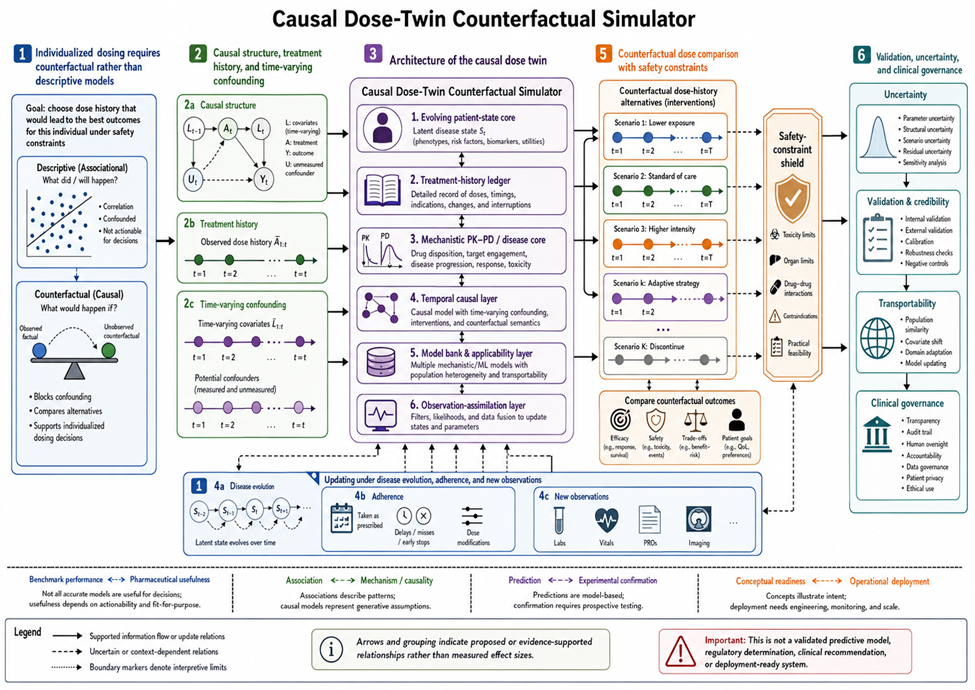
The architecture also requires an evidence-return pathway because internal simulation cannot validate itself. Experimental, clinical, and longitudinal observations may refine computational assumptions, reveal structural failure, or invalidate previously credible parameterizations; proposed links between digital twins and empirical systems emphasize this iterative relationship [15]. A provenance ledger should therefore retain data lineage, treatment definitions, model versions, update history, validation status, and context of use. Table 2 organizes the evidence, constructs, and interpretation boundaries needed to develop architecture of the causal dose twin within the article’s central argument. Figure 1 presents the causal dose-twin counterfactual simulator, showing how the article’s key components and boundaries are connected within architecture of the causal dose twin.
Table 2. Components, relationships, uncertainties, and validation needs within Architecture of the causal dose twin
|
Component or layer |
Inputs |
Core function |
Expected output |
Uncertainty or limitation |
Validation requirement |
|
Counterfactual estimand layer |
Target population, decision time, feasible strategies, outcome, horizon |
Defines the treatment contrast to be simulated |
Explicit comparison question |
Ambiguous intervention versions or shifting outcomes |
Independent review of estimand and clinical relevance |
|
Longitudinal causal structure |
Treatment history, covariates, monitoring, adherence, outcomes |
Represents temporal ordering and treatment-confounder feedback |
Admissible causal pathways and adjustment requirements |
Unmeasured causes and incorrect temporal assumptions |
Causal-diagram review, sensitivity analysis, and identification audit |
|
Patient-state representation |
Concentrations, biomarkers, disease status, organ function, symptoms |
Maintains a probabilistic estimate of the current patient |
Posterior distribution over clinically relevant states |
Partial observability and measurement error |
Posterior predictive checks and state-recovery assessment |
|
Treatment-history ledger |
Intended, prescribed, administered, interrupted, and inferred doses |
Preserves path dependence and realized exposure uncertainty |
Time-indexed treatment record |
Missing administrations and inaccurate timestamps |
Reconciliation against multiple clinical evidence streams |
|
Mechanistic PK–PD–disease core |
Drug properties, patient parameters, exposure, response, toxicity |
Simulates pharmacological and disease-state transitions |
Future exposure, response, toxicity, and disease trajectories |
Structural misspecification and parameter nonidentifiability |
External validation at exposure, biomarker, and outcome levels |
|
Model bank and applicability layer |
Alternative structural models, patient similarity, local evidence |
Represents structural uncertainty and local relevance |
Model-weighted or competing simulations |
Shared omissions and unstable model weights |
External comparison and disagreement analysis |
|
Observation assimilator |
New measurements, adherence evidence, interventions, timestamps |
Updates patient and population knowledge sequentially |
Revised state and uncertainty |
Informative missingness and delayed observations |
Prequential evaluation and controlled update testing |
|
Candidate-strategy generator |
Clinical action set, monitoring rules, treatment objectives |
Constructs feasible dose histories |
Defined fixed or adaptive intervention branches |
Unsupported or clinically unrealistic actions |
Action-space review by clinicians and pharmacologists |
|
Safety-constraint shield |
Contraindications, toxicity limits, monitoring requirements, hard rules |
Excludes or truncates unacceptable strategies |
Safety-filtered candidate set |
Unknown interactions and incomplete rules |
Edge-case testing, red-team scenarios, and failure injection |
|
Uncertainty and applicability monitor |
Parameter, model, causal, measurement, and transport uncertainty |
Determines whether comparison is interpretable |
Uncertainty decomposition, warnings, or abstention |
Unrecognized model failure |
Calibration, shift testing, and coverage assessment |
|
Credibility and provenance ledger |
Data lineage, model version, assumptions, validation records |
Makes simulations reconstructable and reviewable |
Auditable evidence record |
Incomplete documentation or uncontrolled updates |
Independent reproducibility and governance audit |
|
Human authorization interface |
Comparative trajectories, uncertainty, constraints, disagreement |
Supports accountable interpretation and final decision |
Bounded scenarios with reasons to accept, reject, or abstain |
Automation bias and cognitive overload |
Human-factors studies and prospective workflow evaluation |
|
|
|
Figure 1. Causal Dose-Twin Counterfactual Simulator. |
The figure is an original conceptual synthesis that organizes the article’s central contribution across individualized dosing requires counterfactual rather than descriptive models, causal structure, treatment history, and time-varying confounding, causal structure, treatment history, time-varying confounding, architecture of the causal dose twin. Arrows and grouping indicate proposed or evidence-supported relationships rather than measured effect sizes. The figure does not represent a validated predictive model, regulatory determination, clinical recommendation, or deployment-ready system.
Updating Under Disease Evolution, Adherence, and New Observations
A causal dose twin must treat each observation according to what it can legitimately update. In antimicrobial precision dosing, serial concentrations, organ-function measurements, susceptibility information, biomarkers, and clinical context may materially revise exposure and response estimates [16]. A new concentration can inform clearance or distribution assumptions, but it should not automatically alter the disease model, causal graph, or adherence estimate unless the observation contains evidence relevant to those components. Updating should therefore be modular, preserving the distinction between measured evidence, inferred latent state, and structural assumptions.
Patient-level and population-level learning should also occur on different timescales. Continued-learning approaches to model-informed dosing distinguish within-patient updating from revision of population priors across accumulated cases [17]. The proposed twin adopts this distinction to avoid allowing one unusual observation to redefine a population model or allowing a slowly changing population prior to suppress clinically important patient-specific change. Updates to shared models should be version controlled, independently evaluated, and prevented from influencing active decisions until their validity has been reassessed for the intended context.
Disease evolution introduces nonstationarity into treatment response. Progression, remission, acquired resistance, tolerance, immune adaptation, cumulative toxicity, and changing baseline risk can alter the relationship between dose and outcome even when administration remains unchanged. Longitudinal disease-trajectory models may help characterize these changes and reveal heterogeneous response patterns [18]. They do not, however, identify causal treatment effects automatically. Within the twin, disease evolution should be represented as an uncertain transition process that can be challenged by incoming evidence and compared with alternative explanations such as measurement error, altered exposure, co-intervention, or adherence change.
Adherence complicates updating because prescribed, dispensed, administered, and ingested treatment may diverge. Evidence from adherence research shows that imperfect medication use can materially influence apparent response and remains difficult to measure accurately [19]. The twin should therefore maintain a probability distribution over plausible exposure histories rather than converting a weak adherence proxy into a definitive behavioral classification. When outcome deterioration can be explained by several competing histories, simulations should propagate those alternatives separately. Escalation should be withheld when the system cannot distinguish inadequate pharmacological effect from uncertain treatment realization, unless independent clinical considerations justify action.
Counterfactual Dose Comparison with Safety Constraints
Counterfactual dose comparison should begin only after the candidate action space has been clinically bounded. Healthcare reinforcement-learning guidance identifies confounding, reward misspecification, inadequate treatment support, unsafe exploration, and unreliable off-policy evaluation as central threats [20]. These risks are especially consequential in dosing because an apparently favorable strategy may exploit documentation artifacts, selective monitoring, or actions rarely used in comparable patients. The proposed twin therefore excludes unsupported actions, reports weak overlap, and treats retrospective policy value as provisional rather than as evidence of clinical benefit.
Model-informed reinforcement learning can organize adaptive dosing by combining pharmacological structure with sequential action selection [21]. Within the proposed architecture, such methods generate candidate strategies but do not receive independent prescribing authority. The objective must represent multiple clinically relevant consequences, including efficacy, toxicity, treatment burden, monitoring requirements, and delayed effects. Nonnegotiable contraindications and safety limits should be implemented as an independent shield rather than absorbed entirely into an optimization reward that may be misspecified or traded against another objective.
Theoretical model-enhanced dosing studies illustrate how pharmacological knowledge can support policy learning when observations are limited [22]. Their value lies in testing architecture, sensitivity, and failure modes under explicit assumptions, not in establishing bedside effectiveness. A strategy that performs favorably in a simulated environment may inherit the environment’s structural simplifications, omit rare harms, or exploit unrealistic state information. The causal dose twin should therefore compare results across plausible models, perturb uncertain assumptions, and downgrade conclusions when rankings change materially across credible alternatives.
Drug-specific adaptive-dosing simulations further show that policy behavior is conditional on the modeled compound, disease, endpoint, action space, and safety structure [23]. This context dependence precludes a universal dose-policy layer. Each application requires its own feasible interventions, monitoring schedule, outcome hierarchy, stopping rules, and contraindications. The final output should not be a single optimized dose, but a bounded comparison showing expected trajectories, uncertainty, model disagreement, safety exclusions, and reasons for abstention. Human reviewers must be able to determine whether the comparison addresses the actual clinical decision and whether omitted considerations invalidate its use.
Validation, Uncertainty, and Clinical Governance
Validation must be proportional to the consequence of the proposed use. Credibility frameworks for model-informed drug development link model risk and context of use to the required depth of verification and validation [24]. A twin used for hypothesis generation may require less evidence than one influencing a bedside decision, but neither should be described simply as “validated” without specifying the target population, intervention class, endpoint, time horizon, and permitted influence. Validation evidence should be modular so that changes to data, model structure, or action rules trigger reassessment of the affected claims.
Digital twins require lifecycle verification, validation, and uncertainty quantification because their internal state and supporting evidence can change after initial construction [25]. Evaluation should include software verification, causal-assumption review, pharmacological adequacy, state reconstruction, counterfactual discrimination, calibration, external transportability, safety behavior, and update stability. Uncertainty should be decomposed into parameter, structural, measurement, causal-identification, and transport components. A narrow predictive interval cannot compensate for an omitted mechanism or an unidentified intervention contrast.
Clinical governance extends beyond technical performance. Ethical analysis of health digital twins identifies concerns involving consent, privacy, transparency, autonomy, data use, and responsibility across the information lifecycle [26]. The proposed governance layer therefore requires data provenance, access control, model-version records, update authorization, incident reporting, challenge pathways, and accountable human ownership. Patients and clinicians should be informed when outputs depend on uncertain adherence inference, incomplete histories, external data transfer, or models not validated for the local population.
Generalisability is not an intrinsic property that transfers automatically from one cohort or institution to another. Clinical models may behave differently across populations, workflows, measurement systems, treatment policies, and disease prevalence [27]. The causal dose twin must consequently evaluate transportability for each intended setting and monitor subgroup-specific failure after implementation. Aggregate performance should not conceal poor validity in underrepresented groups. Table 3 organizes the evidence, constructs, and interpretation boundaries needed to develop validation, uncertainty, and clinical governance within the article’s central argument.
Table 3. Evaluation, implementation, and research priorities arising from Counterfactual Dosing with Causal Digital Twins under Patient Heterogeneity, Disease Evolution, and Time-Varying Treatment Response
|
Evaluation dimension |
What must be tested |
Suitable evidence or assessment |
Failure signal |
Interpretive limitation |
Decision relevance |
|
Counterfactual estimand validity |
Whether the simulated contrast matches the intended clinical question |
Protocol-level specification and independent estimand review |
Ambiguous strategies, time zero, outcome, or horizon |
A valid estimate can still answer the wrong question |
Determines whether simulation is clinically interpretable |
|
Longitudinal causal identification |
Whether treatment-confounder feedback and selection processes are addressed |
Causal diagrams, positivity assessment, sensitivity analyses, negative controls |
Strong dependence on unsupported assumptions |
No method removes unmeasured confounding automatically |
Governs whether treatment contrasts may be interpreted causally |
|
Pharmacological adequacy |
Whether dose, exposure, response, toxicity, and disease evolution are represented credibly |
External PK, PD, biomarker, and outcome checks |
Good outcome fit with implausible internal behavior |
Predictive agreement does not prove mechanism |
Supports or limits extrapolation to alternative dosing |
|
State reconstruction |
Whether the latent patient state tracks clinically meaningful change |
Posterior predictive checks and held-out longitudinal observations |
Persistent residual patterns or delayed response to change |
Observation prediction does not prove treatment-effect validity |
Determines whether counterfactual branches start from a credible state |
|
Sequential updating |
Whether updates improve inference without destabilizing the system |
Prequential scoring, drift tests, version comparisons |
Catastrophic drift, forgetting, or failure to respond |
More frequent updating is not necessarily better |
Controls whether new observations may alter active simulations |
|
Counterfactual discrimination |
Whether strategy rankings correspond to genuine differences |
Randomized evidence, target-trial emulation, perturbation studies |
Unstable rankings across reasonable specifications |
Retrospective agreement does not establish clinical utility |
Determines whether alternatives can be meaningfully distinguished |
|
Safety-constraint behavior |
Whether prohibited or unsupported actions are blocked |
Edge-case tests, red-team scenarios, failure injection |
Constraint violations or unsafe extrapolation |
Scripted cases cannot cover every interaction |
Sets the maximum permissible influence of the model |
|
Uncertainty calibration |
Whether reported uncertainty reflects observed error |
External and temporally shifted validation |
Overconfidence under shift or model disagreement |
Predictive calibration is not causal certainty |
Supports abstention and communication of decision risk |
|
Transportability and subgroup validity |
Whether conclusions persist across settings and patient groups |
Multi-site external validation and subgroup stress testing |
Aggregate success with subgroup failure |
Statistical parity does not prove equitable benefit |
Limits where the model may be used |
|
Human interpretability |
Whether users understand assumptions, uncertainty, and abstention |
Human-factors studies and realistic case simulations |
Automation bias or inability to identify failure |
User satisfaction does not establish faithfulness |
Determines whether human oversight is meaningful |
|
Governance and provenance |
Whether every simulation and update can be reconstructed |
Version, data-lineage, authorization, and incident audits |
Undocumented model or data changes |
Auditability alone does not establish safety |
Enables accountability, rollback, and independent review |
|
Clinical utility |
Whether use improves decisions or patient-relevant outcomes |
Staged prospective comparative evaluation |
Technical accuracy without improved care |
Process improvement may not equal patient benefit |
Required before consequential clinical reliance |
Limitations and Boundary Conditions
The proposed causal dose twin is a theoretical synthesis assembled from causal inference, pharmacometrics, digital-twin modeling, sequential learning, and governance scholarship. The selected literature supports individual components, but it does not establish that their integration will produce valid individualized treatment effects. Important variables may remain unmeasured, pharmacological structures may be incomplete, treatment versions may be inconsistent, and longitudinal action support may be insufficient. Under these conditions, the system must communicate nonidentifiability or abstain rather than substitute mechanistic plausibility for causal evidence [8].
The framework is also context dependent. Drug classes differ in therapeutic windows, reversibility, delay between exposure and outcome, measurement availability, adherence observability, and consequences of error. A design appropriate for antibiotic concentration targeting may be unsuitable for oncology, immunotherapy, psychiatric treatment, or chronic disease management. Model combination, adaptive policies, or uncertainty quantification cannot create information absent from the evidence base. External validation in one institution or subgroup does not establish transportability to another, particularly when clinical workflows and treatment policies differ [27].
The architecture cannot establish regulatory acceptance, clinical effectiveness, cost-effectiveness, or operational readiness. It does not replace randomized evidence when such evidence is feasible, nor does it remove the need for pharmacovigilance, patient preference, clinician judgment, and multidisciplinary review. Governance documentation can make decisions auditable, but auditability is not equivalent to safety. Similarly, a constrained interface can reduce misuse without eliminating automation bias. Any clinical influence would require staged prospective evaluation tied to a narrowly defined context of use and a predefined rollback pathway [24].
Research Agenda and Implementation Priorities
The first research priority is methodological integration. Future work should define dynamic dose estimands that align causal inference with PK–PD and disease models, including explicit treatment versions, decision intervals, adherence states, rescue interventions, competing events, and stopping rules. Comparative studies should examine when mechanistic simulation and longitudinal g-methods agree, when they diverge, and which assumptions determine the difference. Methods are also needed to propagate causal-identification uncertainty alongside parameter and structural uncertainty rather than reporting only conditional simulation intervals.
The second priority is staged evaluation. Development should progress from software verification and simulation-based state recovery to retrospective external validation, silent prospective evaluation, and controlled clinical testing. Update mechanisms should be assessed prequentially, with predefined criteria for drift, rollback, and revalidation. Safety shields require adversarial testing against unsupported actions, delayed toxicity, missing data, conflicting measurements, and model disagreement. Human-factors studies should assess whether clinicians recognize uncertainty, challenge inappropriate outputs, and use abstention information appropriately [25].
The third priority is infrastructure and governance. Implementation requires interoperable longitudinal records, timestamped administration data, model registries, version-controlled causal assumptions, secure provenance, and multidisciplinary oversight. Reporting standards should distinguish descriptive prediction, causal estimation, mechanistic simulation, policy evaluation, and clinical utility. Each output should identify the intended context, admissible action space, evidence support, uncertainty sources, and reasons for withholding a comparison. Such infrastructure would not make the causal dose twin deployment ready, but it would make future empirical evaluation more reproducible, transparent, and accountable [26].
Conclusion
The causal dose twin reframes individualized dosing as the bounded comparison of alternative treatment histories for an evolving patient rather than the optimization of a single predictive score. Its proposed architecture connects an explicit counterfactual estimand with longitudinal causal structure, treatment-history memory, pharmacological and disease-state simulation, adherence-aware updating, safety constraints, decomposed uncertainty, provenance, and human authorization. The contribution is not a validated dosing technology but a specification of the scientific relationships that credible treatment simulation would need to preserve. Its central boundary is equally important: neither personalization, mechanistic detail, predictive accuracy, nor internal optimization establishes an individual causal benefit. Progress therefore depends on drug-specific causal definitions, suitable longitudinal evidence, prospective validation, transparent uncertainty, and governance proportional to clinical consequence.
Acknowledgments: None
Conflict of interest: None
Financial support: None
Ethics statement: None