Pharmacophore an International Research Journal
Continuous manufacturing is transforming pharmaceutical production by replacing segmented batch operations with integrated, dynamic process trains, which necessitates quality assurance tools that operate continuously rather than relying primarily on end-product release testing. Current control strategies often interpret PAT measurements as isolated trends rather than as part of a connected process state, limiting their ability to anticipate how interacting material attributes, process parameters, and sensor signals shape final product quality. To address this, a digital-twin framework is proposed that ingests multivariate PAT signals, updates a hybrid predictive model, and continuously estimates critical quality attributes in real time, supporting proactive control and real-time release decision-making. The framework integrates a PAT data fusion module, a hybrid physics-informed machine-learning predictor, a digital-twin state estimator, a model drift monitor, and an MES-integrated control advisor, operating as a regulated decision-support architecture rather than an autonomous release mechanism. By enhancing visibility into evolving process quality, enabling early detection of deviations, and helping operators evaluate corrective actions before quality risk becomes material, this approach could also strengthen documentation for real-time release testing through traceable links between sensor data, model predictions, and control recommendations. Overall, an integrated digital-twin framework has the potential to advance the reliability and efficiency of continuous pharmaceutical manufacturing, provided it is implemented with rigorous validation, disciplined model lifecycle management, and alignment with regulatory expectations for predictive quality systems.
Introduction
The transition from batch manufacturing to continuous pharmaceutical production changes quality assurance from a retrospective release activity into a dynamic process-control challenge. Continuous lines require real-time awareness of material flow, equipment state, and evolving product attributes, because disturbances can propagate across blending, granulation, drying, compression, and coating steps before conventional testing can respond [1]. Reviews of continuous solid-dosage manufacturing emphasize that process models and PAT-enabled monitoring are central to maintaining quality-by-control rather than relying only on terminal inspection [2]. In this setting, a digital-twin framework could provide a structured computational layer that links ongoing process signals to predicted critical quality attributes.
PAT has already shown substantial value for monitoring specific attributes in continuous processes, including blend uniformity through Raman and NIR spectroscopy [3], moisture and particle-size-related changes during granulation and drying [4], and tablet properties during integrated powder blending and compression [5]. However, many implementations still focus on one instrument, one unit operation, or one quality attribute rather than the full multivariate state of a manufacturing line. Continuous manufacturing requires synthesis across spectra, process parameters, residence-time effects, and delayed laboratory measurements, because product quality emerges from the interaction of these data streams [6]. A framework that treats PAT as a connected state-estimation problem could therefore extend beyond local monitoring toward real-time quality prediction.
A digital twin can be understood as a living model that mirrors the current state of a physical process, receives sensor updates, and supports prediction or decision-making under changing operating conditions [7]. Pharmaceutical and biopharmaceutical discussions of digital twins increasingly highlight their potential to integrate process data, mechanistic understanding, and predictive analytics across development and manufacturing contexts [8]. Yet a practical gap remains in architectures that combine physics-based process knowledge with data-driven learning while satisfying regulated expectations for validation, traceability, and lifecycle management [9]. This gap is particularly important for continuous manufacturing, where the model must remain synchronized with the line while producing predictions that are interpretable enough to support quality decisions.
This article proposes an AI systems/frameworks perspective on a digital twin that connects real-time PAT data with CQA estimation in continuous pharmaceutical manufacturing. The core thesis is that a hybrid predictive model, combining first-principles process representations with machine-learning residual correction, could improve the robustness of real-time CQA estimates compared with either modeling approach alone [10]. The framework is designed to support closed-loop control recommendations through MES integration while preserving operator oversight and validation discipline [11]. It also positions predicted CQAs and associated uncertainty as components of a real-time release strategy, subject to regulatory evaluation and process-validation expectations [12].
Background
Continuous Manufacturing and Quality-By-Control
Continuous manufacturing replaces sequential batch operations with integrated, dynamically controlled processing, creating opportunities for smaller footprints, improved consistency, and faster response to quality variation. From a quality-by-control perspective, the objective is not simply to test the final product but to maintain the process within a validated design and control space throughout production [1]. Model predictive control has been discussed as a user-oriented strategy for continuous pharmaceutical manufacturing because it can connect process measurements, model predictions, and control actions in a structured way [2]. Regulatory-facing discussions of process models further indicate that model risk, verification, and validation must be considered when predictive models influence manufacturing decisions [12].
Process Analytical Technology in Continuous Lines
PAT instruments such as NIR and Raman spectroscopy provide chemically and physically rich signals that can track blend uniformity, concentration, moisture, and other material attributes during continuous operation. Raman-based monitoring and feedback control have been demonstrated conceptually for continuous powder blending and tableting, showing how spectroscopic signals can be linked to process understanding [3]. NIR-based monitoring has also been used to follow granulation and drying behavior, where spectral information can reflect moisture and particle-related changes relevant to downstream performance [4]. Broader PAT reviews describe these tools as core enablers of continuous process verification when they are embedded in a validated control strategy [13].
Digital Twins in Manufacturing
Digital twins in pharmaceutical manufacturing are typically described as computational representations that combine process data, models, and state-updating mechanisms to represent the current condition of the process [7]. In a manufacturing setting, the twin must not only store data but also maintain synchronization with the physical process and provide predictions that are useful for operational decisions. Recent pharmaceutical perspectives extend the concept across drug development, biomanufacturing, and continuous production, emphasizing the role of real-time data and predictive modeling in transforming process oversight [8]. A process-optimization digital twin further illustrates how computational representations can support scenario analysis and decision-making rather than merely describing historical production data [14].
Hybrid and Physics-Informed Machine Learning Models
Hybrid modeling combines mechanistic process knowledge with data-driven learners, allowing the model to use engineering structure while adapting to empirical deviations. In pharmaceutical continuous manufacturing, this could mean using residence-time distributions, population-balance concepts, or mass-transfer relationships as baseline representations while machine-learning models capture unmodeled nonlinearities [2]. Reviews of artificial neural networks in pharmaceutical PAT note that data-driven models can learn complex relationships from spectra and process variables, but their reliability depends on thoughtful preprocessing, validation, and interpretability [10]. Such hybridization would be expected to improve extrapolation and operator confidence compared with a purely black-box predictor.
Model Maintenance and Real-Time Release
Predictive models used for real-time release must be maintained as manufacturing conditions, raw materials, sensors, and equipment states evolve over time. Regulatory and lifecycle discussions emphasize that models influencing pharmaceutical quality decisions should be verified, validated, monitored, and controlled through formal model-risk frameworks [9]. Practical discussions of PAT and real-time release note that the analytical method, prediction model, and product lifecycle strategy must be considered together rather than as isolated technical components [12]. For a digital twin, this implies that drift detection, retraining governance, version control, and auditability are core framework requirements rather than optional analytics features.
Framework Architecture Overview
High-Level Digital-Twin Architecture
The proposed architecture consists of four connected layers: a physical layer containing equipment, sensors, and PAT instruments; a data layer that aligns, preprocesses, and fuses heterogeneous signals; a digital model layer that estimates CQAs through hybrid prediction; and a control layer that communicates recommendations to operators and manufacturing systems. This layered view is consistent with pharmaceutical digital-twin concepts that emphasize data integration, model-based prediction, and process-state representation [7]. The control layer should be designed as a decision-support interface, because PAT implementation for advanced control requires practical attention to robustness, validation, and the operational context in which recommendations are acted upon [1]. Such a structure allows new sensors, process steps, or model modules to be added without redesigning the entire twin.
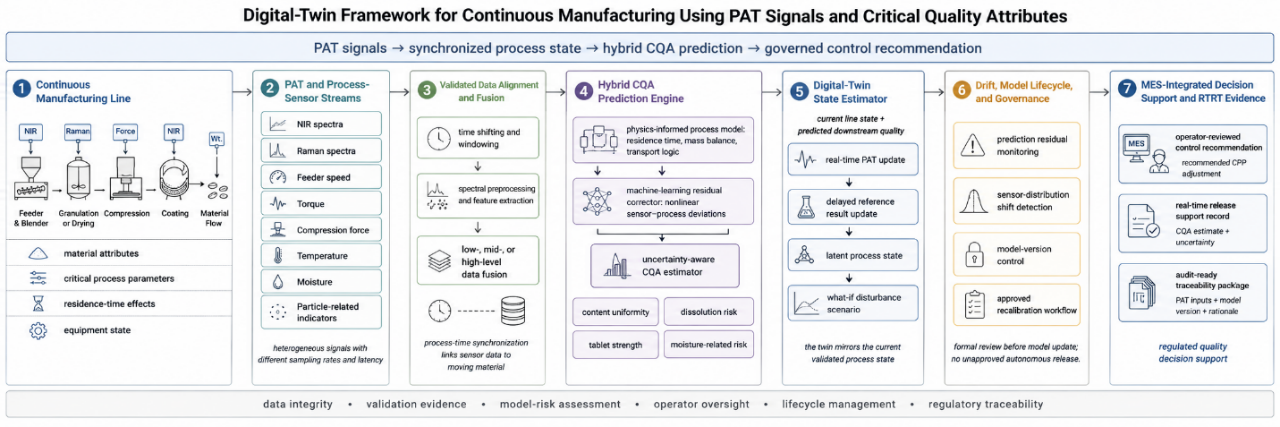
Figure 1 presents the proposed digital-twin architecture linking continuous manufacturing equipment, multivariate PAT streams, validated data fusion, hybrid CQA prediction, drift governance, MES-integrated recommendations, and traceable real-time release support.
|
|
|
Figure 1. Digital-twin framework for continuous manufacturing using PAT signals and critical quality attributes |
Core Input Signals and Outputs
The framework would ingest real-time NIR and Raman spectra, process variables such as feeder speeds and compression force, and derived material indicators such as blend uniformity, moisture content, and particle-size-related features. NIR and Raman spectroscopy have been described as complementary PAT tools for monitoring pharmaceutical solids, with applications across blending, granulation, coating, and tableting [15]. The outputs would include continuous CQA estimates for attributes such as content uniformity, dissolution risk, and tablet mechanical quality, along with uncertainty information and recommended adjustments to critical process parameters. The inclusion of process variables alongside PAT signals reflects the need to connect sensor observations with the operating conditions that generate product quality [6].
Design Principles
The design principles are real-time capability, physics grounding, modularity, data integrity, and continuous recalibration under a validated lifecycle. Real-time capability is needed because continuous production requires the model to update while material is still moving through the line, rather than after a batch is complete [2]. Physics grounding supports interpretability by linking predictions to residence time, material transport, or unit-operation behavior, while modularity allows a twin to extend from blending into granulation, compression, or hot-melt extrusion as process scope changes [14]. Data integrity and traceable recalibration are essential because predictive model outputs may become part of a real-time release or control-support record [12].
Table 1 decomposes the proposed digital twin into functional layers and clarifies how each layer contributes to continuous CQA estimation, control support, validation, and regulated lifecycle governance.
Table 1. Functional Architecture of the Proposed Digital-Twin Framework for Continuous Pharmaceutical Manufacturing
|
Framework layer |
Primary information handled |
Core computational function |
Quality-decision contribution |
Validation or governance requirement |
|
Physical manufacturing layer |
Unit operations, material flow, equipment state, feeder behavior, blender conditions, drying conditions, compression force, coating parameters |
Establishes the real-world process state that the digital twin must represent |
Defines where disturbances originate and how they may propagate downstream into CQA risk |
Equipment qualification, sensor placement justification, process-design-space definition, and documented operating limits |
|
PAT acquisition layer |
NIR spectra, Raman spectra, moisture indicators, particle-related signals, process sensors, time-stamped equipment parameters |
Captures real-time chemical, physical, and process signatures from the moving manufacturing stream |
Converts the continuous line from a periodically sampled process into a continuously observed quality system |
PAT method qualification, calibration maintenance, sampling-rate documentation, sensor health monitoring, and data-integrity controls |
|
Time alignment and preprocessing layer |
Raw spectra, asynchronous process signals, residence-time relationships, delayed reference measurements |
Performs time shifting, windowing, interpolation, spectral correction, smoothing, and feature extraction |
Ensures that CQA predictions are based on the correct material segment and not on misaligned sensor observations |
Preprocessing version control, validated synchronization logic, traceable transformation records, and justification of feature-engineering choices |
|
Data-fusion layer |
Preprocessed PAT features, process parameters, material attributes, latent variables, submodel outputs |
Integrates heterogeneous sources through low-, mid-, or high-level fusion |
Allows CQA estimates to reflect interacting chemical, physical, and operational signals rather than a single isolated trend |
Fusion-strategy justification, sensor-compatibility assessment, missing-data handling, and robustness testing across operating conditions |
|
Hybrid predictive-model layer |
Physics-based process assumptions, machine-learning residuals, reference CQA measurements, process history |
Combines mechanistic prediction with data-driven correction to estimate CQAs and uncertainty |
Supports interpretable real-time estimates of content uniformity, dissolution risk, tablet mechanical quality, and moisture-related quality risk |
Model-risk classification, training-data representativeness, reference-method linkage, uncertainty calibration, and prospective verification |
|
Digital-twin state-estimation layer |
Current sensor state, latent process state, delayed laboratory results, predicted downstream quality |
Maintains a synchronized representation of the manufacturing line and updates the process state as new evidence arrives |
Enables operators to understand how current upstream behavior may affect downstream CQAs before final testing occurs |
State-update traceability, delayed-reference reconciliation, audit trail for prediction revisions, and predefined intervention thresholds |
|
Drift-monitoring and lifecycle layer |
Prediction residuals, sensor-distribution changes, operating-region shifts, recalibration evidence, model metadata |
Detects model drift, manages recalibration, and controls approved model versions |
Prevents silent degradation of prediction reliability during long campaigns, raw-material changes, sensor replacement, or process evolution |
Formal change control, model-version documentation, retraining approval workflow, drift-alarm review, and lifecycle performance monitoring |
|
MES-integrated control-advisor layer |
CQA estimates, uncertainty intervals, recommended CPP adjustments, operator actions, release-support records |
Translates digital-twin outputs into operator-reviewed control recommendations and traceable RTRT evidence |
Supports proactive quality decisions while preserving human oversight and avoiding unapproved autonomous release |
MES integration validation, role-based access, electronic records compliance, operator rationale capture, and release-decision governance |
Pat Data Ingestion and Preprocessing
Multi-Variate Pat Data Acquisition
The PAT ingestion layer would acquire in-line NIR, Raman, and process-sensor streams that may arrive at different sampling rates and with different levels of latency. In continuous tablet manufacturing, spectroscopic monitoring has been used to follow powder blending and tableting behavior, demonstrating the need to align spectral measurements with the movement of material through the line [3]. NIR-based approaches in granulation and drying similarly require synchronization between spectra, equipment conditions, and the evolving state of the product [4]. The framework would therefore align signals on a common process-time basis using validated time-shifting, windowing, or interpolation logic that reflects material residence through each unit operation.
Data Pre-Treatment and Feature Extraction
Spectral data would require preprocessing steps such as scatter correction, baseline handling, smoothing, and feature extraction before being used by the hybrid model. Reviews of NIR applications for blend-uniformity monitoring emphasize that preprocessing and calibration choices strongly influence whether spectral models remain meaningful across process variation [15]. For process sensors, feature extraction could convert raw equipment parameters into fingerprints such as feeder stability, compression-force patterns, torque behavior, or residence-time descriptors. These engineered features would be expected to support more robust CQA prediction because they represent both material signatures and process conditions [13].
Data Fusion – Low-, Mid-, or High-Level
The framework could use low-level fusion by combining preprocessed raw variables, mid-level fusion by concatenating selected latent variables or engineered features, or high-level fusion by combining predictions from separate submodels. PAT data-fusion reviews highlight that different fusion levels are appropriate depending on sensor compatibility, process configuration, and the intended prediction task [6]. Multi-sensor fusion is particularly relevant for powders and granules because no single instrument may fully capture chemical composition, moisture, particle behavior, and equipment state at the same time [16]. A practical digital twin should therefore allow the fusion strategy to be selected and justified during model development rather than fixed as a universal design choice.
Hybrid Predictive Model for CQA Estimation
Physics-Based Process Model
The physics-based component would represent the expected relationship between process settings, material transport, and CQA evolution using simplified mechanistic models. For example, residence-time behavior could connect upstream feeder or blender disturbances to downstream CQA estimates, while population-balance concepts could describe granule-size evolution during wet granulation [2]. In chromatography and other continuous operations, digital-twin work has shown how model-based representations can support process understanding and control design, even when the specific unit operation differs from solid-dosage manufacturing [17]. Within the proposed framework, the mechanistic model would provide a baseline quality estimate and an interpretable structure for what the process should be doing under the current state.
Data-Driven Residual Corrector
The data-driven component would learn the residual between the physics-based estimate and the CQA measured by an accepted reference method, allowing the twin to capture nonlinear effects, sensor interactions, and product-specific deviations. Machine-learning applications in solid oral dosage development show that algorithms can support prediction and decision-making across formulation and process variables when they are carefully validated [18]. Deep-learning approaches have also been explored for continuous solid-dosage manufacturing, suggesting that more flexible models may capture complex relationships in multivariate manufacturing data [19]. In this framework, the residual corrector would be constrained by the mechanistic baseline so that it augments process understanding rather than replacing it with an opaque standalone predictor.
Uncertainty Quantification
The hybrid predictor should return not only a point estimate of each CQA but also an uncertainty range that reflects model confidence under current process and sensor conditions. This is important because real-time release and control decisions require the system to distinguish between a stable prediction and a prediction made under sparse, shifted, or unusual conditions [12]. Model-risk frameworks for pharmaceutical manufacturing indicate that predictive models should be evaluated according to the potential impact of their outputs on product quality and patient risk [9]. In the proposed architecture, uncertainty would guide whether the MES receives a routine control recommendation, an operator-review prompt, or a request for additional reference testing.
Digital Twin Synchronization and Real-Time State Update
Real-Time State Estimation
The digital twin would continuously receive PAT and process-sensor streams and update its internal representation of the manufacturing line as material moves through each unit operation. Blend-uniformity studies in continuous tablet manufacturing show why synchronization between sampled material, spectral measurements, and process location is essential for meaningful state estimation [20]. The hybrid model would operate in a soft-real-time manner, refreshing CQA estimates as new spectra, equipment signals, and derived features become available. This state-update logic would allow the twin to represent not only current sensor values but also the expected downstream quality implications of upstream disturbances.
Handling Time-Delayed Reference Measurements
Reference measurements such as chromatographic assays or offline physical testing would enter the twin with delay, so the framework should incorporate them as corrective evidence rather than as immediate control signals. Continuous manufacturing case studies involving PAT and reference analytics illustrate the need to reconcile in-line predictions with delayed laboratory confirmation during model maintenance and process verification [21]. A Kalman-filter-like update mechanism could adjust the latent process state when delayed results become available, while preserving traceability between the original prediction, the reference result, and any model correction. This approach would help prevent the digital twin from drifting silently away from reference quality measurements over longer manufacturing campaigns.
Process Disturbance Simulation and What-If Scenarios
Beyond real-time monitoring, the digital twin could be used offline to explore process disturbances, material variability, and control strategies before they are implemented on the line. Simulation-oriented digital-twin work in pharmaceutical manufacturing shows how computational process representations can support optimization and risk assessment when linked to process knowledge [14]. A twin could therefore test hypothetical changes in feeder behavior, moisture evolution, blend composition, or compression settings and estimate how those changes would be expected to influence CQAs. Such what-if use would support process development, deviation investigation, and control-space refinement without implying that simulated outputs replace formal validation evidence.
Model Monitoring, Drift Detection, and Lifecycle Management
Performance Monitoring and Drift Detection
The framework would monitor residuals between predicted CQAs and delayed reference results, while also tracking changes in sensor distributions, preprocessing behavior, and process operating regions. PAT studies in granulation and wet processing demonstrate that changes in water addition, mixing, or material state can alter the relationship between spectral signals and product attributes, making drift monitoring essential [22]. The drift-detection module should therefore evaluate whether prediction errors, latent spectral features, or process fingerprints deviate from the validated operating envelope. When a drift alarm occurs, the system would flag the model for technical review and potential recalibration rather than automatically accepting the updated model into production use.
Automated Model Update and Version Control
When recalibration is justified, the framework could retrain the data-driven residual component using newly approved reference measurements while keeping the physics-based structure and validation rules under formal change control. Machine-learning-enabled NIR workflows emphasize that model selection, sample representativeness, generalizability, and transferability should be treated as managed lifecycle questions rather than one-time development tasks [23, 24]. Each model version should retain metadata describing training sources, preprocessing settings, intended operating range, validation evidence, and approval status. This would create an auditable record that supports regulated review while allowing the digital twin to adapt to evolving products, raw materials, and equipment conditions.
Integration with MES and Closed-Loop Control
Control Recommendations
The MES-integrated control advisor would translate predicted CQA risk into suggested process adjustments, such as modifying feeder behavior, blender conditions, drying intensity, or compression settings within an approved design space. Closed-loop control discussions in continuous tablet manufacturing emphasize that control actions should be grounded in process understanding and should respect the practical constraints of pharmaceutical operations [11]. In-line tablet inspection concepts using machine learning further indicate that AI-based quality signals could support earlier identification of defective or drifting tablet states, provided the operator and validation framework remain central to decision-making [25]. The proposed digital twin would therefore issue recommendations with rationale and uncertainty rather than executing unreviewed autonomous changes.
Supporting Real-Time Release Testing
For real-time release testing, the digital twin would provide a continuous, traceable record of predicted CQAs, PAT inputs, model state, uncertainty, and any operator-approved control recommendations. Practical PAT and RTRT discussions emphasize that predictive release strategies must connect analytical method validation, product lifecycle management, and regulatory expectations [12]. The framework’s data-fusion and prediction records could support release decisions by demonstrating that quality was continuously assessed within a validated control strategy rather than inferred only after production. Regulatory acceptance would still require formal evidence that the model, sensors, and control procedures remain suitable for the intended product and manufacturing context.
Table 2 translates digital-twin outputs into manufacturing responses, release-support evidence, and governance safeguards, showing how the framework functions as regulated decision support rather than autonomous quality release.
Table 2. Decision-Support Logic Connecting Digital-Twin Outputs to Manufacturing Actions, Real-Time Release Evidence, and Governance Safeguards
|
Digital-twin signal or condition |
Interpretation within the framework |
Recommended manufacturing response |
Real-time release or documentation value |
Required safeguard before operational use |
|
Stable CQA estimate with low uncertainty |
The process appears to remain within the validated operating envelope, and the hybrid model has sufficient confidence in the prediction |
Continue routine operation while maintaining standard monitoring frequency |
Supports continuous evidence that product quality is being assessed within a validated control strategy |
Confirm that the model version, PAT calibration status, and process conditions match the approved operating space |
|
CQA estimate approaching specification boundary |
The predicted product attribute may remain acceptable but is moving toward elevated quality risk |
Prompt operator review and consider predefined CPP adjustment within approved design space |
Creates early-warning documentation before a deviation becomes material |
Require operator acknowledgement, rationale capture, and confirmation that recommended action is within the validated control strategy |
|
High uncertainty despite acceptable point estimate |
The model output is numerically acceptable but confidence is reduced because the current condition is sparse, shifted, or poorly represented |
Increase reference sampling, request technical review, or hold reliance on model-only evidence |
Prevents false reassurance when a prediction appears acceptable but lacks sufficient support |
Define uncertainty thresholds that trigger additional evidence rather than automatic control or release decisions |
|
Disagreement between PAT-based prediction and delayed reference result |
The twin’s current state estimate may require correction because reference evidence conflicts with prior real-time prediction |
Reconcile the latent process state, investigate alignment or calibration issues, and document correction logic |
Maintains traceability between original prediction, delayed laboratory result, and any subsequent model update |
Preserve audit trail, prohibit silent overwriting of historical predictions, and require quality-system review for repeated discrepancies |
|
Rising prediction residuals across multiple time windows |
The residual corrector or physics-informed baseline may no longer represent the process adequately |
Initiate drift investigation and evaluate whether recalibration or process intervention is required |
Provides documented evidence that model performance is monitored during the product lifecycle |
Use predefined drift criteria, distinguish sensor drift from process drift, and prevent automatic deployment of retrained models |
|
Sensor-distribution shift without immediate CQA failure |
PAT signals or process fingerprints have moved away from the validated reference distribution even if predicted CQAs remain acceptable |
Check sensor status, raw-material attributes, preprocessing behavior, and process conditions |
Documents that the control strategy monitors leading indicators rather than only final CQA excursions |
Require sensor-health checks, preprocessing audit, and operating-region assessment before continued reliance on predictions |
|
Recommended CPP adjustment within approved design space |
The MES advisor has identified a corrective action that is consistent with the validated control strategy |
Operator reviews and approves adjustment to feeder speed, blending condition, drying intensity, or compression setting |
Demonstrates proactive control based on linked PAT signals, CQA estimates, model rationale, and human oversight |
Require role-based approval, electronic record capture, uncertainty display, and rationale for the recommendation |
|
Recommended action outside approved design space |
The model suggests that routine control actions may be insufficient or that the process is outside validated conditions |
Escalate to deviation management, technical review, or batch/lot segregation procedure |
Supports quality-risk documentation by showing that the system did not normalize an unvalidated condition |
Block automatic execution, require quality-unit review, and separate decision support from release authorization |
|
Model recalibration candidate identified |
Newly approved reference data may improve the residual corrector or update calibration boundaries |
Prepare recalibration package but keep current production model unchanged until approved |
Creates lifecycle evidence for model maintenance without compromising production traceability |
Apply formal change control, validation testing, version comparison, approval workflow, and rollback strategy |
|
Release-support package generated |
PAT inputs, model version, predicted CQAs, uncertainty, operator actions, and reference confirmations are assembled into a traceable record |
Use as supporting evidence for real-time release evaluation under the approved quality system |
Strengthens RTRT documentation by linking sensor evidence, prediction logic, control actions, and governance decisions |
Ensure regulatory alignment, data-integrity compliance, method validation, and explicit human release responsibility |
Evaluation Strategy
Predictive Accuracy of CQA Estimates
Predictive evaluation should compare digital-twin CQA estimates with accepted reference methods for attributes such as content uniformity, dissolution behavior, and tablet mechanical quality, while avoiding overinterpretation of any single metric. Blend-uniformity monitoring using stream sampling and NIR spectroscopy illustrates how continuous predictions can be compared with reference measurements in a way that reflects process timing and material movement [26]. The evaluation should examine bias, consistency, and robustness across operating conditions conceptually rather than presenting unsupported numerical performance claims. A successful evaluation would show that the model is suitable for decision support within its validated operating space, not that it universally replaces reference testing.
Drift Detection Effectiveness
Drift-detection evaluation should assess whether the system can identify meaningful changes in sensors, materials, or process behavior before those changes compromise quality decisions. Data-fusion work using material databases and process-model development for high-shear wet granulation suggests that broader information sources can improve the ability to interpret changes in process behavior [27]. The drift monitor should therefore be evaluated using planned stress scenarios, historical deviations, and controlled recalibration cases, with attention to false reassurance as well as excessive alarm generation. Its purpose would be to maintain trust in the digital twin over time by ensuring that the model’s operating context remains aligned with its validated assumptions.
Control Improvement and Efficiency
Control evaluation should focus on whether the digital twin would support more timely, interpretable, and quality-relevant decisions than conventional monitoring alone. Studies combining NIR, Raman, and data-fusion concepts for tablet-quality prediction show how multi-source information can strengthen interpretation of complex process states [28]. The assessment should consider process capability conceptually, deviation handling, operator workload, sampling strategy, and documentation quality, without claiming numerical improvements that were not experimentally demonstrated. In an AIF article, the goal is to define how such improvements should be evaluated in future implementation studies rather than to report fabricated performance outcomes.
Limitations
Need For High-Quality Historical Data to Build the Twin
The proposed framework depends on representative historical and ongoing data that cover raw-material variability, process disturbances, equipment states, and product-specific behavior. Machine-learning applications in solid oral dosage development indicate that predictive usefulness depends strongly on the quality and relevance of the data used to train and validate the model [18]. New products, early development programs, or startup phases may lack sufficient process diversity to support a reliable residual corrector. In those cases, the twin should begin as a constrained decision-support tool and expand only as validated evidence accumulates.
Regulatory Hurdles for Real-Time Release
Regulatory acceptance of AI-augmented predictive quality systems remains an evolving area, especially when model outputs influence release decisions or process interventions. Model-risk and validation frameworks for pharmaceutical manufacturing emphasize the need to define model purpose, assess impact, document assumptions, and maintain lifecycle controls [9]. Even when a digital twin is technically plausible, its use in RTRT would require alignment among PAT validation, process validation, data integrity, change management, and operator governance. The framework should therefore be viewed as a pathway toward regulated real-time release rather than as an automatic substitute for established quality systems.
Conclusion
The proposed digital-twin framework defines a conceptual architecture for continuous pharmaceutical manufacturing that connects PAT signals, process parameters, hybrid predictive modeling, and CQA estimation. It treats quality as an evolving process state rather than as a property discovered only through end-product testing. By maintaining a synchronized representation of the manufacturing line, the framework could help operators understand how current process behavior may affect downstream product quality.
Its main strength is the integration of real-time quality visibility, physics-informed AI, model lifecycle management, and MES-linked decision support. The physics-based component would provide interpretability, while the data-driven residual corrector would capture product- and process-specific deviations. The drift monitor and version-control layer would help keep the model aligned with regulated manufacturing expectations. Together, these features create a practical pathway toward predictive control and real-time release support.
Important challenges remain before such a framework can be adopted broadly. The twin would require high-quality historical data, representative reference measurements, reliable sensor maintenance, and disciplined validation across the product lifecycle. Regulatory maturity will also be necessary so that AI-supported quality predictions can be assessed consistently and transparently. Cybersecurity and data-integrity protections would be essential because the framework depends on connected instruments, manufacturing systems, and decision-support interfaces.
Future progress should come from collaborative demonstration projects involving manufacturers, technology providers, academic groups, and regulatory agencies. These projects should establish validation precedents for hybrid models, uncertainty-aware CQA prediction, drift management, and MES-integrated control recommendations. They should also clarify how digital-twin evidence can support real-time release while preserving human oversight and formal quality governance. Such collaboration could make digital-twin-enabled continuous manufacturing a credible and auditable foundation for future pharmaceutical production.
Acknowledgments: None
Conflict of interest: None
Financial support: None
Ethics statement: None