Pharmacophore an International Research Journal
Drug repurposing promises to shorten parts of therapeutic development by redirecting existing compounds toward new disease indications, yet computationally attractive candidates often receive inconsistent support across transcriptomic signatures, molecular networks, genetics, phenotypic assays, observational data, and prior clinical studies. The unresolved problem is not simply insufficient prediction accuracy. It is the absence of a disciplined method for interpreting evidence sources that differ in biological scale, causal proximity, directionality, context, uncertainty, and translational authority. This article develops a proposed therapeutic evidence-synthesis model in which repurposing is treated as evidence reconciliation rather than score aggregation. The model distinguishes disease-state representation, target-mechanism plausibility, phenotypic response, human causal evidence, prior clinical outcomes, and context transfer as separate evidentiary layers. It further proposes that candidate prioritization should depend on compatibility among these layers, explicit accounting for contradictory and negative findings, and staged decision gates that prevent molecular plausibility from being mistaken for therapeutic readiness. The synthesis emphasizes that supportive evidence can converge without being equivalent, while apparent disagreement may reflect differences in cell type, dose, timing, population, endpoint, disease stage, modality, or mechanism. The proposed contribution is conceptual and requires retrospective and prospective evaluation. It cannot establish efficacy, safety, regulatory acceptability, or deployment readiness for any candidate. Its principal implication is that repurposing systems should expose why evidence agrees or conflicts, how close each signal lies to the intended therapeutic mechanism, and which uncertainties must be resolved before a hypothesis advances toward experimental or clinical testing.
Introduction
Drug repurposing occupies an unusual position in pharmaceutical science because its apparent efficiency derives from partial prior knowledge rather than from evidentiary completeness. Existing compounds may already have characterized chemistry, manufacturing routes, pharmacokinetic information, safety observations, or clinical experience, but these assets do not automatically establish that the same intervention will produce a therapeutically useful effect in a new disease. Repurposing therefore changes the starting point of development without eliminating the need to establish biological relevance, appropriate exposure, mechanistic direction, patient suitability, and clinical benefit. Contemporary repurposing research spans knowledge-based reasoning, omics-driven signature matching, network medicine, human genetics, phenotypic screening, real-world data, and clinical investigation, each of which captures a different portion of the therapeutic argument [1].
Computational methods have expanded the number and diversity of repurposing hypotheses that can be generated. A drug may be prioritized because it reverses a disease-associated expression profile, lies near a disease module in a molecular network, connects to a target through a knowledge graph, phenocopies a desired cellular state, shares a mechanism with an effective therapy, or is associated with improved outcomes in observational data. These signals can be valuable, but they are not interchangeable. Their predictive outputs may refer to molecular opposition, relational proximity, statistical association, phenotypic rescue, or clinical correlation rather than to the same underlying quantity. Evaluating all such outputs through one ranking metric obscures differences in evidence meaning, validation requirements, and translational consequence [2].
The central challenge is therefore not merely to combine more data. It is to reconcile claims that originate from different scientific contexts and may disagree for legitimate reasons. A transcriptomic reversal observed in one cell line may conflict with genetic evidence suggesting that the relevant target should be activated rather than inhibited. A network score may support a drug–disease relationship while a previous trial failed because the tested population, dose, disease stage, formulation, or endpoint did not match the proposed mechanism. Conversely, a prior negative outcome may reveal a genuine mechanistic contradiction that should strongly reduce enthusiasm for the candidate. Computational repurposing consequently requires explicit treatment of context, contradiction, and inferential distance rather than unqualified evidence accumulation [3].
This article proposes an original therapeutic evidence-synthesis model that treats drug repurposing as a structured reconciliation problem. The model does not replace experimental pharmacology, causal investigation, safety assessment, clinical development, or regulatory review. Instead, it organizes the evidentiary questions that should be answered before a repurposing hypothesis is interpreted as sufficiently coherent to advance. Its central contribution is a distinction among evidence-source identity, biological directionality, causal proximity, contextual compatibility, prior failure, and translational readiness. Candidate prioritization is thereby reframed from “Which drug receives the highest score?” to “Which hypothesis retains a scientifically defensible interpretation after supportive, contradictory, uncertain, and negative evidence have been reconciled?”
Why Repurposing Signals Frequently Conflict Across Evidence Sources
Repurposing signals frequently conflict because different analytical methods operationalize therapeutic relevance in different ways. Even within transcriptomic connectivity analysis, candidate rankings may vary according to the disease signature, perturbation reference set, scoring method, weighting scheme, and definition of reversal. A compound can therefore appear strongly connected under one formulation and weakly or oppositely connected under another without either analysis necessarily containing a computational error. Comparative work on connectivity scoring shows that multiple scores can capture partly different aspects of the relationship between disease-associated and drug-induced expression, making reconciliation necessary when rankings diverge [4]. The conflict is scientific as well as statistical: a score may reflect broad transcriptional opposition while failing to identify whether the affected genes belong to a causally relevant pathway, an adaptive response, or a downstream disease consequence.
Reproducibility further limits the interpretation of isolated repurposing signals. Perturbational signatures may vary with concentration, exposure duration, cell lineage, assay conditions, batch structure, and preprocessing decisions. Disease signatures can likewise change with tissue source, disease stage, patient composition, cell-type abundance, and analytical normalization. Evaluations of connectivity-map-based repositioning have shown that candidate recovery and ranking can be unstable across datasets and analytical choices [5]. This instability does not render signature methods useless; rather, it changes the evidentiary claim they can support. A reproducible, context-matched reversal may justify mechanistic investigation, whereas a single high score from a poorly matched model should remain a weak hypothesis-generating observation.
Knowledge graphs and network models introduce a different class of conflict. Their outputs depend on which entities and relationships are represented, how evidence is curated, whether contradictory relations are encoded, and how missing links are treated. A drug may rank highly because it is connected to many well-studied targets or diseases, while a less frequently studied compound may receive a lower score despite having a more specific biological rationale. Database overlap, literature bias, relation-type ambiguity, temporal inconsistency, and incomplete provenance can all influence apparent network support. Reviews of knowledge-graph repurposing methods show substantial variation in graph construction, included databases, prediction tasks, and evaluation strategies [6]. Consequently, graph support should be interpreted as structured relational evidence, not as direct proof of mechanism or clinical effect.
Genomic repurposing methods also differ in what they infer. Some associate disease-linked loci with candidate genes; others use expression or protein quantitative-trait loci, Mendelian randomization, colocalization, pathway enrichment, or genetic similarity to known drug mechanisms. These approaches vary in their assumptions about causal variants, gene assignment, horizontal pleiotropy, tissue relevance, and the equivalence between lifelong genetic perturbation and pharmacological intervention. Methodological surveys demonstrate that genomic repurposing pipelines can produce different candidate sets because they occupy different positions between disease association and therapeutic mechanism [7]. The proposed model therefore treats disagreement not as noise to be averaged away, but as information about which inferential step remains unresolved. Table 1 organizes the evidence, constructs, and interpretation boundaries needed to develop why repurposing signals frequently conflict across evidence sources within the article’s central argument.
Table 1. Evidence domains, core questions, scientific requirements, and interpretation boundaries for Why repurposing signals frequently conflict across evidence sources
|
Construct or evidence domain |
Core question |
Scientific basis |
Role in the article |
Failure or overclaiming risk |
Boundary statement |
|
Disease-signature evidence |
Does the drug perturbation oppose or normalize a disease-associated molecular state? |
Comparison of disease-associated and compound-induced molecular profiles |
Generates an initial directionally interpretable hypothesis |
Treating transcriptional opposition as therapeutic efficacy |
Signature reversal alone does not establish causal mechanism, target engagement, or patient benefit |
|
Perturbation context |
Was the drug measured in a biologically relevant cell type, concentration, duration, and state? |
Context-dependent molecular and cellular response |
Determines whether a signature is transferable to the proposed indication |
Generalizing from unmatched models |
Evidence is conditional on similarity between the experimental system and the intended disease context |
|
Target-mechanism evidence |
Does the compound engage a target or pathway plausibly involved in disease biology? |
Pharmacology, target annotation, pathway biology, and mechanistic experiments |
Connects a candidate to an interpretable intervention mechanism |
Inferring mechanism from association or proximity alone |
A plausible target relationship requires confirmation of engagement, direction, and disease relevance |
|
Network or knowledge-graph evidence |
Is the candidate relationally connected to disease-relevant genes, pathways, phenotypes, or therapies? |
Typed biomedical relationships and network topology |
Integrates heterogeneous evidence and exposes possible mechanistic paths |
Equating graph proximity with causality or efficacy |
Network position is supportive only when relation types, provenance, and inferential distance remain visible |
|
Human genetic evidence |
Does human variation support a causal role for the proposed target or pathway? |
Genetic association, variant-to-gene mapping, colocalization, and causal inference |
Increases or decreases causal plausibility and may inform directionality |
Assuming genetic support guarantees pharmacological success |
Genetic evidence strengthens a hypothesis but does not resolve modality, dose, timing, tissue, or safety |
|
Phenotypic evidence |
Does the compound produce a relevant functional response in a disease model? |
Cellular, organoid, tissue, or organism-level functional assays |
Tests whether molecular predictions translate into a measurable biological effect |
Treating model rescue as clinical benefit |
Phenotypic activity remains dependent on model validity, exposure, mechanism, and translatability |
|
Prior clinical evidence |
What has already been observed in treated patients or trials? |
Trials, observational analyses, safety reports, and treatment histories |
Constrains indication transfer and identifies supportive or negative human evidence |
Ignoring failure or interpreting uncontrolled associations as efficacy |
Clinical evidence must be interpreted in relation to population, dose, timing, comparator, endpoint, and study design |
|
Contradiction structure |
Are conflicting findings mechanistically incompatible or contextually explainable? |
Cross-evidence comparison and causal interpretation |
Prevents automatic averaging of incompatible claims |
Downgrading all disagreement equally or selecting only supportive evidence |
Contradictions must be classified before they are weighted |
|
Evidence provenance |
Where did each claim originate, and how directly does it support the hypothesis? |
Source traceability, study design, curation, and versioning |
Preserves accountability and enables later reassessment |
Combining evidence without source identity |
Integrated evidence must remain separable and auditable |
|
Translational boundary |
What decision can the available evidence justifiably support? |
Alignment between evidence maturity and development action |
Restricts conclusions to the appropriate stage |
Converting computational prioritization into treatment recommendation |
Candidate ranking can support investigation but cannot establish clinical use |
Disease Signatures, Target Mechanisms, Phenotypes, and Prior Clinical Outcomes
Disease signatures provide a representation of the molecular state associated with a condition, but they should not be interpreted as the disease itself. Large perturbational resources enable systematic comparison between disease-associated expression patterns and compound-induced responses across many experimental settings [8]. Their value lies in identifying drugs that may oppose, reinforce, or reorganize selected components of a molecular state. Yet a disease signature may contain causal drivers, compensatory responses, treatment effects, changes in cell composition, and nonspecific consequences of tissue injury. The proposed evidence-synthesis model therefore divides signature evidence into at least three interpretive classes: potentially causal features, mechanistically informative correlates, and context-dependent consequences. A candidate should receive stronger support when its perturbation affects the first two classes in a direction consistent with therapeutic benefit, rather than merely producing a large global reversal score.
Cellular resolution is particularly important because bulk disease profiles can combine signals from multiple cell types with different or opposing roles. A compound predicted to reverse the average tissue signature may suppress a protective response in one population while correcting a pathogenic state in another. Single-cell-guided repurposing pipelines demonstrate how drug prioritization can change when disease signatures are decomposed by cell type and when the relative importance of affected populations is considered [9]. In the proposed model, cellular context is not a minor adjustment applied after candidate ranking. It is a primary compatibility condition that influences whether evidence can be transferred from the measured system to the intended therapeutic setting. Context assessment should consider cell identity, disease state, tissue environment, exposure conditions, and whether the molecular response occurs in the compartment where the mechanism must operate.
Target mechanisms provide an explanatory bridge between molecular reversal and functional intervention. A drug may normalize a disease-associated profile through its intended target, through polypharmacology, through cellular stress, or through a secondary adaptive response. These possibilities have different implications for efficacy, selectivity, safety, and transfer to another indication. Phenotypic profiling of non-oncology compounds in cancer models illustrates that repurposing opportunities can emerge from systematic functional testing, while also showing that activity may be lineage-specific, concentration-dependent, and mechanistically heterogeneous [10]. Phenotypic evidence is therefore stronger than a purely relational prediction when it demonstrates a relevant functional effect, but it remains incomplete until the responsible mechanism, achievable exposure, selectivity, and disease-model validity are understood. The model consequently treats phenotype and mechanism as mutually constraining evidence layers rather than as substitutes.
Prior clinical outcomes occupy the highest human-proximity layer but still require contextual interpretation. Observational treatment histories may reveal associations between drug exposure and disease outcomes, yet they are vulnerable to confounding by indication, treatment selection, adherence, comorbidity, healthcare access, and measurement practices. Target-trial emulation offers a structured way to align observational analyses with a hypothetical randomized comparison by defining eligibility, treatment strategies, follow-up, outcomes, and analytic assumptions [11]. Within the proposed model, prior clinical evidence is examined through a context-transfer profile comprising indication, population, disease stage, dose, route, treatment timing, duration, comparator, endpoint, and co-therapy. A favorable association increases confidence only when these elements are sufficiently compatible with the proposed use and major biases have been addressed. A negative result is likewise not automatically universal: it may invalidate the mechanism, or it may delimit the conditions under which the candidate should not be expected to work. Evidence reconciliation begins by determining which of these interpretations is scientifically defensible.
Evidence-Reconciliation Logic for Candidate Prioritization
The proposed model begins by treating each repurposing hypothesis as a structured claim rather than as a drug name attached to a score. The claim specifies the candidate, proposed indication, intended mechanism, required direction of modulation, relevant biological compartment, anticipated phenotype, and clinical context. Evidence is then attached to this claim according to its source and inferential role. Heterogeneous biomedical networks demonstrate that drugs, diseases, genes, pathways, phenotypes, adverse effects, and established treatments can be integrated without representing every relationship as equivalent [12]. In the proposed model, this heterogeneity is preserved so that a drug–disease association, drug–target interaction, target–pathway relationship, and clinical observation remain distinguishable throughout prioritization.
The first reconciliation operation is evidence typing. Each item is classified as signature, mechanistic, genetic, phenotypic, network, observational, interventional, safety, pharmacological, or contextual evidence. It is also annotated by provenance, study design, model system, population, direction of effect, and distance from the proposed therapeutic outcome. Network-based repurposing linked with population-level analysis illustrates how predictions generated at one evidentiary level may be evaluated against another without implying that the two levels establish the same claim [13]. The model therefore prohibits simple vote counting. Several correlated databases or algorithms may represent one underlying evidence stream, whereas one well-designed human study may provide a qualitatively different constraint.
The second operation is compatibility assessment. Evidence is judged against the proposed target–mechanism–context statement rather than against the candidate in the abstract. Compatibility asks whether the disease process, drug action, tissue, direction, dose, timing, and observed phenotype can coexist within one biologically plausible account. Multilayer knowledge-graph learning shows that drug-repurposing inference can draw on relationships across genes, drugs, and diseases while preserving semantic structure [14]. The proposed model extends this principle conceptually by distinguishing supportive compatibility, unresolved compatibility, contextual incompatibility, and mechanistic incompatibility. A source may therefore support one component of a hypothesis while contradicting another.
The third operation is bounded prioritization. Candidates are assigned an evidence profile rather than a universal scalar value. The profile records evidentiary convergence, causal proximity, directionality agreement, context match, negative evidence, unresolved contradictions, and validation requirements. Network-medicine platforms illustrate the value of integrating disease-module identification, drug prioritization, statistical assessment, and expert input within one analytical environment [15]. The proposed contribution is not the platform itself but the reconciliation logic applied before advancement: candidates move forward because their evidence profile is coherent enough for a specified next decision, not because heterogeneous signals have been collapsed into a deceptively precise aggregate score.
Weighting Directionality, Context, Causal Proximity, and Negative Evidence
Directionality concerns whether the pharmacological action of a candidate moves a disease-relevant process in the therapeutically required direction. A target may be associated with disease without indicating whether activation, inhibition, stabilization, degradation, or partial modulation is appropriate. The druggable-genome literature demonstrates how human genetics can support target identification while leaving separate questions concerning tractability, pharmacological modality, and target validation [16]. Within the proposed model, directional evidence receives weight only when the direction of the exposure or molecular perturbation can be related plausibly to the intended drug action. A target–disease link without directional information increases relevance but does not establish a therapeutic intervention strategy.
Causal proximity describes the inferential distance between an observed signal and the proposed therapeutic effect. Randomized clinical evidence generally lies closer to patient benefit than database co-occurrence, but proximity is not synonymous with universal superiority because the clinical context may not match the new hypothesis. Human genetic support can strengthen confidence in a drug mechanism, yet analyses of development outcomes show that its association with success depends on how targets, indications, and genetic relationships are defined [17]. The model therefore uses causal proximity as one dimension rather than as an automatic hierarchy. Genetic, mechanistic, phenotypic, observational, and clinical evidence must still be evaluated for relevance to the exact target–indication pair.
Context weighting determines whether evidence generated in one setting can inform another. Tissue, cell type, ancestry, age, disease stage, exposure duration, comorbidity, treatment history, and endpoint can alter the meaning of an otherwise credible signal. Phenome-wide Mendelian-randomization analyses combined with colocalization illustrate both the value of genetically informed target assessment and the possibility that apparently causal associations may be weakened when linked signals are examined more carefully [18]. Context weighting should therefore decrease as the biological or clinical transfer distance increases. It should not be implemented as an arbitrary numerical penalty; it should identify which contextual assumptions must be tested before the evidence is transferable.
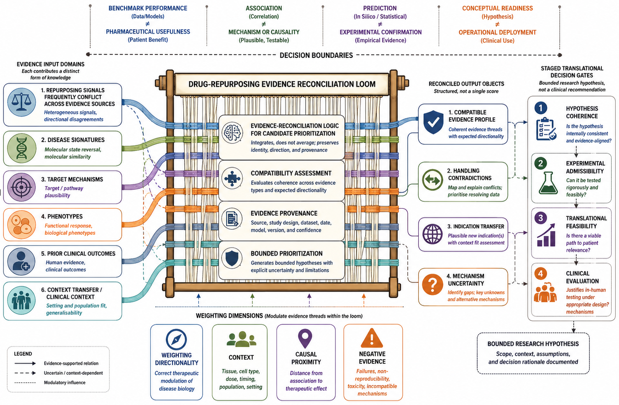
Negative evidence includes findings that oppose efficacy, indicate an incompatible mechanism, identify toxicity, expose non-reproducibility, or show failure under specified conditions. Its weight depends on study validity and contextual relevance. Human genetic data can contribute to safety assessment by revealing phenotypes associated with long-term modulation of a therapeutic target, although genetic perturbation is not fully equivalent to drug exposure [19]. The proposed model distinguishes absence of supporting evidence from evidence of absence, and it distinguishes contextual failure from mechanism-level failure. Strong negative evidence cannot be neutralized merely by accumulating additional low-proximity positive predictions. Figure 1 presents the drug-repurposing evidence reconciliation loom, showing how the article’s key components and boundaries are connected within weighting directionality, context, causal proximity, and negative evidence.
|
|
|
Figure 1. Drug-Repurposing Evidence Reconciliation Loom. |
The figure is an original conceptual synthesis that organizes the article’s central contribution across repurposing signals frequently conflict across evidence sources, disease signatures, target mechanisms, phenotypes, and prior clinical outcomes, disease signatures, target mechanisms, prior clinical outcomes, evidence-reconciliation logic for candidate prioritization. Arrows and grouping indicate proposed or evidence-supported relationships rather than measured effect sizes. The figure does not represent a validated predictive model, regulatory determination, clinical recommendation, or deployment-ready system.
Handling Contradictions, Indication Transfer, and Mechanism Uncertainty
Contradictions should first be classified according to the scientific claim they affect. Direct contradictions occur when credible evidence supports opposing directions for the same mechanism in a sufficiently similar context. Apparent contradictions arise when studies measure different outcomes, populations, doses, disease stages, or biological compartments. Representation contradictions reflect incompatible database labels or relation types, while temporal contradictions arise when evidence predates changes in disease definition, treatment practice, or mechanistic knowledge. Clinician-centered knowledge-graph models illustrate the potential value of exposing multi-hop rationales and predicted contraindications rather than returning drug rankings alone [20]. The proposed model similarly requires each contradiction to remain traceable to the evidence path that produced it.
Indication transfer is evaluated by comparing the original and proposed uses across mechanism, exposure, tissue distribution, patient population, disease biology, endpoint, and treatment setting. Prior approval may reduce uncertainty about selected characteristics of a compound, but it does not make the original dose, formulation, or safety profile automatically suitable for a new disease. Integrated analyses combining gene-expression information with clinical data demonstrate how molecular predictions may be tested against patient-level observations [21]. Such convergence strengthens a hypothesis when the molecular direction and clinical phenotype are aligned, but observational replication does not remove confounding or substitute for controlled prospective evaluation.
Prior clinical failure must be interpreted as structured evidence rather than as a binary property of the molecule. Large randomized evaluations of repurposed antiviral regimens showed that compelling biological rationales and widespread clinical interest did not ensure benefit in hospitalized patients [22]. In the proposed model, a failed study is decomposed into mechanism tested, population, disease stage, exposure, treatment timing, comparator, endpoint, adherence, and study quality. A well-conducted failure under conditions that adequately test the proposed mechanism should strongly reduce priority. A failure under materially different conditions may instead define a boundary beyond which the evidence should not be generalized.
Mechanism uncertainty persists when the observed effect cannot be attributed confidently to the proposed target, when a drug has multiple relevant targets, or when activity appears only at exposures unlikely to be clinically attainable. Randomized evidence on hydroxychloroquine in hospitalized patients illustrates how in vitro activity and early uncontrolled findings can be contradicted by appropriately designed clinical evaluation [23]. The lesson is not that every negative trial invalidates every conceivable use of a compound. It is that mechanistic reinterpretation after failure must be prospective and testable rather than an ad hoc attempt to preserve the hypothesis. The model therefore requires explicit documentation of which mechanistic proposition survived, which was contradicted, and what new evidence would be necessary to justify reconsideration.
Translational Decision Gates for Repurposing Hypotheses
The proposed translational sequence contains gates rather than a single advancement threshold. At each gate, the relevant question is whether the evidence is sufficient for the next form of inquiry, not whether the candidate is generally “promising.” Real-world-data studies can generate, prioritize, or evaluate repurposing hypotheses, but their interpretation is sensitive to clinical granularity, data quality, confounding, treatment selection, and outcome definition [24]. Accordingly, observational support may justify deeper causal analysis or prospective study design, but it should not be converted directly into a therapeutic recommendation.
The hypothesis-coherence gate asks whether the candidate, indication, mechanism, direction, and context form a scientifically consistent claim. The experimental-admissibility gate asks whether the mechanism and phenotype can be tested in an appropriate model at relevant exposure. The translational-feasibility gate addresses formulation, pharmacokinetics, tissue access, dose rationale, safety, intellectual-property constraints, manufacturing, and the feasibility of generating confirmatory evidence. Contemporary analyses of therapeutic innovation in repurposing emphasize that an integrated evidence base, credible dose rationale, and clear development plan are needed early rather than after a candidate has attracted extensive attention [25].
The mechanistic-phenotypic gate requires evidence that the candidate produces a relevant functional effect and that the effect can be connected sufficiently to the proposed therapeutic mechanism. Phenotypic discovery literature shows that functionally useful compounds may emerge before their precise targets are fully understood, but it also emphasizes target deconvolution, model relevance, and translational interpretation [26]. The proposed model therefore does not require complete mechanistic certainty before every experiment. It requires the degree of uncertainty to be visible and proportional to the proposed decision. A candidate with strong phenotype but uncertain mechanism may advance to deconvolution studies, not directly to clinical efficacy claims.
The clinical-evaluation gate asks whether residual uncertainty can be addressed through an ethically and scientifically justified human study. This includes a defensible patient population, treatment window, comparator, dose, endpoint, monitoring plan, and evidence that the mechanism can operate under the proposed conditions. Multidimensional pharmaceutical-development frameworks demonstrate the importance of aligning target biology, tissue exposure, safety, patient selection, and therapeutic differentiation [27]. The proposed repurposing model adapts this logic by requiring prior failures and indication-transfer assumptions to be reviewed before clinical advancement. Table 2 organizes the evidence, constructs, and interpretation boundaries needed to develop translational decision gates for repurposing hypotheses within the article’s central argument.
Table 2. Evaluation, implementation, and research priorities arising from Drug Repurposing as Evidence Reconciliation across Disease Signatures, Molecular Mechanisms, Prior Failures
|
Component or layer |
Inputs |
Core function |
Expected output |
Uncertainty or limitation |
Validation requirement |
|
Hypothesis specification |
Candidate, indication, proposed target, mechanism, direction, tissue, population, and endpoint |
Converts an unbounded candidate into a testable therapeutic claim |
Versioned hypothesis statement |
Initial mechanism or context may be incompletely known |
Independent expert review and consistency assessment |
|
Evidence typing |
Signature, network, genetic, phenotypic, pharmacological, observational, trial, and safety evidence |
Preserves the scientific meaning and provenance of each source |
Typed evidence inventory |
Sources may be correlated or incompletely reported |
Source-level audit and reproducible extraction |
|
Directionality assessment |
Disease-associated direction, drug action, genetic effects, pathway response, and phenotype |
Tests whether modulation is aligned with intended benefit |
Directionality-compatible or unresolved classification |
Genetic and pharmacological perturbations may differ |
Target-engagement and perturbation studies |
|
Context compatibility |
Cell type, tissue, disease stage, ancestry, dose, timing, route, population, and endpoint |
Determines whether evidence can transfer to the proposed use |
Context-transfer profile |
Relevant contextual variables may be unavailable |
Replication in matched biological and clinical settings |
|
Causal-proximity assessment |
Association, network path, genetic inference, mechanism, phenotype, observational outcome, and trial result |
Locates evidence along the path from signal to therapeutic effect |
Causal-proximity profile |
High proximity does not ensure contextual fit |
Triangulation using independent designs |
|
Contradiction classification |
Opposing directions, discordant phenotypes, database conflicts, and prior failures |
Distinguishes mechanistic incompatibility from contextual disagreement |
Resolved, bounded, unresolved, or disqualifying contradiction |
Selective reporting may conceal negative findings |
Prespecified contradiction adjudication |
|
Negative-evidence layer |
Failed replication, toxicity, contraindication, null phenotype, observational harm, and trial failure |
Prevents supportive evidence from overwhelming credible adverse findings |
Negative-evidence register |
Absence of evidence may be confused with evidence of absence |
Validity and relevance assessment for each negative result |
|
Experimental-admissibility gate |
Coherent mechanism, suitable model, feasible assay, achievable exposure, and measurable phenotype |
Determines whether laboratory evaluation is justified |
Experimental study recommendation or de-prioritization |
Model systems may not reproduce human disease |
Reproducibility across complementary models |
|
Translational-feasibility gate |
Pharmacokinetics, formulation, tissue exposure, safety, manufacturing, and development constraints |
Tests whether biological plausibility can become a viable development program |
Translational feasibility statement |
Existing data may derive from another dose or indication |
Fit-for-purpose pharmacology and safety studies |
|
Clinical-evaluation gate |
Human rationale, dose, population, timing, comparator, endpoint, monitoring, and equipoise |
Determines whether prospective clinical evaluation is scientifically defensible |
Trial-ready research hypothesis, not a clinical recommendation |
Residual confounding and mechanism uncertainty may remain |
Prospectively registered and appropriately controlled evaluation |
|
Post-evidence updating |
New experimental, observational, safety, or clinical findings |
Revises the hypothesis without erasing prior evidence |
Versioned evidence profile and decision history |
Updating may be biased toward preserving favored candidates |
Independent reassessment using prespecified rules |
Limitations and Boundary Conditions
The proposed model is a conceptual synthesis and has not been empirically validated as a prioritization system. It does not establish an optimal mathematical weighting function, universal evidence hierarchy, or numerical threshold for candidate advancement. The relevance of each evidentiary layer varies across disease areas, modalities, mechanisms, and development stages. A genetic signal may be highly informative for one target yet limited for another, while a phenotypic assay may closely reproduce one disease process but poorly model another. The framework can organize such differences, but it cannot determine their importance without domain-specific scientific judgment.
The model is also limited by the evidence available to populate it. Repurposing databases may contain incomplete target annotations, publication bias, duplicated evidence, inconsistent disease terminology, and outdated clinical information. Negative experiments and abandoned programs may be less visible than positive findings. Transcriptomic, network, genetic, phenotypic, and observational sources can share hidden dependencies, creating an appearance of independent convergence. Reconciliation cannot correct these problems automatically; it can only make provenance, dependence, uncertainty, and missingness explicit. Poor-quality evidence does not become reliable merely because it has been carefully categorized.
The framework cannot establish efficacy, safety, benefit–risk acceptability, regulatory suitability, or clinical readiness. It is not a substitute for experimental confirmation, pharmacological characterization, toxicology, clinical-trial design, or patient-centered decision-making. Its use as an automated prescribing or operational development tool would exceed its intended scope. The appropriate output is a bounded statement about what the current evidence supports, what it contradicts, and which study should occur next. Human scientific oversight remains necessary at every gate, particularly when evidence is sparse, contradictory, or consequential.
Research Agenda and Implementation Priorities
The first priority is to evaluate whether explicit reconciliation improves decision quality compared with conventional ranking. Retrospective studies should reconstruct completed repurposing programs without using information that became available after the original decision. Candidate rankings based on score aggregation could then be compared with profiles that preserve directionality, context, causal proximity, contradiction, and negative evidence. Evaluation should examine whether the proposed model identifies known failure mechanisms, avoids unsupported escalation, and produces stable explanations under reasonable changes in data source or analytical method. Such work should assess decision calibration rather than only candidate-retrieval accuracy.
A second priority is the development of interoperable evidence representations. Repurposing resources require controlled descriptions of disease state, target action, molecular direction, exposure, tissue, population, endpoint, provenance, and evidentiary status. Contradictory claims should be stored without forcing premature resolution, and historical versions should remain accessible when knowledge changes. Reporting standards should require authors to distinguish database prediction, mechanistic inference, experimental confirmation, observational association, and clinical evaluation. Candidate lists should be accompanied by explicit applicability boundaries and major negative findings rather than by performance metrics alone.
The third priority is staged prospective validation. Early studies should test individual components, including contradiction classification, context-transfer assessment, and negative-evidence weighting. Later studies could embed the complete model within multidisciplinary repurposing programs and record how it changes experiments, de-prioritization, and escalation decisions. Implementation should begin as a transparent deliberative aid rather than an automated decision engine. Advancement toward operational use would require reproducibility across therapeutic areas, evidence that the model improves decisions without concealing uncertainty, and governance mechanisms for expert challenge, documentation, updating, and accountability.
Conclusion
Drug repurposing is not adequately represented as the search for a single persuasive signal or the optimization of one predictive score. It is an evidence-reconciliation problem in which disease signatures, molecular mechanisms, phenotypes, human genetics, clinical histories, negative findings, and contextual constraints make different claims about the same therapeutic hypothesis. The proposed Drug-Repurposing Evidence Reconciliation Loom preserves these differences while organizing directionality, causal proximity, context compatibility, contradiction, and prior failure into bounded candidate profiles and staged translational gates. Its contribution is conceptual rather than validated: it can help clarify why a candidate should be investigated, de-prioritized, or reconsidered, but it cannot establish efficacy, safety, clinical utility, regulatory acceptability, or deployment readiness. The central requirement is not universal evidentiary agreement, but a transparent account of which findings converge, which remain uncertain, which conflict, and what evidence is required before the hypothesis can responsibly advance.
Acknowledgments: None
Conflict of interest: None
Financial support: None
Ethics statement: None