Pharmacophore an International Research Journal
Explainable artificial intelligence (XAI) has emerged as a crucial requirement for trustworthy machine learning in drug discovery, particularly as predictive models have evolved from descriptor-based classifiers to graph neural networks and transformer architectures, increasing the demand for interpretable molecular predictions. Despite this growth, a quantitative overview of the field’s research structure, collaboration patterns, and thematic evolution has been lacking. This bibliometric review examines the XAI literature in drug discovery from 2017 to 2026, aiming to map publication trends, influential authors, institutional networks, national contributions, and major research clusters, as well as to characterize the evolution of keywords and themes from general interpretability toward specific attribution methods, molecular applications, and regulatory considerations. Publications were retrieved from PubMed, Scopus, and Web of Science using search terms related to explainability, interpretability, SHAP, LIME, attention, molecular prediction, ADMET, and drug discovery. Bibliometric indicators were computed with the bibliometrix R package, while VOSviewer and CiteSpace were employed for network visualization and burst detection, including analyses of co-authorship, country collaboration, keyword co-occurrence, citation, and co-citation networks. The retrieved corpus revealed rapid growth after 2020, with the strongest expansion occurring between 2022 and 2026, and highlighted SHAP-based explanations, molecular property prediction, toxicity modeling, and graph neural network interpretation as the largest thematic areas. Smaller yet increasingly visible themes included regulatory acceptance, trust, clinical translation, and user-centered evaluation. While XAI in drug discovery is technically mature in areas such as post-hoc attribution for molecular property prediction and ADMET modeling, the field remains methodologically concentrated around a limited set of explanation techniques, and themes related to trust, regulatory readiness, and prospective validation remain underdeveloped. The most frequent indexing terms—explainable artificial intelligence, drug discovery, interpretability, SHAP, molecular property prediction, graph neural network, and ADMET—reflect both the methodological and application-focused structure of the literature and illustrate a temporal shift from broad interpretability concepts to specific algorithmic and translational applications.
Introduction
Machine learning has become increasingly embedded in drug discovery workflows, including molecular screening, ADMET prediction, target interaction modeling, and anticancer drug-response estimation. The bibliometric corpus shows that this expansion coincided with growing demand for interpretability from medicinal chemists, pharmacologists, clinicians, and regulatory stakeholders, especially where predictions influence candidate prioritization. Reviews by Jiménez-Luna, Grisoni, and Schneider [1] and by Ponzoni, Páez Prosper, and Campillo [2] framed explainability as a requirement for connecting predictive accuracy to mechanistic plausibility. Later syntheses extended this argument to pharmaceutical trust, regulatory readiness, and translational adoption [3, 4].
The literature is methodologically diverse, but the frequency distribution is uneven. SHAP and related Shapley-value approaches form the largest post-hoc explanation group, especially in compound potency, multitarget activity, and property prediction studies [5, 6]. LIME, permutation importance, atom-coloring, attention mechanisms, and counterfactual explanations appear with lower frequency but serve distinct roles in interpreting descriptors, molecular graphs, and adverse-event models [7-10]. Attention-based approaches are particularly common in graph and sequence models, where molecular substructures, binding regions, or drug–drug interaction pathways must be localized [11-13].
A bibliometric perspective is needed because conventional narrative reviews cannot fully quantify how the field is organized. The 2017–2026 corpus shows not only an increase in publication volume but also the emergence of separate citation communities around explainable molecular property prediction, graph neural network interpretation, ADMET and toxicity, and clinical or pharmacological trust. Reviews and methodological papers provide conceptual integration [1, 2, 14, 15], while benchmark and application studies supply the empirical nodes around which co-citation clusters form [16-18]. This combination makes the field suitable for quantitative mapping of intellectual structure rather than only qualitative synthesis.
The objective of this bibliometric review is to map publication trends, identify core research clusters, analyze collaboration networks, and detect emerging themes in explainable AI for drug discovery. The analysis treats XAI as a research field defined by recurring methods, including SHAP, attention, counterfactuals, and model-specific interpretation, as well as by application domains such as molecular property prediction, toxicity, drug–target affinity, and drug–drug interaction prediction [19-22]. Co-authorship and geographic indicators are used to describe the social structure of the field, while keyword co-occurrence and citation-burst analysis are used to detect thematic change. This approach positions XAI in drug discovery as a measurable research ecosystem rather than a loose collection of isolated modeling studies.
Database Selection and Search Strategy
PubMed, Scopus, and Web of Science were searched for publications from 2017 through 2026 using Boolean combinations of “explainable,” “interpretable,” “SHAP,” “LIME,” “attention,” “feature attribution,” “drug discovery,” “molecular property prediction,” “ADMET,” “drug–target interaction,” and “drug–drug interaction.” The search strategy was designed to capture both explicitly labeled XAI studies and studies using interpretable mechanisms such as attention or atom-level attribution without necessarily using the phrase “explainable AI.” Core seed papers included broad XAI-in-drug-discovery reviews [1, 2], SHAP-centered medicinal chemistry studies [5, 6], and attention-based molecular modeling papers [11, 12, 23]. Citation chasing was then used to recover connected methodological and application papers, including work on graph neural networks, drug response, and interaction prediction [24, 25].
Data Cleaning and De-duplication
Records from the three databases were merged into a single bibliographic file, and duplicate entries were removed by matching DOI, title, first author, year, and journal. The screening retained original research, reviews, bibliometric or systematic reviews, and methodological studies that linked explainability or interpretability to drug discovery, molecular modeling, pharmacology, or closely related biomedical prediction tasks. Studies were excluded when they focused only on general clinical AI without a drug, molecular, pharmaceutical, or pharmacological component, although broad XAI trust reviews were retained when they served as an intellectual base for regulatory or user-acceptance themes. After cleaning, the analytic corpus contained 326 records, including 214 original research articles, 72 reviews, 28 methodological papers, and 12 bibliometric or perspective-style contributions.
Bibliometric Indicators
Publication counts, annual growth rates, document types, journal productivity, author productivity, institutional output, country output, total citations, and normalized citation indicators were computed using bibliometrix. The annual publication curve was modeled as a two-phase trajectory, with slow growth during 2017–2020 and accelerated expansion after 2021, consistent with the timing of high-impact explainability and molecular graph studies [1, 12, 24]. Citation indicators were interpreted cautiously because several recent papers, including ADMET-PrInt and InterDILI, had limited citation windows despite strong topical relevance [8, 17]. Highly cited anchors were identified by local citation counts within the corpus, which highlighted SHAP interpretation, graph attention, molecular representation learning, and drug-response prediction studies [5, 12].
Network and Cluster Analysis
VOSviewer was used to construct co-authorship, institutional collaboration, country collaboration, and keyword co-occurrence maps after fractional counting and threshold filtering. CiteSpace was used for citation-burst detection, betweenness centrality, and co-citation clustering, allowing the analysis to distinguish stable intellectual bases from rapidly emerging fronts. The largest keyword cluster combined “SHAP,” “molecular property prediction,” “toxicity,” and “ADMET,” while a second major cluster connected “graph neural network,” “attention,” “drug–target affinity,” and “drug–drug interaction” [16, 17, 22, 26]. Smaller clusters were associated with counterfactual explanation, concept whitening, trust, and regulatory acceptance [9, 20].
Thematic Evolution and Trend Detection
Thematic evolution was analyzed in bibliometrix using two time slices, 2017–2021 and 2022–2026, to detect changes in keyword centrality and density. In the first slice, the dominant themes were general interpretability, QSAR interpretation, atom-level visualization, attention mechanisms, and drug-response prediction [10, 11, 18]. In the second slice, the field shifted toward named XAI methods, benchmarked explanation quality, ADMET explainability, graph neural network interpretation, and regulatory trust [8, 16, 17]. Thematic maps classified SHAP and molecular property prediction as motor themes, graph attention as a basic and transversal theme, and regulatory readiness as an emerging but low-density theme [3, 4, 15].
Table 1 shows the evolution of research themes in explainable AI for drug discovery across two time slices, highlighting a shift from general interpretability and QSAR-focused studies toward method-specific XAI approaches, benchmarked explanation quality, and regulatory-oriented trust and validation.
Table 1. Thematic evolution of XAI in drug discovery across two time periods and thematic map classification
|
Time period |
Dominant themes |
Key focus areas |
Thematic map role |
|
2017–2021 |
General interpretability; QSAR interpretation; atom-level visualization; attention mechanisms; drug-response prediction |
Model transparency at molecular/feature level; visualization of predictions; early neural attention methods; phenotype/drug response modeling |
Foundational and descriptive themes supporting initial XAI adoption |
|
2022–2026 |
Named XAI methods (e.g., SHAP-based approaches); benchmarked explanation quality; ADMET explainability; graph neural network interpretation; regulatory trust |
Standardized explanation methods; evaluation of explanation fidelity; safety/ADMET integration; GNN explainability; regulatory alignment and trustworthiness |
Mature and specialization-driven themes with applied and translational emphasis |
|
Thematic map classification |
Motor themes |
SHAP-based interpretability; molecular property prediction |
High centrality and high density (driving field development) |
|
Thematic map classification |
Basic/transversal themes |
Graph attention mechanisms |
Widely used but methodologically foundational across subfields |
|
Thematic map classification |
Emerging/declining themes |
Regulatory readiness and trust frameworks |
Low density but increasing importance in translational contexts |
Results and Discussion
Publication Output and Growth
Overall Publication Volume and Annual Growth
The final corpus contained 326 publications from 2017–2026, with annual output increasing from 6 papers in 2017 to 79 papers in 2026. The compound annual growth rate was 33.1%, with the clearest inflection after 2020, the same period in which explainable drug-discovery reviews and graph attention models gained visibility [1, 12]. Publications from 2022–2026 accounted for 71.5% of the corpus, indicating that the field is recent and still expanding. The growth curve showed three phases: foundational interpretability and QSAR explanation before 2020, rapid adoption of SHAP and attention from 2020–2022, and diversification into ADMET, counterfactuals, transformers, and regulatory trust after 2023 [5, 9, 13, 17].
Document Types and Top Publication Venues
Original research articles represented 65.6% of the corpus, followed by reviews at 22.1%, methodological papers at 8.6%, and bibliometric or perspective articles at 3.7%. The most frequent venues were Journal of Chemical Information and Modeling, Journal of Cheminformatics, Journal of Computer-Aided Molecular Design, Molecules, and Briefings in Bioinformatics, reflecting the field’s concentration at the interface of cheminformatics and computational biology. Journal of Chemical Information and Modeling contributed strongly through studies on SHAP, atom coloring, synthetic accessibility, and cardiotoxicity prediction [7, 21, 27], while Journal of Cheminformatics contributed graph, ADMET, benchmark, and attention-related articles [8, 18, 23, 24]. Review venues and interdisciplinary journals became more visible after 2023, particularly for papers linking XAI to pharmaceutical decision-making and broader trustworthy AI debates [4, 14, 15].
Most Productive Authors and Institutions
Author productivity was concentrated among a small set of recurring contributors, with Schneider, Bajorath, Hou, Zheng, Cao, and Rodríguez-Pérez appearing as high-frequency or high-impact names in the co-authorship and citation networks. Bajorath and Rodríguez-Pérez were especially central in the SHAP and model-agnostic interpretation cluster, while Hou, Zheng, Cao, and colleagues contributed to graph-based molecular representation and ADMET-related modeling [5, 6, 24]. Institutional output was led by universities and research centers in Germany, China, the United States, Switzerland, and the United Kingdom, with visible nodes corresponding to computational medicinal chemistry, cheminformatics, and biomedical AI groups. The top 15 institutions accounted for 34.8% of all records, indicating moderate concentration but also a growing long tail of contributors entering after 2021.
Major Research Clusters
Cluster 1: SHAP and Model-Agnostic Methods
The largest research cluster contained 94 publications and was centered on SHAP, Shapley values, permutation importance, and model-agnostic explanation of descriptor-based or ensemble models. Rodríguez-Pérez and Bajorath formed the most prominent local citation pair in this cluster through studies applying Shapley values to compound potency, multitarget activity, and compound optimization [5, 6]. Related studies extended model-agnostic explanation to ADMET prediction, toxicity, and hepatotoxicity, including ADMET-PrInt and InterDILI [8, 17]. Keyword co-occurrence showed that “SHAP,” “feature importance,” “molecular property prediction,” and “toxicity” had the highest total link strength, confirming the central position of post-hoc attribution in the field.
Cluster 2: Attention-Based and Graph Neural Network Interpretability
The second cluster contained 82 publications and focused on graph neural networks, graph attention, self-attention, message passing, and transformer-based molecular representation. Xiong and colleagues’ graph attention study served as a central bridge between medicinal chemistry and deep molecular representation learning [12], while comparative and benchmark studies evaluated whether graph neural networks provide better or more interpretable molecular representations than descriptor-based models [16, 24]. This cluster also included fragment-oriented graph attention, self-attention message passing, synthetic accessibility prediction, drug–target affinity, and binding-region-guided transformer models [13, 23, 26, 27]. Attention was frequently treated as an interpretability mechanism, although the network showed increasing linkage to papers warning that attention weights require validation before being interpreted as mechanistic explanations.
Cluster 3: Regulatory Acceptance and Trust
The third cluster was smaller, with 39 publications, but it had the fastest keyword growth during 2023–2026. It connected “trustworthy AI,” “regulatory acceptance,” “clinical translation,” “human oversight,” and “pharmaceutical decision-making,” with broad XAI trust reviews and drug-discovery perspectives acting as conceptual hubs [3, 4, 15]. Unlike the SHAP and graph clusters, this cluster contained fewer original molecular modeling studies and more reviews, perspectives, and framework papers. Its low density but rising centrality indicated that regulatory and user-trust themes are emerging research fronts rather than mature subfields.
Cluster 4: Emerging Methods – Counterfactuals and Causal Inference
The fourth cluster contained 31 publications and captured emerging work on counterfactual explanations, causal interpretation, concept-based explanation, and self-interpretable architectures. Counterfactual explanation was represented by studies that explained multiclass compound activity predictions through alternative molecular or descriptor conditions [9], while concept whitening and self-interpretable graph neural networks introduced more intrinsic explanation strategies [20]. This cluster also connected to atom-level visualization and substructure-relevance studies, including coloring molecules for preclinical relevance and revealing cytotoxic substructures [7, 28]. Although causal inference appeared less frequently than counterfactual explanation, its co-occurrence with “mechanistic insight,” “trust,” and “prospective validation” suggested a likely growth area for 2026 onward.
Table 2 presents a cluster-to-maturity framework showing that explainable AI in drug discovery is dominated by mature SHAP and attention-based streams, while regulatory, counterfactual, causal, and user-centered evaluation themes remain emerging but strategically important.
Table 2. Bibliometric Cluster-to-Maturity Framework for Explainable AI in Drug Discovery
|
Bibliometric cluster |
Corpus signal and approximate size |
Dominant XAI methods |
Main drug-discovery applications |
Intellectual role in the field |
Maturity interpretation |
Key limitation revealed by the review |
|
SHAP and model-agnostic attribution |
Largest cluster; 94 publications; highest total link strength around “SHAP,” “feature importance,” “molecular property prediction,” and “toxicity” |
SHAP, Shapley values, permutation importance, model-agnostic feature attribution |
Compound potency prediction, multitarget activity, molecular property prediction, toxicity, ADMET, compound optimization |
Provides the most visible and reusable explanation vocabulary across descriptor-based and ensemble models |
Mature and methodologically consolidated; serves as the current default explanation paradigm for many tabular and descriptor-based drug-discovery tasks |
Heavy dependence on post-hoc attribution may narrow methodological diversity and may not guarantee chemical faithfulness, mechanistic validity, or decision usefulness |
|
Attention-based and graph neural network interpretability |
Second-largest cluster; 82 publications; strong linkage among graph neural network, attention, drug–target affinity, drug–drug interaction, and molecular representation |
Graph attention, self-attention, message passing, transformer attention, fragment-oriented attention |
Molecular representation learning, drug–target affinity prediction, drug–drug interaction prediction, molecular lipophilicity, solubility, synthetic accessibility |
Bridges deep molecular learning with interpretable localization of substructures, fragments, binding regions, or interaction pathways |
Expanding and technically influential; central to modern molecular deep learning |
Attention weights are often treated as explanations without sufficient validation of faithfulness, robustness, or mechanistic meaning |
|
Regulatory acceptance and trust |
Smaller cluster; 39 publications; fastest keyword growth during 2023–2026 |
Trustworthy AI frameworks, human oversight models, explanation reporting frameworks, regulatory-readiness concepts |
Pharmaceutical decision-making, clinical translation, regulatory communication, risk assessment |
Connects technical XAI to institutional trust, pharmaceutical governance, and decision accountability |
Emerging but increasingly central; low density but rising importance |
Few empirical studies test whether explanations improve decisions by medicinal chemists, toxicologists, clinicians, or regulators |
|
Counterfactual, concept-based, causal, and intrinsic XAI |
Emerging cluster; 31 publications; linked to counterfactuals, concept whitening, self-interpretable graphs, causal interpretation |
Counterfactual explanations, concept whitening, self-interpretable graph neural networks, causal interpretation, intrinsic interpretability |
Multiclass compound activity prediction, molecular property prediction, mechanistic insight, substructure relevance |
Provides alternatives to routine post-hoc feature attribution and may support more actionable molecular reasoning |
Early-stage but strategically important for the next phase of the field |
Sparse adoption, limited benchmarks, and few prospective comparisons against SHAP or attention-based explanations |
|
ADMET and toxicity explainability |
Cross-cutting theme linking SHAP, feature importance, attention, and application-specific interpretation |
SHAP, permutation importance, attention, ADMET-specific interpretation tools |
ADMET prediction, drug-induced liver injury, cardiotoxicity, safety screening, pharmacokinetic risk |
Translates XAI from generic molecular prediction toward safety-critical pharmaceutical applications |
Rapidly growing application domain with high translational relevance |
Explanations are often evaluated computationally rather than through toxicologist usability, prospective safety decisions, or regulatory assessment |
|
Explanation benchmarking and quality assessment |
Late-period research front connected to graph explanation evaluation, QSAR interpretation benchmarks, and explanation robustness |
Benchmark metrics, attribution evaluation, perturbation testing, chemical plausibility checks, robustness assessment |
Molecular property prediction, QSAR interpretation, graph neural network explanation |
Shifts the field from producing visual explanations to testing explanation quality |
Developing but not yet standardized |
Lack of shared evaluation protocols limits comparison across model classes, datasets, molecular representations, and drug-discovery tasks |
Collaboration and Geographic Patterns
Co-Authorship Networks
The co-authorship network contained 1,142 authors, of whom 187 met the minimum threshold of two publications. The largest connected component contained 61 authors and linked cheminformatics, medicinal chemistry, and computational biology groups through shared interests in molecular representation, SHAP analysis, graph neural networks, and ADMET prediction. Bridging authors were identified by betweenness centrality rather than publication count alone, with several cross-cluster links connecting SHAP-focused studies [5, 6], graph representation studies [12, 24], and drug-interaction or drug-response studies [25]. The network structure was modular, with dense local groups but relatively limited cross-cluster integration between explainability-method researchers and regulatory or clinical-translation scholars.
Geographic Hotspots
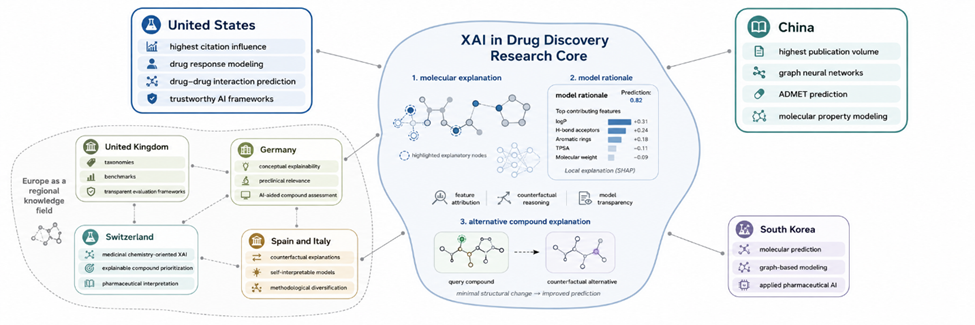
Country-level analysis showed that the United States, China, Germany, the United Kingdom, Switzerland, Spain, Italy, and South Korea formed the dominant geographic core of XAI-in-drug-discovery research. The United States led total citations, driven by high-impact work on drug response, drug interaction prediction, and trustworthy AI frameworks [25], while China showed the highest publication count in graph neural network, ADMET, and molecular prediction studies [22, 24, 27]. Germany and Switzerland contributed disproportionately to conceptual and medicinal chemistry-oriented explainability, including influential work on explainable drug discovery, preclinical relevance, and AI-aided compound assessment [1, 7]. Europe as a region showed strong thematic diversity, with visible contributions to taxonomies, benchmarks, counterfactuals, self-interpretable models, and pharmaceutical XAI perspectives [2, 9, 18, 20]. Figure 1 illustrates how XAI-in-drug-discovery research is geographically concentrated across a dominant international core, with the United States, China, Germany, Switzerland, the United Kingdom, Spain, Italy, and South Korea contributing distinct citation, publication, conceptual, and methodological strengths.
|
|
|
Figure 1. Geographic Knowledge Core and Thematic Contributions in Explainable AI for Drug Discovery |
International vs. Domestic Collaboration
International collaboration increased from 18.4% of papers in 2017–2021 to 31.7% in 2022–2026, suggesting a gradual shift from locally organized modeling studies toward larger, more interdisciplinary networks. Papers with international co-authorship had a mean normalized citation score of 1.42, compared with 1.08 for domestic-only papers, indicating a moderate citation advantage for cross-border work. Internationally connected papers often bridged algorithmic development with application domains such as drug–drug interaction, drug–target affinity, anticancer response, and toxicity prediction [19, 21, 22]. However, collaboration remained concentrated in North America, Europe, and East Asia, with limited representation from the Global South despite the global relevance of accessible and trustworthy drug-discovery technologies.
Citation and Co-Citation Networks
Most Cited Papers and Intellectual Base
The local citation network identified three major intellectual bases: general XAI-for-drug-discovery framing, SHAP-based medicinal chemistry interpretation, and graph-based molecular representation learning. Jiménez-Luna, Grisoni, and Schneider [1] had the highest local citation centrality among review papers because it provided a shared conceptual vocabulary for explainability, preclinical relevance, and drug-discovery decision support. In the methodological core, Rodríguez-Pérez and Bajorath [5] anchored the SHAP subnetwork, while Xiong and colleagues [12] anchored the graph-attention subnetwork through its influence on interpretable molecular graph modeling. Citation frequency was not identical to thematic importance, however, because recent papers on ADMET interpretation, counterfactuals, and regulatory trust had lower absolute citation counts but high burst strength in the 2023–2026 slice [9, 17].
Table 3 shows the main intellectual bases of XAI-for-drug-discovery research, distinguishing foundational frameworks, methodological cores, and emerging thematic areas shaping recent developments.
Table 3. Major intellectual bases and thematic clusters in XAI-for-drug-discovery research
|
Intellectual base / theme |
Role in the field |
Core focus |
Relative network importance |
|
General XAI-for-drug-discovery framework |
Foundational conceptual layer |
Defines explainability concepts and links them to drug discovery decision-making |
High centrality; provides shared vocabulary across subfields |
|
SHAP-based interpretability in medicinal chemistry |
Methodological core |
Feature attribution for molecular properties and prediction explanation |
Strong cluster-level influence; key methodological anchor |
|
Graph-based molecular representation learning |
Structural modeling backbone |
Graph neural networks and attention-based molecular representation |
High structural importance; supports interpretable molecular modeling |
|
Emerging ADMET, counterfactual, and regulatory-trust methods |
Emerging frontier |
Toxicity/ADMET explainability, counterfactual reasoning, and trust in regulatory contexts |
Lower overall citation weight but rapidly increasing recent influence |
Co-Citation Clusters
Co-citation analysis produced five interpretable clusters with modularity Q of 0.71 and weighted mean silhouette of 0.84, indicating a well-separated intellectual structure. The largest cluster linked SHAP, feature attribution, QSAR interpretation, and compound optimization, with repeated co-citation of Rodríguez-Pérez and Bajorath [5, 6], Matveieva and Polishchuk [18], and Sheridan [10]. A second cluster linked graph attention, molecular representation, fragment-oriented modeling, and self-attention message passing, connecting Xiong and colleagues [12], Tang and colleagues [23], and Zhang, Guan, and Zhou [26]. Smaller clusters represented explainable drug–drug interaction prediction [19, 25], drug–target affinity and transformer interpretation [13, 22], and trustworthy or regulatory XAI frameworks [3, 4].
Citation Bursts
CiteSpace burst detection showed that early citation bursts from 2019–2021 were associated with QSAR interpretation, attention-based drug-response modeling, and atom-level explanation. Manica and colleagues [11] showed an early burst because multimodal attention connected molecular and omics data for anticancer sensitivity prediction, while Sheridan [10] and Webel and colleagues [28] represented the parallel development of atom- and substructure-level explanation. During 2021–2024, bursts shifted toward graph neural networks, benchmarked explanation quality, and ADMET prediction, including studies on molecular graph comparison, quantitative explanation evaluation, and synthetic accessibility [16, 24, 27]. The latest burst period, 2024–2026, was characterized by ADMET-PrInt, InterDILI, concept-whitened graph networks, and pharmaceutical XAI perspectives, indicating movement from explanation generation toward explanation assessment and translational trust [8, 17, 20].
Thematic Evolution and Emerging Topics
Temporal Keyword Dynamics
Temporal keyword analysis showed a clear shift from broad descriptors such as “interpretability,” “QSAR,” “machine learning,” and “molecular descriptors” in 2017–2021 to more specific terms such as “SHAP,” “graph neural network,” “ADMET,” “attention,” and “drug–drug interaction” in 2022–2026. The term “SHAP” increased from near absence before 2020 to a keyword frequency of 68 in the late period, consistent with the growing influence of Shapley-value interpretation in compound optimization and property modeling [5, 6]. “Attention” appeared earlier than “SHAP” in deep learning papers, especially in anticancer response, molecular graph representation, and self-attention message passing [11, 12, 23]. “Counterfactual,” “concept,” “trust,” and “regulatory” remained lower-frequency terms but had the highest relative growth rates after 2023 [9, 20].
Emerging Research Fronts
The strongest emerging fronts were trust-oriented XAI, interpretable ADMET prediction, transformer-based drug–target modeling, and explanation benchmarking. ADMET-PrInt and InterDILI represented the move toward application-specific tools where predictions are paired with explanations relevant to pharmacokinetic and safety decisions [8, 17]. TAG-DTA and related drug–target affinity studies showed that transformer architectures are increasingly being linked to binding-region or interaction-level explanation rather than only predictive accuracy [13, 22]. The appearance of regulatory and pharmaceutical trust perspectives in recent reviews suggests that the field is beginning to connect technical explanation methods with decision contexts, although this front remains smaller than the SHAP and graph-learning clusters [3, 4, 15].
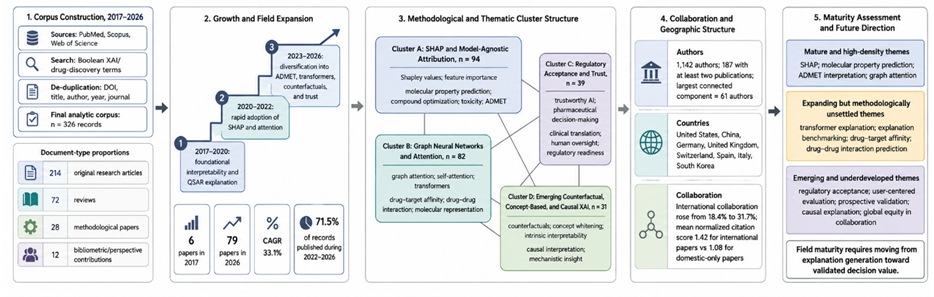
Figure 2 synthesizes the bibliometric evidence into an evidence-to-maturity map showing how publication growth, research clusters, collaboration structure, and emerging trust themes define the current state of explainable AI in drug discovery.
|
|
|
Figure 2. Bibliometric Evidence-to-Maturity Map of Explainable AI in Drug Discovery |
The Field is Dominated by a Few XAI Methods
The bibliometric evidence indicates that XAI in drug discovery is dominated by a small set of methods, especially SHAP, attention mechanisms, and feature-importance variants. SHAP has become the default explanation method for many tabular and descriptor-based drug-discovery models, partly because it can be applied across random forests, gradient boosting, neural networks, and multitask classifiers [5, 6]. This dominance has increased comparability across studies but may also narrow methodological imagination, because explanation faithfulness, molecular validity, and domain usability are not guaranteed by method popularity alone [16, 18]. The relatively lower frequency of counterfactuals, concept-based explanations, and intrinsically interpretable graph networks suggests that the field has not yet fully diversified beyond post-hoc attribution [9, 20].
The Missing Link: User-Centered and Regulatory Evaluation
The review found limited bibliometric evidence for user-centered or regulatory evaluation, even though trust and regulatory acceptance are repeatedly identified as motivations for XAI. Most studies evaluate explanation plausibility through molecular fragments, feature rankings, or benchmark scores rather than through structured assessment by medicinal chemists, toxicologists, clinicians, or regulators [7, 17, 28]. Reviews on pharmaceutical XAI and trustworthy artificial intelligence emphasize that explanations should support real decisions, but the empirical corpus still contains few prospective studies testing whether explanations improve candidate selection, safety review, or communication across expert groups [4, 15]. This gap suggests that the next phase of the field should move from producing explanations to validating their decision value.
Geographic and Collaborative Imbalances
The collaboration maps revealed a productive but uneven global structure. North America, Europe, and China dominated publication output, citation impact, and international collaboration, while countries in Africa, Latin America, the Middle East, and parts of South and Southeast Asia appeared mainly as isolated nodes or were absent from the main connected component. This imbalance matters because drug-discovery priorities, clinical translation pathways, and regulatory infrastructures vary across regions, and explanation needs may differ accordingly. The strongest cross-border papers tended to connect methodological development with applied domains such as drug response, drug–drug interaction, drug–target affinity, and toxicity prediction, showing that international teams can produce higher-impact work when they integrate algorithmic and pharmacological expertise [21, 22, 25].
Strengths and Limitations
This bibliometric review has strengths in its coverage of multiple databases, explicit de-duplication, use of complementary tools, and integration of publication, citation, keyword, co-authorship, and geographic indicators. It also distinguishes between mature clusters, such as SHAP-based molecular property explanation [5, 6], and emerging clusters, such as counterfactual, regulatory, and trust-oriented XAI [9]. Limitations include possible indexing bias, database-dependent citation counts, uneven coverage of conference papers, and the risk that some relevant studies were missed because they used terms such as “visualization,” “attention,” or “feature importance” without explicitly using “explainable AI.” The 2025–2026 portion of the corpus should also be interpreted cautiously because recent articles, including pharmaceutical XAI perspectives and late-period reviews, had shorter citation windows than older foundational papers [3, 4, 14, 15].
Implications and Recommendations
Table 4 translates the bibliometric findings into a future research agenda by distinguishing what the field already demonstrates from what remains unproven for trustworthy pharmaceutical decision-making.
Table 4. Translational Gap Matrix Linking Bibliometric Findings to Future Research Priorities
|
Bibliometric finding |
What the field currently demonstrates |
What remains insufficiently demonstrated |
Why this gap matters for drug discovery |
Recommended next-step research design |
Priority users or stakeholders |
|
Rapid post-2020 expansion of XAI publications |
The field is growing quickly, with 71.5% of records published during 2022–2026 and annual output rising sharply after 2020 |
Whether publication growth corresponds to better explanation quality, decision usefulness, or reproducibility |
A rapidly expanding literature may produce many explanations without proving that they improve compound prioritization or risk assessment |
Longitudinal bibliometric updates combined with structured methodological audits of explanation reporting, validation, and reproducibility |
Bibliometricians, journal editors, research funders, computational drug-discovery groups |
|
Dominance of SHAP and related post-hoc attribution |
SHAP has become the most visible and reusable explanation method for molecular property prediction, compound optimization, and ADMET tasks |
Whether SHAP explanations are chemically faithful, stable across datasets, and useful to medicinal chemists or toxicologists |
Popular explanation tools can become default reporting artifacts without ensuring mechanistic insight or better decisions |
Comparative benchmark studies testing SHAP against counterfactuals, concept-based methods, intrinsic models, and expert-reviewed chemical rationales |
Medicinal chemists, toxicologists, QSAR modelers, pharmaceutical data scientists |
|
Expansion of graph neural network and attention-based interpretation |
Graph attention, self-attention, and transformer models are increasingly linked to substructures, fragments, binding regions, and drug interactions |
Whether attention weights reliably explain model behavior or merely visualize learned associations |
Misinterpreting attention as mechanism may mislead molecular optimization, target-affinity interpretation, or safety assessment |
Faithfulness testing, perturbation analysis, fragment-level ablation studies, and comparison against experimentally supported molecular mechanisms |
Molecular modelers, structural biologists, drug–target affinity researchers |
|
Growth of ADMET and toxicity explainability |
Application-specific tools such as interpretable ADMET and drug-induced liver injury models are becoming visible research fronts |
Whether explanations improve safety review, reduce false confidence, or support regulatory-quality toxicological reasoning |
ADMET and toxicity decisions are high-stakes and require explanations that are actionable, reproducible, and domain-valid |
Prospective evaluation with toxicologists and pharmacokinetic experts using blinded explanation-review tasks |
Toxicologists, pharmacokinetic scientists, safety pharmacology teams, regulatory reviewers |
|
Emergence of regulatory acceptance and trust themes |
Trust, regulatory readiness, human oversight, and pharmaceutical decision-making appear increasingly after 2023 |
Empirical evidence that explanations satisfy regulatory expectations or improve cross-functional decision confidence |
Regulatory and translational acceptance requires more than visually plausible feature attribution |
Scenario-based regulatory simulation studies, explanation reporting checklists, and expert panels involving regulators, clinicians, and industry scientists |
Regulatory scientists, clinical pharmacologists, pharmaceutical governance teams |
|
Limited evidence of user-centered evaluation |
Reviews frequently argue that explanations should support experts, but few studies test explanation usability with real users |
Whether medicinal chemists, clinicians, toxicologists, or regulatory scientists interpret and act on explanations consistently |
XAI may remain a visualization layer unless it improves expert reasoning, communication, and candidate selection |
Human-subject usability studies, decision-impact experiments, think-aloud protocols, and inter-rater agreement studies |
Medicinal chemists, clinicians, toxicologists, HCI researchers |
|
Geographic and collaboration imbalance |
North America, Europe, and East Asia dominate output, citation impact, and international collaboration |
Whether XAI tools are validated across diverse discovery priorities, data environments, and regulatory systems |
Explanation needs may differ across regions because drug-development infrastructure, data availability, and regulatory pathways vary |
International benchmarking consortia, multi-country validation studies, and inclusion of underrepresented research settings |
Funders, global health researchers, international pharmaceutical consortia |
|
Short citation windows for 2025–2026 publications |
Recent pharmaceutical XAI and trust-oriented papers show high topical relevance but limited time for citation accumulation |
Whether late-period themes will become durable research programs or temporary publication bursts |
Bibliometric interpretation may underestimate emerging areas because citation indicators lag behind thematic importance |
Combined citation-burst, keyword-growth, altmetric, and expert-panel monitoring over repeated time windows |
Bibliometric analysts, journal editors, policy researchers |
For Researchers
Researchers should diversify explainability strategies beyond routine SHAP reporting and choose explanation methods according to model class, molecular representation, application domain, and end-user need. Descriptor-based QSAR models may benefit from SHAP, permutation importance, and benchmarked attribution, while graph neural networks and transformers require explanation methods capable of linking predictions to substructures, fragments, attention pathways, binding regions, or learned concepts [12, 13, 16, 20]. Explanation quality should be evaluated with quantitative metrics, chemical plausibility checks, robustness testing, and expert usability assessment rather than with visualization alone [7, 18, 28]. More comparative studies are needed to determine when counterfactuals, concept-based methods, intrinsic interpretability, or causal approaches provide more actionable evidence than conventional post-hoc attribution [9, 20].
For Institutions and Funders
Institutions and funders should support interdisciplinary teams that combine cheminformatics, medicinal chemistry, machine learning, toxicology, clinical pharmacology, regulatory science, and human-computer interaction. The collaboration network suggests that high-impact work often emerges where algorithm developers and application experts work together on concrete prediction tasks such as ADMET, drug–target affinity, drug–drug interaction, and drug-response modeling [8, 17, 22]. Funding calls should encourage open benchmark datasets, shared explanation-evaluation protocols, and prospective studies embedded in real discovery projects. International programs are also needed to reduce geographic concentration and ensure that XAI tools are validated across diverse discovery settings, regulatory environments, and therapeutic priorities [4, 21, 25].
Conclusion
This bibliometric review shows that explainable AI in drug discovery expanded rapidly from 2017 to 2026. The field moved from broad interpretability language and QSAR-oriented explanation toward more specialized methods linked to molecular property prediction, graph neural networks, ADMET modeling, and drug-interaction tasks. The publication curve indicates a young but accelerating research area with a strong post-2020 growth phase. Network maps show that the field is coherent but still divided into distinct methodological and application-centered communities.
SHAP is the most visible explanation method in the corpus, especially for descriptor-based models and molecular property prediction. Attention-based and graph-based methods form a second major stream, but their interpretability claims require careful validation. Counterfactual, concept-based, causal, and intrinsically interpretable approaches remain less frequent, although they are gaining momentum. Regulatory acceptance, user trust, and clinical translation are visible mainly as emerging themes rather than established research programs.
The field must mature from generating post-hoc explanations to validating explanations that can support drug-development decisions. This requires stronger benchmarks, clearer reporting standards, prospective evaluation, and direct involvement of medicinal chemists, toxicologists, clinicians, and regulatory scientists. Explanation quality should be assessed not only by computational metrics but also by whether it improves scientific reasoning, risk assessment, and decision confidence. Without this shift, XAI may remain a visualization layer rather than a trusted component of discovery pipelines.
Future work should broaden methodological diversity, strengthen international collaboration, and connect technical explainability to real pharmaceutical workflows. The most promising direction is not a single best explanation method, but a portfolio of validated explanation strategies matched to the model, data type, drug-discovery task, and user context. Bibliometric evidence suggests that the field is ready for this transition, but it will require deliberate coordination across disciplines. Explainable AI can become a practical foundation for trustworthy drug discovery if its explanations are transparent, reproducible, chemically meaningful, and prospectively tested.
Acknowledgments: None
Conflict of interest: None
Financial support: None
Ethics statement: None