Pharmacophore an International Research Journal
Tablet formulation failures are often driven by chemical and physical instability, which is affected by excipient selection, moisture uptake, manufacturing stresses, and storage conditions. Conventional stability prediction approaches—based on empirical rules, compatibility screens, and univariate kinetic models—offer limited insight into the complex interactions among multiple excipients, environmental stressors, and formulation variables. To overcome these limitations, this study introduces an explainable machine learning framework for predicting tablet shelf-life and degradation tendencies, leveraging excipient properties, moisture sorption characteristics, and accelerated stability data. The framework employs tree-based ensemble models, such as gradient-boosted trees or random forests, trained on formulation records encompassing excipient descriptors, moisture uptake parameters, process variables, and stability endpoints. SHAP analysis is then applied to break down each prediction into contributions from individual formulation and storage features, allowing the model to not only identify formulations at risk of instability but also elucidate underlying causes, such as hygroscopic fillers, moisture-sensitive drugs, insufficient moisture protection, or interactions between humidity and excipient chemistry. By linking predictions to actionable formulation levers, this explainable approach supports insight-driven optimization, enhancing product robustness and streamlining tablet development beyond traditional trial-and-error methods.
Introduction
Tablet stability failures carry significant development, manufacturing, and regulatory consequences because a product that appears acceptable at release may later undergo chemical degradation, impurity formation, dissolution change, hardness loss, or moisture-mediated physical transformation. Conventional real-time and accelerated stability studies remain essential, but they are slow and often describe the observed outcome without revealing the formulation-level causes of instability. Accelerated stability modeling has been positioned as a way to support quality-by-design thinking, but its conventional use still depends heavily on observed degradation trends rather than interpretable links between excipient selection and product behavior [1]. Recent stability-modeling discussions emphasize earlier patient access and development efficiency, yet they also highlight the continuing need for approaches that can connect stability risks to controllable product attributes [2].
Machine learning has attracted growing interest in pharmaceutical development because formulation datasets are increasingly multidimensional, combining material attributes, process conditions, and performance endpoints. Reviews of artificial intelligence in pharmaceutical technology describe opportunities across formulation development, manufacturing, quality control, and post-market surveillance, but they also make clear that model usefulness depends on whether scientists can interpret and trust the outputs [3, 4]. Machine learning directed formulation development has similarly been framed as a tool for navigating complex design spaces, although black-box predictions alone provide limited practical guidance for formulation scientists [5]. For tablet stability, this limitation is especially important because a model that only predicts failure without explaining whether moisture uptake, excipient chemistry, or processing stress is responsible cannot easily guide reformulation.
Formulation-level data are well suited to interpretable modeling because many stability-relevant variables are already captured during development. Drug-excipient compatibility studies can provide information on chemical incompatibility, while recent machine learning work has begun to address compatibility prediction from formulation-relevant descriptors [6]. Moisture-sensitive formulations also generate rich data through excipient screening, relative humidity cycling, and moisture scavenging studies, which can reveal how local water uptake alters degradation behavior [7, 8]. The availability of excipient grades, moisture sorption profiles, accelerated storage conditions, and manufacturing records therefore creates a realistic basis for explainable models that connect material properties to stability outcomes.
The central thesis of this article is that an explainable machine learning model could predict tablet stability from excipient properties, moisture uptake, accelerated stability data, and processing variables while simultaneously identifying the drivers of each prediction. Tree-based models are attractive in this setting because they can represent non-linear and interaction effects among humidity, temperature, excipient hygroscopicity, and drug-excipient compatibility, while SHAP values can translate those relationships into additive feature contributions [9]. Recent pharmaceutical examples of interpretable modeling, including work on disintegration processes and formulation parameter prediction, show how machine learning explanations can be aligned with formulation science rather than treated as purely computational outputs [10, 11]. In this framework, the prediction is not the final deliverable; the explanation is the bridge between model output and formulation decision. A stronger version of the framework would also treat moisture behavior, excipient instability, and pharmaceutical development governance as linked evidence streams rather than separate background variables. Excipient stability reviews show that excipients can undergo physical, chemical, and functional changes that influence tablet performance, making excipient degradation and incompatibility part of the model’s causal interpretation rather than simple formulation metadata [12]. Water–solid interaction research further indicates that sorbed water differs in amount, location, mobility, and thermodynamic state, so moisture features should distinguish bulk uptake from bound or localized water that may affect drug degradation, powder behavior, compaction, and final product performance [13]. Because hygroscopicity varies across active ingredients as well as excipients, API-level water uptake descriptors should also be incorporated to avoid attributing all moisture-driven risk to the excipient system alone. Finally, quality-by-design principles support the use of explainable predictions only when they strengthen product and process understanding, connect critical material attributes with critical quality attributes, and guide a traceable control strategy rather than replacing confirmatory stability evidence.
Background
Mechanisms of Tablet Instability
Tablet instability may arise through chemical pathways such as hydrolysis, oxidation, isomerization, and drug-excipient reactions, as well as physical pathways such as crystallisation, amorphous phase separation, polymorphic conversion, and moisture-driven mechanical change. Moisture is especially important because it can act as a reactant, plasticizer, mobility enhancer, or local microenvironment modifier, while temperature increases molecular mobility and accelerates degradation kinetics. Studies of moisture-sensitive products show that relative humidity cycling can affect solid dosage stability in ways that are not captured by a single static humidity condition [7]. Work on the physical stability of amorphous solid dispersions further illustrates that formulation composition and storage environment jointly influence whether a solid product remains stable or undergoes structural change [14].
Excipient Properties Influencing Stability
Excipient properties influence tablet stability because excipients are not inert placeholders; they determine water uptake, microenvironmental pH, glass transition behavior, particle contact, compact structure, and chemical compatibility. Hygroscopicity, glass transition temperature, acid-base character, reducing sugar content, particle size, and specific surface area can each affect degradation by altering water availability, mobility, or reactive contact between drug and excipient. Reviews and experimental work on excipient choice emphasize that the same drug can show different stability behavior depending on the excipient system used [15, 16]. Studies of commonly used excipients and enalapril maleate demonstrate that condensed water and excipient identity can shape solid-state degradation behavior, making excipient descriptors essential predictors rather than optional metadata [17].
Moisture Uptake and Drug-Excipient Interactions
Moisture uptake affects tablets through both bulk sorption and local water localization, creating microclimates around the active pharmaceutical ingredient that may differ from the nominal storage relative humidity. Moisture sorption isotherms, water activity, and excipient water-binding capacity can therefore provide mechanistic descriptors for explainable stability models. Investigations of starch-based excipients in moisture-sensitive tablets show that different excipient types can act as moisture scavengers or moisture reservoirs depending on their sorption behavior and formulation context [8]. Broader discussions of excipient roles in moisture management reinforce that moisture distribution within a solid dosage form is formulation-dependent and should be represented explicitly when predicting stability [18].
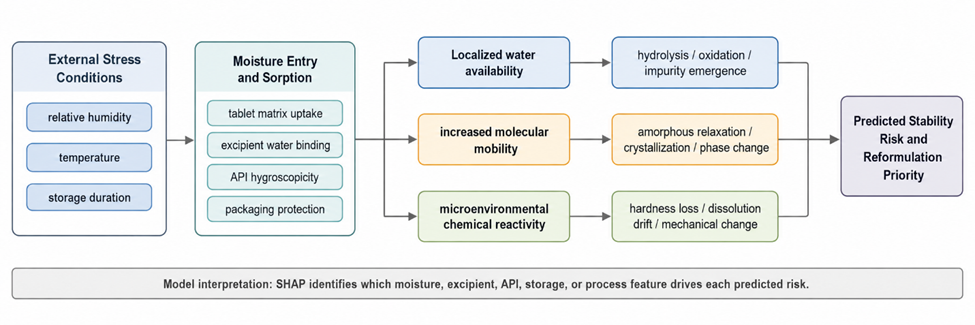
Figure 1 illustrates the moisture-mediated stability risk pathway through which storage humidity, excipient water sorption, API hygroscopicity, and localized water mobility may contribute to chemical degradation, physical transformation, or tablet performance change.
|
|
|
Figure 1. Mechanistic Pathways Linking Environmental Stress, Moisture Uptake, and Solid-State Instability Leading to Drug Product Stability Risk |
Machine Learning in Stability Science
Machine learning has already been applied to related pharmaceutical stability and formulation tasks, including prediction of amorphous solid dispersion stability, solid dispersion formulation design, and chemically stable dispersion formation. Random forest, support vector machine, partial least squares, transfer learning, and multitask learning approaches have been explored for complex formulation datasets where mechanistic equations alone are difficult to apply [14, 19–21]. Deep learning has also been investigated for physical stability prediction in amorphous systems, showing the broader interest in data-driven stability science while raising interpretability concerns [22]. For tablet stability, these studies suggest that predictive models can learn formulation-property relationships, but their adoption would be strengthened by explanations that identify the formulation drivers behind each prediction.
Explainable AI for Pharma and Regulatory Context
Explainable AI methods such as SHAP, LIME, permutation importance, and partial dependence plots are valuable because they translate complex model behavior into feature-level evidence that formulation scientists can evaluate. SHAP is particularly relevant for tree-based models because it can provide consistent additive attributions that connect each prediction to specific descriptors such as hygroscopicity, moisture gain, storage humidity, or excipient grade [9]. In pharmaceutical settings, explainability also supports quality-by-design thinking by making explicit which material attributes and process parameters are expected to influence critical quality attributes [23]. Interpretable modeling examples in orally disintegrating tablets demonstrate how model explanations can be used to puzzle out formulation mechanisms rather than simply generate predictions [10].
Model Development Overview
High-Level Predictive Workflow
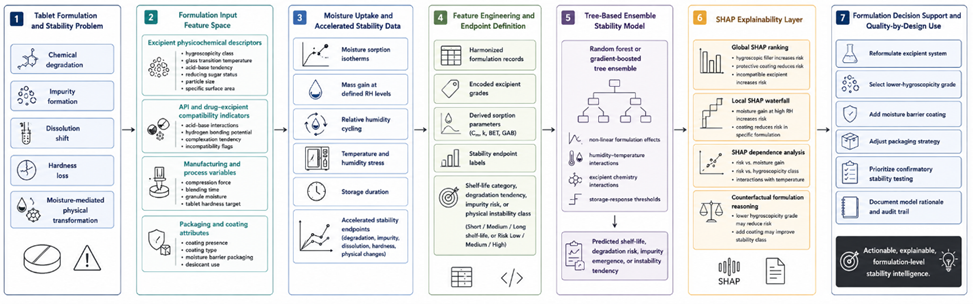
The proposed workflow begins with formulation input data, including excipient properties, moisture sorption descriptors, drug-excipient compatibility indicators, storage conditions, and manufacturing variables, which are supplied to a trained random forest or gradient-boosted tree model. The model would conceptually predict a stability endpoint such as degradation tendency, shelf-life category, impurity emergence risk, or degradation rate constant, without treating the numerical output as sufficient by itself. After each prediction, SHAP values would be computed to show how individual inputs increased or decreased the predicted stability risk, following the principle of additive explanation described for tree-based explainable AI [9]. This structure is consistent with recent pharmaceutical artificial intelligence frameworks that position predictive modeling as most useful when it is integrated with formulation knowledge and decision support [5, 24].
Figure 2 presents the proposed explainable tablet stability prediction workflow, linking formulation descriptors, moisture sorption behavior, accelerated storage conditions, tree-based ensemble modeling, SHAP interpretation, and formulation optimization decisions.
|
|
|
Figure 2. Explainable Machine Learning Workflow for Tablet Stability Prediction Using Excipient Properties, Moisture Uptake, and Accelerated Stability Data |
Core Input Feature Groups
The model would use four core feature groups: excipient physicochemical descriptors, moisture uptake parameters, accelerated storage conditions, and manufacturing process variables. Excipient descriptors could include glass transition temperature, hygroscopicity class, acid-base character, particle size, specific surface area, and reducing sugar status, while moisture features could include mass gain at defined relative humidities or fitted isotherm parameters. Accelerated stability inputs would capture temperature, humidity, packaging, and storage duration, and process descriptors could include compression force, coating presence, and other manufacturing variables known to affect compact structure. The rationale for combining formulation and process variables is supported by hybrid modeling work in drug product development, where formulation and manufacturing information are treated together rather than as separate domains [25].
Design Principles
The first design principle is that the model should be interpretable enough to support formulation decisions, meaning that feature attributions must be available at both global and individual-formulation levels. The second principle is that the explanation should be chemically plausible, so attributions to moisture uptake, excipient chemistry, or storage humidity should be evaluated against known compatibility and moisture-management behavior [6, 18]. The third principle is that the model should be updateable as new batches, new excipient grades, and new accelerated stability observations become available, reflecting the iterative nature of formulation development described in machine learning directed formulation research [5]. The overall design therefore treats explainability not as an afterthought but as a requirement for using artificial intelligence in quality-oriented pharmaceutical development [3].
Data Sources and Feature Engineering
Compilation of Tablet Stability Datasets
A tablet stability dataset for this framework would be compiled from internal development batches, drug-excipient compatibility studies, moisture sorption experiments, accelerated stability reports, and carefully selected literature data. The dataset should include diverse active ingredients, filler-binder systems, disintegrants, lubricants, coating approaches, and storage conditions so that the model can learn patterns across formulation space rather than only memorize one product family. Literature on excipient compatibility prediction suggests that machine learning can use compatibility-related descriptors as formulation-level inputs, while stability studies of excipient-rich systems show why these descriptors should be linked to observed degradation or physical change [6, 17]. Public and literature-derived formulation data would need careful harmonization because analytical methods, impurity reporting, and excipient grade descriptions may differ across studies.
Encoding Excipient Properties and Moisture Data
Excipient chemistry can be encoded using numerical descriptors such as molecular class, acid-base tendency, reducing functionality, glass transition temperature, particle size distribution, specific surface area, and hygroscopicity measures. Moisture sorption data could be represented as raw mass-gain values at selected relative humidity levels or as derived parameters from isotherm models, depending on the resolution and consistency of available experimental data. Studies of moisture management in tablets show that moisture uptake is not merely a storage-condition variable but a formulation property that depends on excipient type, matrix composition, and water localization [8, 18]. Powder-property prediction work also supports the broader idea that physical material descriptors can be transformed into machine-learning features for pharmaceutical development tasks [26].
Table 1 organizes the formulation, moisture, process, and stability endpoint variables into a model-ready feature architecture that clarifies how pharmaceutical knowledge can be encoded for explainable tablet stability prediction.
Table 1. Formulation-Relevant Feature Architecture for Explainable Tablet Stability Prediction
|
Feature Domain |
Representative Variables |
Pharmaceutical Stability Rationale |
Expected Model Role |
Example SHAP-Based Interpretation |
|
Excipient hygroscopicity and water-binding behavior |
Hygroscopicity class; equilibrium moisture content; water activity; moisture sorption isotherm parameters; mass gain at defined relative humidity levels |
Determines whether the tablet matrix acts as a moisture reservoir, moisture scavenger, or humidity-sensitive environment that can accelerate degradation or physical transformation |
Primary predictor of moisture-mediated degradation, dissolution shift, hardness loss, and phase instability |
High moisture gain at elevated relative humidity increases predicted instability risk, suggesting the need for a less hygroscopic excipient grade or stronger moisture protection |
|
Excipient chemical reactivity and compatibility |
Acid-base character; reducing sugar status; reactive functional groups; compatibility screen result; known drug–excipient incompatibility indicator |
Excipient chemistry can promote hydrolysis, oxidation, Maillard-type reactions, pH-mediated degradation, or direct drug–excipient reaction |
Helps identify chemical drivers of impurity emergence and incompatibility-related degradation |
A reducing filler or acidic excipient contributes positively to degradation risk, indicating a formulation-level incompatibility concern |
|
Excipient physical and structural properties |
Glass transition temperature; particle size; specific surface area; porosity-related descriptors; compactibility-related attributes |
Physical properties influence water localization, particle contact, molecular mobility, compaction behavior, and mechanical stability |
Supports prediction of physical instability, hardness change, dissolution drift, and moisture-sensitive matrix behavior |
Large surface area or low glass transition-related stability contributes to risk, suggesting that physical material attributes are influencing instability |
|
API stability susceptibility |
Hydrolysis sensitivity; oxidation sensitivity; solid-state form; amorphous/crystalline status; moisture sensitivity class |
The same excipient and storage environment may produce different outcomes depending on the intrinsic vulnerability of the active ingredient |
Enables API-specific risk stratification and prevents treating all drug substances as equivalent |
A moisture-sensitive API strongly amplifies the effect of humidity-related features, indicating mechanism-specific instability |
|
Accelerated storage conditions |
Temperature; relative humidity; storage duration; humidity cycling; open or closed storage condition; packaging configuration |
Accelerated stability conditions create stress signals that reveal degradation tendency and physical transformation risk |
Provides experimental stress context for learning shelf-life or degradation-risk patterns |
Elevated humidity and temperature jointly increase predicted degradation tendency, especially in moisture-absorbing formulations |
|
Manufacturing and process variables |
Compression force; granulation type; drying conditions; coating presence; process temperature; compaction stress |
Manufacturing can alter compact structure, water distribution, residual moisture, thermal exposure, and drug–excipient contact |
Captures process-related modifiers of stability risk that are not explained by composition alone |
High compression or inadequate drying contributes to instability, suggesting process optimization rather than excipient replacement |
|
Protective formulation and packaging attributes |
Moisture barrier coating; desiccant use; blister or bottle packaging; polymer coating type; protective excipient strategy |
Protective measures may reduce water ingress, limit humidity exposure, or buffer moisture-sensitive components |
Allows the model to distinguish high-risk compositions from mitigated formulations |
Moisture barrier packaging or protective coating contributes negatively to instability risk, supporting a control-strategy rationale |
|
Stability endpoint labels |
Degradation rate tendency; impurity emergence; shelf-life category; dissolution shift; hardness loss; physical instability class |
Endpoint selection determines whether the model learns chemical degradation, physical instability, or combined tablet failure behavior |
Defines the target prediction and shapes pharmaceutical interpretation of the model output |
A prediction of impurity risk should be interpreted differently from a prediction of hardness loss or dissolution drift |
Defining Stability End-points
Stability endpoints should be defined in a way that is both scientifically meaningful and compatible with formulation decision-making, such as degradation rate tendency, time to a defined degradation threshold, impurity emergence, dissolution shift, hardness change, or physical instability classification. Accelerated stability data can provide labels or target endpoints, but the model should be framed conceptually rather than as a replacement for confirmatory stability testing. The endpoint definition should reflect whether the main concern is chemical degradation, moisture-mediated physical change, or a combined failure mode, since amorphous solid dispersion studies show that different stability mechanisms may require different target representations [14, 27]. Processing studies involving thermally labile drugs also illustrate that stability-relevant endpoints may arise from both formulation composition and manufacturing stress, making endpoint selection central to model credibility [28].
Explainable Model Architecture
Model Choice – Tree-Based Ensemble
A tree-based ensemble such as random forest or gradient boosting is appropriate for this conceptual framework because formulation datasets are typically tabular, heterogeneous, and rich in non-linear interactions. Such models can represent threshold-like effects, such as a sharp increase in instability when moisture gain and storage humidity jointly exceed a formulation-specific tolerance, while remaining compatible with SHAP-based explanation workflows. SHAP explanations for tree models provide a structured way to assign feature contributions to individual predictions, and exact Shapley-value computation has also been discussed for support vector machine classification, showing the wider relevance of explanation methods beyond trees [9, 29]. In pharmaceutical formulation contexts, where interpretability must be linked to actionable material choices, tree ensembles offer a practical balance between flexibility and explanation.
Training and Regularization
Training should be designed to avoid overfitting because tablet stability datasets are often smaller, more heterogeneous, and more expensive to generate than datasets in many other machine-learning domains. Cross-validation, restricted model complexity, careful feature selection, and conservative tuning would be used to evaluate whether the learned relationships are stable across active ingredients, excipient classes, and storage conditions. Hybrid modeling and transfer learning strategies may be useful when related formulation datasets are available, because they allow prior knowledge from one formulation or product family to support learning in another without assuming that all mechanisms are identical [25]. Recent formulation and stability modeling studies also suggest that algorithm choice should be paired with scientific validation, so regularization must be interpreted alongside chemical plausibility rather than treated as a purely computational exercise [19, 20].
Output: Stability Estimate and Explanation Object
The model output would consist of a stability estimate and a corresponding explanation object, with the estimate representing a conceptual prediction of shelf-life, degradation tendency, or stability risk and the explanation object representing the feature-level rationale behind that prediction. For each formulation, the SHAP vector would identify whether properties such as excipient hygroscopicity, moisture gain at high relative humidity, acidic microenvironment, storage temperature, or compression-related compact structure pushed the prediction toward higher or lower instability. This dual output is important because pharmaceutical artificial intelligence should support decision-making rather than merely generate scores, as emphasized in reviews of AI for solid dosage form development and pharmaceutical technology [3, 24]. The explanation object would therefore become a formulation-development artifact that can be reviewed, challenged, and updated as new stability evidence emerges.
Linking Stability Drivers to Formulation Decisions
Global SHAP Analysis to Rank Formulation Factors
Global SHAP analysis would summarize how formulation and storage variables influence stability predictions across the development dataset. For example, if excipient hygroscopicity, moisture gain at high relative humidity, or acidic microenvironment consistently increases predicted degradation risk, these variables would be ranked as priority formulation risks rather than treated as isolated observations. This approach is consistent with moisture-management studies showing that excipient identity and water uptake can materially affect the stability of moisture-sensitive solid dosage forms [8, 18]. A global SHAP ranking would therefore help formulation scientists identify which excipient attributes should be controlled most tightly during early formulation screening.
Local Explanations for a Single Tablet Formulation
For an individual tablet formulation, a SHAP waterfall explanation would show how each input feature shifts the prediction away from a baseline stability expectation. The additive structure can be written conceptually as y^=E[f(X)]+j=∑ϕj , where y^
 is the predicted stability endpoint, E[f(X)] ) is the model baseline, and (ϕj
 ) is the SHAP contribution of feature ( j ). This would allow a scientist to see whether the predicted instability is mainly driven by a hygroscopic filler, a high storage humidity condition, an incompatible excipient, or the absence of moisture-protective packaging. Such local interpretation aligns with explainable modeling principles in which individual predictions are decomposed into transparent feature contributions rather than presented as opaque scores [9].
Counterfactual Reasoning for Formulation Improvement
Counterfactual reasoning would allow the formulation scientist to ask how the stability prediction might change if a risky excipient were replaced, a less hygroscopic grade were selected, or a moisture barrier coating were introduced. In this setting, the model would not claim that the counterfactual formulation has been experimentally proven stable; instead, it would identify which modification would be expected to reduce risk and why. Drug-excipient compatibility prediction work supports the idea that computational models can help prioritize safer formulation choices before extensive stability testing is performed [6]. When combined with SHAP values, the counterfactual output would show whether the expected improvement is attributable to reduced moisture uptake, lower chemical incompatibility, or a more favorable storage-response profile.
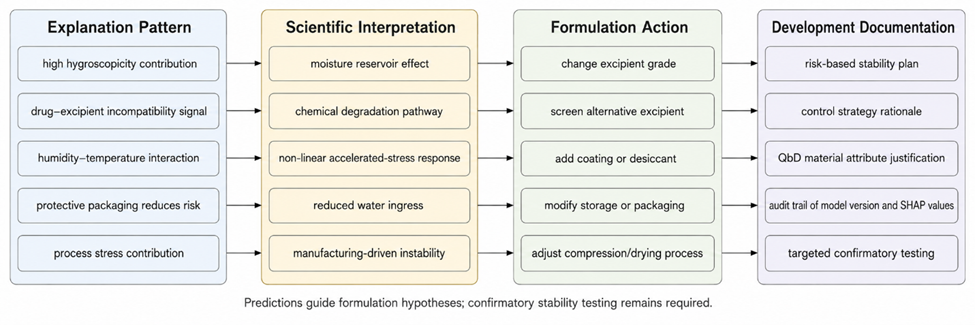
Figure 3 translates SHAP explanation patterns into formulation interpretation, practical development actions, and quality-by-design documentation pathways.
|
|
|
Figure 3. From Model Explanation to Development Decisions: Translating SHAP-Based Insights into Scientific Interpretation, Formulation Actions, and Regulatory Documentation |
Table 2 translates common SHAP explanation patterns into formulation decisions, stability risk controls, and quality-by-design documentation pathways.
Table 2. Translating SHAP Explanations into Tablet Formulation Decisions and Stability Risk Controls
|
Explanation Pattern Identified by the Model |
Likely Pharmaceutical Interpretation |
Recommended Formulation or Development Action |
Translational Value for Formulation Scientists |
Documentation or Quality-by-Design Relevance |
|
High positive SHAP contribution from excipient hygroscopicity |
Moisture-absorbing excipient is likely increasing local water availability and accelerating chemical or physical instability |
Replace with a lower-hygroscopicity grade, reduce excipient proportion, or add a moisture-management excipient |
Converts a statistical risk signal into a specific excipient-selection hypothesis |
Supports justification for excipient grade selection and moisture control strategy |
|
High positive SHAP contribution from moisture gain at elevated relative humidity |
The formulation may be vulnerable under humid storage, shipping, or climate-zone conditions |
Strengthen moisture barrier packaging, add desiccant, evaluate coating, or conduct targeted humidity stress testing |
Helps prioritize stability studies under realistic humidity-risk conditions |
Links accelerated humidity response to risk-based stability planning |
|
High positive SHAP contribution from drug–excipient incompatibility indicator |
Chemical interaction between the API and excipient may be contributing to impurity formation or degradation |
Screen alternative excipients, conduct compatibility confirmation, or reformulate the excipient system |
Directs investigation toward chemical compatibility rather than generic instability |
Provides traceable rationale for compatibility-driven reformulation |
|
Strong interaction between storage humidity and excipient chemistry |
Moisture and chemical reactivity may jointly destabilize the tablet more than either factor alone |
Test alternative excipient chemistry under controlled humidity levels and compare predicted risk reduction |
Identifies non-linear formulation mechanisms that univariate stability models may miss |
Supports mechanistic quality-by-design interpretation of material attribute interactions |
|
Negative SHAP contribution from protective coating or packaging |
Moisture-protective design appears to reduce predicted instability risk |
Preserve or optimize coating and packaging strategy; compare coated versus uncoated scenarios |
Highlights protective formulation levers rather than only risk factors |
Supports control-strategy documentation for product robustness |
|
Positive SHAP contribution from process stress variables |
Compression, heat, drying, or manufacturing conditions may be contributing to instability |
Adjust compression force, drying protocol, coating process, or process temperature |
Distinguishes composition-driven instability from process-driven instability |
Connects critical process parameters with stability-related critical quality attributes |
|
Local SHAP explanation dominated by one excipient feature |
A single material attribute may be the main driver of instability for a specific formulation |
Conduct targeted excipient substitution or grade comparison before broad reformulation |
Reduces trial-and-error screening by focusing on the most plausible formulation lever |
Creates an auditable formulation rationale for targeted experimental follow-up |
|
Global SHAP ranking repeatedly identifies moisture-related variables |
Moisture management is likely a dominant stability determinant across the formulation dataset |
Develop moisture-control design rules for early formulation screening |
Converts dataset-level model behavior into platform formulation knowledge |
Supports broader development guidance and internal formulation decision rules |
|
Counterfactual explanation shows risk reduction after replacing a hygroscopic excipient |
A feasible formulation modification may reduce predicted instability without changing the entire product design |
Prioritize the counterfactual formulation for accelerated confirmation testing |
Translates predictive modeling into a ranked experimental plan |
Documents why a formulation alternative was selected for further development |
|
SHAP explanation conflicts with known compatibility or stability evidence |
The model may be extrapolating, overfitting, or learning a dataset artifact |
Review data quality, retrain model, restrict applicability domain, or require additional experiments |
Prevents blind trust in computational predictions and reinforces scientist oversight |
Supports model governance, applicability-domain control, and auditability |
Interaction between Excipient Properties and Storage Conditions
SHAP dependence plots would be used to explore whether the effect of one feature changes across the range of another feature, such as whether moisture uptake becomes more destabilizing at elevated temperature. This is important because accelerated stability behavior is often governed by interactions among humidity, thermal stress, and formulation composition rather than by a single isolated factor. Relative humidity cycling studies show that dynamic moisture exposure can influence solid dosage stability, while accelerated stability modeling frameworks emphasize the importance of storage stress in predicting product behavior [1, 7]. An explainable interaction analysis would therefore help identify formulations that may be acceptable under moderate conditions but vulnerable in hot or humid climates.
Explainability Methods for Formulation Scientists
Visualization in an Interactive Dashboard
An interactive dashboard would present the predicted stability profile together with global and local SHAP explanations, allowing formulation scientists to explore model behavior without writing code. The dashboard could show which excipient properties, moisture parameters, and storage conditions are responsible for the current prediction, while allowing controlled “what-if” changes to formulation inputs. Previous explainable formulation modeling in orally disintegrating tablets demonstrates that visualization can help scientists connect model behavior with formulation mechanisms [10]. Such a dashboard would be most useful when it supports scientific questioning rather than simply displaying a model score.
Narrative Generation from SHAP Values
Narrative generation would translate the largest SHAP contributors into formulation-language explanations, such as stating that predicted degradation risk is elevated because a moisture-absorbing disintegrant is combined with a hydrolysis-prone active ingredient under humid storage. This narrative should remain traceable to the underlying feature attributions, so the explanation is not a generic template but a structured interpretation of the model output. Similar formulation-focused machine learning studies show that model outputs become more useful when they are mapped to familiar pharmaceutical concepts such as disintegration behavior, material properties, and formulation parameters [11, 30]. In tablet stability prediction, narrative explanations would help scientists convert computational signals into practical formulation hypotheses.
Audit Trail and Model Documentation
Every model prediction should generate an audit trail containing the input variables, predicted endpoint, SHAP values, model version, and date of evaluation. This documentation would support internal review and help demonstrate that formulation decisions were based on a consistent, traceable, and scientifically interpretable process. Quality-by-design literature emphasizes the importance of understanding how material attributes and process parameters influence product quality, and explainable model documentation can help formalize that understanding [23]. In regulatory-facing settings, the audit trail would not replace stability data but could support the rationale for formulation selection, packaging strategy, and risk-based stability planning.
On-boarding and Trust Building
Trust in an explainable stability model would be built by comparing its explanations with known pharmaceutical mechanisms and historical compatibility observations. If the model identifies moisture uptake, excipient incompatibility, or thermal stress as major drivers in cases where prior stability studies reached the same conclusion, scientists would have stronger grounds for using the tool in formulation discussions. Studies on excipient choice, condensed water effects, and moisture-sensitive tablets provide mechanistic anchors against which model explanations can be assessed [15–17]. This alignment between model logic and established formulation science is essential because interpretability is only useful when the explanation is scientifically credible.
Integration into Formulation Optimization Workflow
Early-Stage Screening Tool
During pre-formulation, the explainable model could be used to rank candidate blends by predicted stability risk before committing to extensive long-term studies. A scientist could compare candidate excipient systems, identify high-risk drug-excipient combinations, and prioritize blends that appear less vulnerable to moisture-driven degradation or physical transformation. Machine learning directed formulation development supports this type of early decision support, especially when the model helps narrow a complex design space rather than replace experimental confirmation [5]. For solid dosage forms, this workflow would be particularly useful when compatibility data, excipient descriptors, and accelerated screening results are available before final formulation selection [24].
Supporting Regulatory Discussions
Explainable stability predictions could support regulatory discussions by making explicit which formulation attributes and control strategies are expected to preserve product quality. For example, the model could justify the selection of a low-hygroscopicity excipient, a moisture barrier coating, or protective packaging by showing that these features reduce predicted instability risk in a mechanistically plausible way. Regulatory-relevant stability modeling emphasizes the value of connecting development decisions to product understanding, and accelerated stability approaches have already been discussed in relation to quality-by-design [1, 2]. An XAI framework would extend this logic by adding feature-level transparency to the stability risk assessment.
Evaluation Strategy
Predictive Performance
Predictive performance should be evaluated without relying on a single random split, because stability datasets may contain related batches, related active ingredients, and repeated formulation families. Cross-validation could be structured by active ingredient, formulation type, or time period so that the evaluation asks whether the model generalizes beyond closely related records. Machine learning studies in solid dispersion stability and formulation design show that model assessment should reflect the intended use case and the chemical diversity of the formulation space [14, 19, 20]. Performance metrics such as prediction error for shelf-life or degradation tendency could be reported in a future experimental study, but this conceptual article does not present numerical outcomes.
Explanation Fidelity and Usefulness
Explanation fidelity should be assessed by determining whether SHAP explanations remain consistent under reasonable model perturbations and whether they reflect the behavior of the underlying predictive model. Explanation usefulness should be assessed by formulation scientists, who would judge whether the identified drivers match known compatibility findings, moisture-management principles, and practical formulation levers. Work on exact Shapley-value explanations for support vector machine models and SHAP explanations for tree models highlights the importance of linking mathematical attribution methods to interpretable model behavior [9, 29]. In a pharmaceutical setting, a useful explanation is one that supports a scientifically defensible decision, not merely one that is visually clear.
Prospective Impact
A prospective evaluation would test whether the explainable model changes formulation decisions in a way that improves development efficiency. Candidate formulations could be screened using the model, revised according to the most plausible SHAP-identified risks, and then evaluated through conventional accelerated and confirmatory stability studies. Artificial intelligence reviews in pharmaceutical technology emphasize that the value of such tools should be judged by their effect on development workflows, product understanding, and decision quality rather than by prediction alone [3, 4]. The appropriate question is therefore whether model-guided formulation choices would be expected to reduce avoidable stability failures while preserving the role of experimental verification.
Limitations
Data Scarcity and Variability
A major limitation is that tablet stability data are costly, slow to generate, and often heterogeneous across products, analytical methods, excipient grades, and storage protocols. This variability can make it difficult for a model to distinguish true formulation mechanisms from differences in measurement practice or reporting conventions. Hybrid modeling and transfer learning may help when related formulation datasets exist, but they cannot eliminate the need for curated, high-quality stability records [25]. Therefore, an explainable model should be treated as a decision-support tool whose reliability depends directly on the quality and representativeness of the data used to train it.
Extrapolation to New Chemical Space
The model may not reliably predict stability for a new active ingredient, novel excipient, or unfamiliar degradation pathway that lies outside the chemical and formulation space represented in training data. This limitation is especially important for APIs with unusual solid-state behavior, excipients with poorly characterized moisture interactions, or manufacturing processes that introduce new thermal or mechanical stress. Studies involving thermally labile drugs and amorphous dispersion phase behavior illustrate that formulation stability can depend on mechanism-specific phenomena that may not transfer automatically across systems [27, 28]. Domain knowledge, targeted compatibility testing, and confirmatory stability studies therefore remain essential even when explainable predictions appear plausible.
Conclusion
An explainable tablet stability framework could connect excipient properties, moisture uptake, accelerated storage conditions, and manufacturing variables to conceptual predictions of shelf-life or degradation tendency. Its central value would be the ability to pair each stability estimate with a feature-level explanation that identifies why a formulation is expected to be stable or unstable.
The strongest advantage of this approach is transparency. By using SHAP-driven explanations, the model could translate complex non-linear relationships into formulation-relevant drivers such as hygroscopicity, moisture gain, excipient incompatibility, storage humidity, and protective coating effects.
Important challenges remain before such a framework could be used routinely. These include expanding curated stability datasets, harmonizing stability endpoints, building confidence among formulation scientists, and defining how explainable model outputs should be documented in quality-by-design and regulatory contexts.
Future progress will depend on collaborative data sharing, careful prospective evaluation, and pilot deployment in industrial formulation workflows. If implemented responsibly, explainable stability modeling could help reduce trial-and-error formulation work and support more robust tablet product development.
Acknowledgments: None
Conflict of interest: None
Financial support: None
Ethics statement: None