Pharmacophore an International Research Journal
Machine-learning models can rank molecules, estimate molecular properties, and predict compound–target relations with increasing computational accuracy. Nevertheless, an accurate prediction does not necessarily reveal why a molecule behaves as predicted, whether the model has learned pharmacologically relevant information, or whether its explanation can support an experimental decision. This conceptual gap is especially consequential in early drug discovery, where model outputs are frequently interpreted across virtual screening, target assessment, lead optimization, and experimental prioritization. This Original Conceptual Theory Article develops evidence-constrained interpretability as a proposed theory for distinguishing molecular explanations that merely describe predictive behavior from interpretations that may support bounded pharmacological reasoning. The theory treats representation traceability, attribution faithfulness, independent evidence linkage, mechanistic-status qualification, uncertainty characterization, and decision-context alignment as interdependent conditions rather than interchangeable indicators of explanation quality. It further distinguishes benchmark performance from prospective usefulness, model attribution from biological mechanism, molecular plausibility from developability, and predictive confidence from calibrated uncertainty. Under the proposed theory, a molecular feature acquires pharmacological meaning only provisionally and only when the inferential step connecting that feature to a target, mechanism, or discovery decision is supported by evidence appropriate to the claim. The contribution is conceptual rather than empirically validated and does not establish causal explanation, clinical utility, regulatory acceptability, or operational readiness. Its principal implication is that interpretable molecular prediction should be evaluated as an evidence-governed scientific practice rather than as the production of visually plausible feature maps. This perspective may support more disciplined use of prediction and explanation in early discovery while identifying the experiments required to test, revise, or reject pharmacological interpretations.
Introduction
Machine learning has become embedded in several stages of pharmaceutical research, including molecular property prediction, compound prioritization, target-related modeling, toxicity assessment, and candidate generation. Its expanding role reflects the ability of computational models to extract regularities from chemical and biological data at scales that are difficult to examine manually. However, the scientific value of such models remains conditional on the quality, provenance, and relevance of the data from which their predictions are learned [1]. Computer-assisted drug discovery also encompasses heterogeneous tasks, representations, objectives, and validation strategies, meaning that a favorable result in one computational setting cannot be assumed to carry the same meaning in another [2]. The central problem is therefore not whether a model can produce an accurate molecular prediction, but what that prediction legitimately permits a scientist to infer about a molecule, target, mechanism, or experimental decision.
This distinction matters because early drug discovery depends on decisions made under substantial biological and chemical uncertainty. A model may assign a high probability of activity, predict a favorable property value, or rank a compound above alternatives without revealing whether the result arises from a transferable chemical relation, an assay-specific correlation, a data artifact, or a representation-dependent shortcut. Contemporary drug-design workflows consequently require more than improvements in architecture or benchmark performance: they require connections among model outputs, synthesis feasibility, experimental evidence, medicinal-chemistry reasoning, and iterative decision making [3]. Without those connections, computational accuracy may increase the efficiency of ranking while leaving the evidentiary basis of the ranking unresolved.
Explainable artificial intelligence has been proposed as one route toward greater transparency in molecular prediction. Attribution maps, attention scores, surrogate models, counterfactual examples, and related methods can expose features associated with a model output, but their pharmaceutical interpretation remains conditional on domain-sensitive validation [4]. The rapid adoption of deep learning across drug-discovery tasks has widened the range of predictions that can be generated, yet methodological breadth does not establish that a model has acquired mechanistic or pharmacological understanding [5]. A highlighted substructure may identify a feature used by the model, for example, while remaining silent about whether that feature contributes to binding, selectivity, permeability, toxicity, assay interference, or an unmeasured confounding relation. Interpretability thus becomes scientifically meaningful only when the inferential distance between model behavior and pharmacological claim is made explicit.
Molecular prediction and generation also require confidence assessment and medicinal-chemistry interpretation before they can guide discovery decisions [6]. This article proposes evidence-constrained interpretability as a conceptual theory for governing that transition. The theory does not treat interpretability as a single model property or visualization technique. Instead, it defines an interpretation as pharmacologically admissible only when the prediction object is specified, the molecular representation is traceable, the explanation is faithful to the model, the attributed feature is linked to independent evidence, the mechanistic status of the claim is declared, relevant uncertainty is characterized, and the interpretation is aligned with a specific decision context. The need for such a theory follows from convergent recognition that pharmaceutical machine learning is constrained by data suitability, representation, evaluation design, experimental closure, and workflow integration [1-3]. The proposed contribution is therefore an organizing theory for disciplined interpretation, not an empirically validated framework, universal standard, or deployment-ready decision system.
Why Predictive Accuracy Can Fail To Produce Pharmacological Understanding
Predictive accuracy describes correspondence between model outputs and observed labels under a specified evaluation design. Pharmacological understanding, by contrast, concerns whether the relations inferred from a prediction are scientifically relevant to molecular behavior, biological interaction, mechanism, or a defined discovery decision. These constructs may overlap, but they are not equivalent. Ligand-based benchmarks can reward recognition of chemical similarity patterns that recur across training and test sets, allowing a model to appear generalizable while primarily reproducing memorized chemical neighborhoods [7]. Structure-based virtual-screening evaluations are likewise sensitive to the composition of active and inactive compounds, including differences that may be unrelated to the intended protein–ligand interaction [8]. Accuracy can therefore be genuine with respect to the benchmark while remaining misleading with respect to the scientific question that the benchmark is assumed to represent.
The problem becomes more pronounced when hidden dataset regularities provide predictive shortcuts. Analyses of DUD-E have shown that deep-learning models can exploit benchmark-specific biases and achieve apparently strong performance without necessarily learning the intended physical determinants of molecular recognition [9]. Collectively, benchmark memorization, chemical-data bias, and hidden dataset artifacts demonstrate that predictive success may reflect the structure of an evaluation resource rather than transferable pharmacological knowledge [7-9]. This does not make benchmark evaluation useless. It means that a benchmark result must be interpreted as evidence about performance under a defined data-generating and splitting procedure, not as automatic evidence of mechanism, target engagement, prospective enrichment, or therapeutic relevance.
A second source of failure is mismatch between the model endpoint and the decision for which the prediction is used. A model trained to reproduce an assay label may learn relations associated with assay conditions, measurement technologies, compound availability, or historical selection practices. Even when such a model predicts held-out observations accurately, the output may not answer whether a compound binds through the proposed mode, retains activity in a different biological system, possesses suitable selectivity, or can be developed into a useful therapeutic candidate. Realistic impact from artificial intelligence in drug discovery consequently depends on appropriate problem formulation, validation, and integration into scientific workflows rather than on predictive performance alone [10]. Pharmacological understanding requires a defensible account of what the label represents, what alternative explanations remain plausible, and which additional evidence would discriminate among them.
A third source of failure lies in the evidence substrate itself. Chemical and biological datasets frequently combine measurements generated under different protocols, laboratories, concentration ranges, biological systems, annotation practices, and quality controls. Data availability is therefore not equivalent to data suitability, and a large dataset is not necessarily informative for the intended pharmacological question. The provenance, measurement context, and limitations of the source data constrain what a model can infer and what a scientist may responsibly claim from its output [11]. Evidence-constrained interpretation must accordingly begin before model explanation: it begins with the definition of the endpoint, the suitability of the data, the possibility of leakage or confounding, and the relationship between the computational task and the intended discovery decision. Table 1 organizes the evidence, constructs, and interpretation boundaries needed to develop why predictive accuracy can fail to produce pharmacological understanding within the article’s central argument.
Table 1. Evidence domains, core questions, scientific requirements, and interpretation boundaries for why predictive accuracy can fail to produce pharmacological understanding
|
Construct or evidence domain |
Core question |
Scientific basis |
Role in the article |
Failure or overclaiming risk |
Boundary statement |
|
Prediction-object specification |
What endpoint, label, unit of analysis, and use case is actually being predicted? |
Assay definition, label provenance, measurement process, model output, and applicability domain |
Establishes the precise object to which accuracy applies |
Treating a proxy endpoint as evidence of target engagement, efficacy, safety, or therapeutic value |
Accurate prediction of a proxy does not establish the downstream pharmacological phenomenon |
|
Benchmark validity |
Does the evaluation test transferable learning or reward recurrence of chemical similarity and dataset structure? |
Split design, scaffold distribution, temporal separation, duplicate control, and prospective testing |
Distinguishes benchmark success from generalizable molecular prediction |
Claiming generalization from random or chemically permissive splits |
Performance is valid only for the evaluated distribution and testing procedure |
|
Chemical-data bias |
Are active and inactive classes distinguishable through unintended chemical or database artifacts? |
Property distributions, analogue density, source composition, decoy construction, and sampling history |
Identifies non-pharmacological signals that can drive prediction |
Interpreting shortcut learning as recognition of molecular interaction determinants |
Dataset separability does not prove learning of the intended physical or biological relation |
|
Biological and assay context |
What biological system, assay technology, protocol, and measurement conditions produced the labels? |
Target format, cell background, concentration, readout, controls, and experimental provenance |
Connects the computational label to the scientific phenomenon it represents |
Generalizing an assay-specific association to mechanism, efficacy, or clinical effect |
An assay label supports only claims compatible with its experimental context |
|
Molecular applicability domain |
Is the compound sufficiently represented by the training evidence for the prediction to be interpretable? |
Chemical similarity, scaffold coverage, representation distance, and out-of-domain assessment |
Qualifies whether a prediction and explanation can be relied upon for a particular molecule |
Assigning confident meaning to unfamiliar chemistry |
Model confidence within an unfamiliar region is not equivalent to validated applicability |
|
Evidence hierarchy |
What independent evidence supports the transition from prediction to association, hypothesis, mechanism, or confirmation? |
Structural data, structure–activity relationships, target assays, mutagenesis, orthogonal experiments, and prospective testing |
Prevents semantic escalation of model outputs |
Describing attribution as causal or mechanistic evidence |
The strength of the claim must not exceed the strength and independence of the supporting evidence |
|
Decision-context alignment |
Which concrete discovery decision is the interpretation intended to support? |
Screening capacity, optimization objective, experimental alternatives, cost of error, and human expertise |
Makes usefulness conditional on a defined scientific action |
Treating generic intelligibility as decision value |
An interpretation useful for triage may be inadequate for mechanistic inference or lead optimization |
|
Experimental closure |
Which observation could corroborate, revise, or falsify the interpretation? |
Prospective assays, synthesis, structural studies, target engagement, negative results, and model updating |
Converts interpretation into a testable scientific hypothesis |
Using explanation as an endpoint rather than the beginning of investigation |
A prediction becomes stronger evidence only through appropriate independent testing |
Molecular Representations, Attribution Methods, and the Limits of Post Hoc Explanation
A molecular model cannot learn from a molecule in the abstract; it learns from a representation. Fingerprints encode predefined fragments and topological patterns, descriptor vectors summarize selected physicochemical properties, graphs represent atoms and bonds with local neighborhoods, string encodings express molecules as symbol sequences, and three-dimensional approaches may incorporate conformers or spatial interaction features. Each representation preserves some chemical distinctions while suppressing others. Performance across molecular-learning benchmarks varies with task definition, representation, split strategy, and evaluation metric, so no benchmark can establish universal utility for a representation or model family [12]. This dependence has direct interpretive consequences. An explanation can identify only relations that are expressible within the model’s input and learned state. A model that lacks explicit stereochemical, conformational, protonation, assay, or target-context information cannot recover those factors through post hoc visualization.
Learned representations may capture task-relevant chemical regularities more flexibly than fixed descriptors, but their contents are distributed across parameters and may not correspond to concepts recognized by medicinal chemists. Comparative analyses of molecular property prediction demonstrate that representation choice influences both performance and the information made available to the model [13]. Evidence-constrained interpretability therefore requires representation traceability: a documented account of what was encoded, what was omitted, how molecules were standardized, which alternative encodings were plausible, and whether the explanation is robust to chemically equivalent representations. A substructure highlighted in one encoding should not be assumed to constitute a representation-independent explanation. Disagreement across randomized strings, graph constructions, conformers, or preprocessing pipelines may indicate interpretive instability, but agreement alone still does not establish biological validity.
Attribution methods add a second inferential layer. They estimate how model outputs respond to features, perturbations, internal attention patterns, local surrogates, or contrastive molecular changes. Attribution has been used to examine whether neural models capture binding-related molecular patterns, showing that model-used features can sometimes correspond to chemically meaningful hypotheses [14]. Nevertheless, attribution remains an explanation of model behavior. It does not independently prove that a highlighted atom, bond, substructure, residue, or interaction is responsible for a biological mechanism. Correlated features may receive interchangeable importance; perturbations may create chemically invalid molecules; attention may not measure causal contribution; and visually plausible maps may remain unstable across models or training runs. The proposed theory therefore separates model faithfulness from pharmacological faithfulness. The former asks whether an explanation accurately reflects the predictor. The latter asks whether the resulting interpretation is supported by independent chemical, structural, target, mechanistic, or experimental evidence. Post hoc explanation may contribute to pharmacological understanding only when this second evidentiary step is made explicit rather than assumed.
Evidence-Constrained Interpretability: Proposed Concepts and Definitions
Interpretability is often treated as an intrinsic quality of a model or as a property conferred by applying an explanation method. Such treatment is inadequate for pharmaceutical prediction because explanation techniques differ in their access to the underlying model, their local or global scope, the features they expose, and the form of explanation they produce [15]. This article therefore proposes evidence-constrained interpretability as a theory of interpretive admissibility rather than a new attribution algorithm. Under this theory, a molecular interpretation is admissible for pharmacological reasoning only when it states what the model predicted, traces the representation from which that prediction arose, demonstrates that the explanation reflects the model’s behavior, links the explanation to evidence independent of the model, qualifies the mechanistic status of the claim, characterizes uncertainty, and specifies the decision for which the interpretation is intended. This definition aligns interpretability with predictive accuracy, descriptive accuracy, and relevance to the scientific audience rather than reducing it to visual simplicity [16].
The proposed theory distinguishes several levels of interpretive claim. A predictive association states that a molecular feature is statistically related to an output within the modeled data. A model rationale states that the feature materially contributed to the model’s prediction. A pharmacological hypothesis links that feature provisionally to a target, process, property, or experimental outcome. A mechanistic claim requires independent evidence that the feature participates in the biological or physicochemical process being asserted. Experimental confirmation requires an appropriately designed observation that corroborates the specified relation while addressing plausible alternatives. These levels should not be collapsed because explanation purposes, stakeholders, and acceptable evidence differ across scientific contexts [17]. Evidence-constrained interpretability consequently requires every interpretive statement to carry an explicit mechanistic-status label rather than allowing association, model rationale, mechanism, and causality to merge rhetorically.
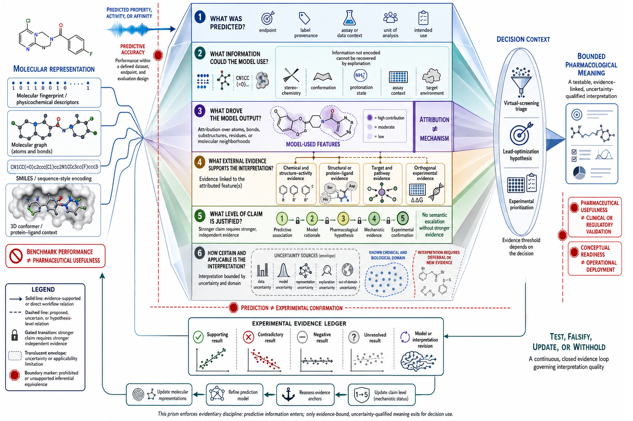
The internal logic of the theory consists of six connected conditions. First, prediction-object specification identifies the endpoint, unit of analysis, data-generating context, and intended use. Second, representation traceability documents the molecular and biological information available to the model. Third, attribution faithfulness tests whether the explanation reflects actual predictive dependence rather than a chemically persuasive narrative. Fourth, independent evidence anchoring links attributed features to structural, chemical, target, assay, or literature evidence. Fifth, uncertainty qualification records predictive, model, data, explanation, and out-of-domain uncertainty. Sixth, decision-context alignment determines whether the resulting interpretation is sufficient for a particular screening, optimization, or experimental-prioritization decision. This separation is necessary because the plausibility of an explanation does not establish its faithfulness to the predictor [18]. Figure 1 presents the evidence-constrained molecular interpretation prism, showing how the article’s key components and boundaries are connected within evidence-constrained interpretability: proposed concepts and definitions.
|
|
|
Figure 1. Evidence-Constrained Molecular Interpretation Prism. |
The figure is an original conceptual synthesis that organizes the article’s central contribution across predictive accuracy versus pharmacological understanding, molecular representations, attribution methods, and the limits of post hoc explanation, molecular representations, attribution methods, the limits of post hoc explanation, evidence-constrained interpretability: proposed concepts and definitions. Arrows and grouping indicate proposed or evidence-supported relationships rather than measured effect sizes. The figure does not represent a validated predictive model, regulatory determination, clinical recommendation, or deployment-ready system.
The theory also rejects the assumption that its conditions can be collapsed into one universal interpretability score. An explanation could be faithful to a predictor yet unsupported by biological evidence, stable across retraining yet based on a biased endpoint, chemically plausible yet irrelevant to the intended decision, or useful for compound triage yet insufficient for a mechanistic claim. Explainability evaluation is therefore multidimensional and purpose-dependent rather than reducible to one metric [19]. Evidence-constrained interpretability should be applied as a structured scientific argument: each inferential step must be inspectable, its evidence source must be identifiable, uncertainty must remain visible, and unsupported steps must be marked as hypotheses. The theory is proposed as a basis for future testing and comparison, not as a validated checklist or certification system.
Linking Molecular Features to Targets, Mechanisms, and Decision Context
The transition from a molecular feature to a target-related interpretation begins with a distinction between predictive relevance and physical or biological participation. Sequence-based drug–target affinity models can learn associations between compound and protein encodings that support affinity prediction [20]. Such performance demonstrates that predictive structure exists in the input data, but it does not independently establish which atomic interaction occurs, whether the predicted relation survives assay transfer, or whether the feature highlighted by an explanation contributes causally to binding. Evidence-constrained interpretation therefore treats affinity prediction as one evidentiary layer. Structural observations, biochemical assays, mutagenesis, competition studies, selectivity profiles, and related evidence occupy separate layers that may strengthen, qualify, contradict, or overturn the model-derived hypothesis.
Interpretable compound–protein models can generate attention patterns connecting molecular substructures with protein residues, thereby offering candidate hypotheses about interaction determinants [21]. Graph-convolutional models likewise encode local molecular and protein structure for drug–target interaction prediction [22]. These methods can make a prediction more scientifically inspectable, but inspectability should not be confused with mechanistic confirmation. A residue or substructure identified by the model may correlate with activity because it represents direct interaction, scaffold membership, physicochemical context, analogue density, or a dataset-specific regularity. The interpretation becomes stronger only when independent evidence discriminates among those possibilities.
Graph-based affinity models further illustrate the difference between representation-level improvement and pharmacological explanation. Molecular graphs may improve prediction by preserving atom–bond neighborhoods that are obscured in simpler encodings [23]. Nevertheless, the semantic meaning assigned to a learned graph feature remains conditional on the endpoint, training distribution, target representation, and explanation method. Evidence-constrained interpretability therefore requires a feature-to-evidence chain: the molecular feature must first be shown to influence the prediction, then connected to an independently supported target-related relation, and finally classified according to whether the evidence supports association, binding hypothesis, mechanistic participation, or experimental confirmation. Skipping any link risks converting a model rationale into an unsupported pharmacological narrative.
Decision context determines how complete that chain must be. A feature explanation used to diversify compounds selected for screening may require evidence of predictive faithfulness, applicability, and uncertainty, while a claim about binding mechanism requires substantially stronger structural and experimental support. Unified drug–target prediction libraries demonstrate that representations, architectures, training resources, and task choices materially affect model outputs [24]. The theory therefore makes interpretation conditional on the decision being supported, the alternatives under consideration, the cost of error, and the availability of confirmatory experiments. The same explanation may be admissible for low-consequence triage, insufficient for lead-series design, and unacceptable as evidence of target mechanism. Pharmacological meaning is consequently not an intrinsic property of the explanation; it is a bounded relation among the model, external evidence, and the scientific decision.
Evaluating Faithfulness, Stability, Uncertainty, and Pharmacological Usefulness
Evaluation should first determine whether an explanation is faithful to the prediction it purports to explain. In molecular property prediction, uncertainty methods vary in how well they calibrate confidence, rank likely errors, and identify cases requiring caution [25]. A comparable principle applies to explanations: a chemically intuitive attribution is not necessarily faithful, and a faithful attribution is not necessarily pharmacologically valid. Faithfulness can be examined through model-sensitive perturbation, feature removal, local surrogate fidelity, retraining, and comparison with known model dependencies. Molecular validity must be preserved during such tests because deleting atoms, breaking aromatic systems, or generating implausible analogues may measure response to invalid inputs rather than response to a scientifically meaningful intervention.
Stability addresses whether similar predictions produce similar interpretations under changes that should not alter the scientific conclusion. Relevant tests include retraining with different initializations, bootstrapping the data, changing equivalent molecular encodings, varying conformers, and examining matched molecular pairs. Scalable uncertainty methods exhibit different task-dependent strengths and weaknesses, making method selection itself part of the evaluation problem [26]. In drug design, predictive confidence must also be distinguished from calibrated uncertainty arising from noise, model limitations, sparse chemical coverage, and distribution shift [27]. Explanation stability and uncertainty should therefore be evaluated jointly: a stable explanation may still be systematically wrong, while an unstable explanation may reveal that apparently confident predictions rest on poorly determined internal rationales.
The available uncertainty literature indicates that calibration, scalability, and interpretation cannot be represented by a single confidence value [25-27]. Evidence-constrained interpretability extends this observation by proposing an interpretive uncertainty profile containing at least four elements: uncertainty in the prediction, uncertainty arising from the molecular representation, uncertainty in the explanation method, and uncertainty in the external evidence used to support a pharmacological claim. Evidential approaches can jointly model molecular predictions and uncertainty and may assist prioritization when their assumptions and calibration are made explicit [28]. They do not, however, establish that the explanation is mechanistically correct. Uncertainty qualification should modify the permissible strength of the interpretation rather than function as a decorative confidence interval around an otherwise unbounded claim.
Pharmacological usefulness is the most application-dependent evaluation dimension. It asks whether the explanation improves a defined scientific decision compared with prediction alone, conventional chemical reasoning, or another appropriate baseline. Molecular counterfactuals can identify local structural changes associated with altered predictions and thereby clarify model sensitivity [29]. Their usefulness depends on chemical validity, accessibility, applicability to the relevant series, and whether the contrast suggests an informative experiment. A useful explanation may reveal a model shortcut, identify an analogue that distinguishes competing hypotheses, expose an out-of-domain prediction, or justify deferral. User satisfaction or visual plausibility is insufficient. Evaluation should instead examine whether the interpretation improves hypothesis quality, experimental discrimination, error detection, compound selection, or justified refusal to act.
Implications for Virtual Screening, Lead Optimization, and Experimental Prioritization
In virtual screening, evidence-constrained interpretability can help distinguish ranking efficiency from evidentiary significance. Deep-learning-assisted docking can reduce the number of compounds subjected to computationally intensive evaluation and thereby expand the chemical space that can be searched [30]. The resulting predictions remain prioritization devices rather than proof of binding, potency, selectivity, or therapeutic value. Interpretability may add value when it reveals why a model favors particular chemotypes, whether those rationales persist across related compounds, and whether the ranked candidates occupy unfamiliar chemical regions. It may also identify cases in which high scores are supported by unstable, biased, or representation-dependent features and should therefore be deprioritized or tested cautiously.
Prospective screening provides a stronger test because computational ranking is closed by synthesis, acquisition, and experimental evaluation. Ultra-large-library docking has produced new chemotypes through workflows in which predictions were followed by empirical testing and characterization [31]. Evidence-constrained interpretation would not replace that closure. It would document which molecular features drove prioritization, what structural or target evidence supported those features, what uncertainty remained, and which observations could falsify the working hypothesis. The objective is not to require mechanistic certainty before screening, but to ensure that a screening explanation is represented as a bounded selection rationale rather than as an established mechanism.
In lead optimization, the theory supports comparison of competing molecular modifications rather than unrestricted acceptance of a feature map. Rapid computational and experimental identification of kinase inhibitors illustrates the potential value of tightly connected design–test cycles [32]. Within such a cycle, explanations may help identify features associated with potency, selectivity, or another modeled endpoint, but optimization decisions must remain multiparametric. A substructure associated with improved predicted activity may simultaneously affect solubility, permeability, metabolic stability, toxicity, synthetic accessibility, or intellectual novelty. Evidence-constrained interpretability therefore requires endpoint-specific evidence and uncertainty, explicit identification of unmodeled objectives, and human review of the tradeoffs introduced by each proposed modification.
Experimental prioritization is the context in which the proposed theory may provide its clearest scientific benefit. Prediction-guided antibiotic discovery has shown that computational prioritization becomes pharmacologically meaningful when candidates undergo extensive biological evaluation [33]. Explainable deep learning has also been used to identify a structurally distinct antibiotic class whose predictions were followed by experimental testing [34]. These examples support the importance of prospective closure, but they do not validate a universal interpretability theory. Under the proposed approach, an explanation should identify the next experiment most capable of separating competing interpretations—for example, an orthogonal assay, a matched molecular pair, a selectivity test, structural analysis, or a target-engagement experiment. Table 2 organizes the evidence, constructs, and interpretation boundaries needed to develop implications for virtual screening, lead optimization, and experimental prioritization within the article’s central argument.
Table 2. Evaluation, implementation, and research priorities arising from From Molecular Accuracy to Pharmacological Meaning An Evidence-Constrained Theory of Interpretable Prediction
|
Component or layer |
Inputs |
Core function |
Expected output |
Uncertainty or limitation |
Validation requirement |
|
Prediction-object specification |
Endpoint definition, labels, assay context, model output, intended use |
Defines what the prediction represents and what it does not represent |
Bounded predictive claim |
Proxy mismatch, label ambiguity, measurement noise |
Independent review of endpoint suitability and data provenance |
|
Representation traceability |
Molecular encoding, preprocessing, conformers, target information, omitted variables |
Identifies what information was available to the model |
Representation record and omission statement |
Encoding dependence and incomplete molecular context |
Robustness testing across scientifically defensible representations |
|
Attribution-faithfulness assessment |
Predictor, explanation method, perturbations, retraining runs |
Tests whether highlighted features materially influence the prediction |
Model-rationale statement |
Correlated features, invalid perturbations, method disagreement |
Model-sensitive and chemistry-preserving faithfulness tests |
|
Independent evidence anchoring |
Structural evidence, SAR, assays, target annotations, literature, negative findings |
Links model-used features to evidence external to the predictor |
Evidence-linked molecular hypothesis |
Sparse, conflicting, or biased evidence |
Orthogonal evidence review and prospective falsification |
|
Mechanistic-status qualification |
Attribution result and external evidence tier |
Distinguishes association, model rationale, hypothesis, mechanism, and confirmation |
Explicit claim-status label |
Ambiguous or mixed evidence |
Predefined criteria for movement between evidence levels |
|
Uncertainty qualification |
Calibration data, ensembles, out-of-domain measures, explanation variance |
Limits reliance on uncertain predictions and explanations |
Case-specific uncertainty profile |
Calibration drift and incomplete uncertainty decomposition |
Evaluation under scaffold, temporal, and distribution shifts |
|
Virtual-screening use |
Ranked molecules, applicability information, feature rationales, assay capacity |
Supports compound selection and diversification |
Bounded screening-priority rationale |
Ranking may exploit artifacts or omit relevant properties |
Prospective comparison with prediction-only and standard workflows |
|
Lead-optimization use |
Confirmed series data, multiparameter endpoints, counterfactual analogues |
Supports generation of testable structural hypotheses |
Prioritized analogue or modification hypothesis |
Activity cliffs, property tradeoffs, synthesizability limits |
Series-specific synthesis and experimental evaluation |
|
Experimental prioritization |
Competing hypotheses, uncertainty, experimental cost, expected discrimination |
Selects experiments that can confirm, revise, or reject interpretations |
Testable next-experiment recommendation |
Information gain may be estimated incorrectly |
Prospective assessment against conventional expert prioritization |
|
Governance and revision |
Versioned evidence, negative results, model updates, human decisions |
Preserves provenance and supports correction |
Auditable interpretation record |
Selective reporting and automation bias |
Independent oversight, challenge procedures, and periodic reassessment |
Limitations and Boundary Conditions
The proposed theory has conceptual limitations. Its components are analytically separable but may interact differently across endpoints, representations, model classes, and discovery organizations. Representation traceability may be relatively straightforward for fixed molecular descriptors and substantially more difficult for multimodal learned embeddings. Independent evidence may be abundant for well-characterized targets but sparse for phenotypic screens, novel targets, or poorly studied chemical matter. Decision-context alignment also depends on institutional resources, available assays, and the consequences of false-positive and false-negative decisions. The theory therefore cannot be assumed to have one universal implementation or one fixed evidence threshold.
The supporting evidence base also has limitations. Much of the available literature evaluates prediction, explanation, uncertainty, or discovery workflows separately rather than testing their integration within a common prospective design. Retrospective benchmarks may not capture temporal changes, project-specific selection pressures, assay transfer, or the compound-quality constraints encountered in real discovery programs. Explainability studies frequently evaluate plausibility, feature recovery, or local sensitivity without establishing improved pharmaceutical decisions. Uncertainty methods are similarly conditional on the evaluated tasks and calibration procedures [27]. These limitations mean that the proposed relations among faithfulness, evidence linkage, uncertainty, and usefulness remain theoretical until tested prospectively.
The theory must not be used to certify a molecular mechanism, clinical benefit, regulatory acceptability, or deployment readiness. It cannot convert weak labels into strong biological evidence, recover information omitted from the representation, eliminate distribution shift, or ensure that human reviewers will identify every misleading explanation. A structured interpretation may still be wrong, and a well-supported molecular hypothesis may fail because of unmodeled pharmacokinetic, toxicological, formulation, synthetic, or biological factors. The theory is intended to constrain claims and organize testing, not to replace medicinal chemistry, structural biology, pharmacology, toxicology, experimentation, or accountable scientific judgment.
Research Agenda and Implementation Priorities
The first research priority is to operationalize pharmacological meaning without reducing it to subjective plausibility. Prospective studies should compare prediction-only outputs, conventional post hoc explanations, and evidence-constrained interpretations in clearly defined tasks such as compound triage, analogue selection, target-hypothesis testing, and assay prioritization. Evaluation should measure whether interpretations improve decision quality, identify model failure, produce more discriminating experiments, or support justified deferral. Studies should preregister the intended decision, evidence thresholds, comparison condition, failure criteria, and handling of negative results. The proposed theory should be revised or rejected when its conditions do not improve scientific reasoning.
A second priority is the development of chemistry- and pharmacology-sensitive evaluation infrastructure. Benchmark resources should include representation variants, matched molecular pairs, activity cliffs, stereochemical alternatives, temporal splits, unfamiliar scaffolds, contradictory assays, and negative controls. Explanation evaluation should distinguish model faithfulness from evidence-link validity and should record disagreement among attribution methods rather than concealing it. Data and explanation provenance should be versioned so that interpretations can be reconstructed after model updates or new experiments. Such infrastructure would support cumulative testing of when an explanation remains stable, when it changes appropriately, and when it creates an unjustified mechanistic narrative.
Implementation should proceed in stages. Initial use should be limited to low-consequence research settings in which explanations are treated as hypotheses, human oversight is available, and all outputs can be challenged. A second stage may incorporate prospective evaluation within defined virtual-screening or optimization workflows, with predefined stopping rules and explicit comparison against existing practice. Broader use should depend on replicated evidence that the approach improves a specified decision without increasing automation bias, workload, or false confidence. At every stage, the implementation record should preserve the prediction, representation, explanation method, evidence links, uncertainty assessment, human decision, experimental outcome, and subsequent revision.
Conclusion
Evidence-constrained interpretability is proposed as a theory for governing the transition from molecular prediction to bounded pharmacological meaning. Its central claim is that predictive accuracy, feature attribution, chemical plausibility, and model confidence are individually insufficient to establish pharmacological understanding. An admissible interpretation must specify the prediction object, trace the molecular representation, demonstrate faithfulness to the predictor, connect attributed features to independent evidence, declare the mechanistic status of each claim, characterize uncertainty, and align the interpretation with a defined discovery decision. The theory does not validate molecular mechanisms, guarantee prospective success, or establish clinical, regulatory, or deployment readiness. Its intended contribution is to make inferential boundaries visible and to convert explanations into testable, revisable scientific hypotheses. By treating interpretation as an evidence-governed practice rather than a visualization endpoint, the proposed theory offers a basis for evaluating when molecular predictions may inform virtual screening, lead optimization, and experimental prioritization—and when the scientifically responsible outcome is to withhold interpretation and obtain additional evidence.
Acknowledgments: None
Conflict of interest: None
Financial support: None
Ethics statement: None