Pharmacophore an International Research Journal
Organ-on-chip systems can generate human-relevant observations of tissue exposure, transport, metabolism, injury, and pharmacodynamic response, yet these observations do not translate directly into predictions of organism-level pharmacology. A measured chip signal remains conditional on device geometry, materials, flow, cell provenance, tissue maturity, exposure history, sampling procedures, and assay interpretation. This article proposes a Mechanistic Translation and Uncertainty Architecture for connecting organ-on-chip evidence with human pharmacology without treating platform performance, biological resemblance, or model fit as sufficient evidence of translational validity. The architecture comprises a structured representation of device and tissue states, a measurement-interpretation layer, mechanistic interfaces linking cellular and tissue processes with physiologically based pharmacokinetic, pharmacokinetic–pharmacodynamic, and quantitative systems pharmacology models, a multimodal calibration layer, an uncertainty ledger, and a context-of-use qualification gate. Its central principle is that translation is a sequence of conditional transformations rather than a direct endpoint mapping. Uncertainty must therefore be identified at its source, propagated across interfaces, and interpreted relative to the intended prediction or decision. Clinical pharmacology observations, quantitative imaging, biomarkers, and omics measurements are positioned as complementary constraints that may expose model discrepancy as well as refine parameters. The proposed architecture is conceptual and has not been empirically validated, clinically qualified, or accepted for regulatory use. Its applicability will depend on organ system, compound properties, biological context, available evidence, and decision consequence. By separating observation from biological state, local mechanism from whole-body behavior, calibration from confirmation, and prediction from decision fitness, the architecture provides a structured basis for evaluating when organ-on-chip signals may contribute to defensible human-pharmacology inference.
Introduction
Organ-on-chip technologies have progressed from specialized microfluidic prototypes toward increasingly sophisticated experimental systems intended to reproduce selected aspects of human tissue physiology, disease, and drug response. Their scientific and commercial development has expanded the range of available tissue models, biological readouts, and potential pharmaceutical applications, but platform maturation does not by itself resolve how an observed response should be translated into human pharmacology [1-3]. A device may reproduce a barrier, metabolic pathway, contractile response, or inflammatory phenotype while still omitting organism-level determinants such as inter-organ exchange, systemic clearance, endocrine regulation, immune trafficking, compensatory physiology, and population variability. The central translational problem is therefore not whether a chip appears biologically realistic in isolation, but whether its outputs can be interpreted within a defensible chain of mechanistic and evidentiary relationships.
This problem is particularly important for computational pharmaceutical science. Quantitative clinical pharmacology offers mathematical structures for linking experimental measurements with human exposure and response, but those structures require clearly defined inputs, physiological assumptions, parameter provenance, and uncertainty characterization [4]. Organ-on-chip measurements cannot simply be inserted into a physiologically based pharmacokinetic or pharmacokinetic–pharmacodynamic model as though they were direct estimates of human organ function. Their meaning depends on how the device modifies transport, binding, residence time, metabolism, tissue accessibility, and signal generation. Computational integration therefore requires an explicit representation of the experimental system that produced each parameter or response trajectory.
Organ-specific microphysiological systems illustrate both the opportunity and the interpretive difficulty. Liver platforms, for example, may provide information about metabolism, accumulation, cellular injury, or functional response, yet the relevance of each output depends on tissue competence, exposure conditions, assay design, and the intended pharmacological question [5]. Similar constraints apply to intestinal, renal, cardiac, vascular, neural, and multi-organ systems. A model that performs adequately for mechanistic interpretation within one device may remain unsuitable for cross-platform comparison, human pharmacokinetic prediction, population extrapolation, or development decision support. Translational usefulness must consequently be evaluated as context-dependent rather than treated as an inherent property of the platform.
This article develops an original Mechanistic Translation and Uncertainty Architecture as a conceptual contribution for organizing organ-on-chip evidence within human-pharmacology modeling. The proposed architecture separates six functions: representation of device conditions, tissue states, and exposure histories; interpretation of measured signals; mechanistic connection across biological scales; calibration with clinical, imaging, biomarker, and omics evidence; propagation of uncertainty; and qualification for a predefined context of use. It does not claim that these components have been validated as a unified system. Instead, it specifies the relationships and boundary conditions that should be examined before chip-derived evidence is used for prediction, comparison, or decision support.
The Translation Gap between Organ-On-Chip Outputs and Human Pharmacology
The translation gap begins with a mismatch between the scale at which an organ-on-chip observation is generated and the scale at which a pharmaceutical inference is desired. A chip typically measures a local event under controlled conditions: disappearance of a compound from a perfusate, appearance of a metabolite, alteration of barrier permeability, release of a biomarker, change in contractility, or development of cellular injury. Human pharmacology, by contrast, concerns systemic exposure, tissue distribution, clearance, temporal response, interindividual variability, and the interaction of multiple organs and regulatory systems. Studies integrating vascularized organ chips, coupled gut–liver platforms, and time-resolved pharmacokinetic–pharmacodynamic measurements show that quantitative translation becomes possible only when inter-organ processing and temporal exposure are modeled explicitly [6-8].
The gap is therefore not a single scaling problem. It comprises at least four distinct inferential transitions: from nominal device input to effective tissue exposure; from measured signal to latent biological state; from local tissue process to organ contribution; and from organ contribution to whole-body behavior. Each transition requires its own assumptions, parameterization, and evidence. Reviews of organ-chip pharmacokinetic applications emphasize that platform configuration, readout selection, physiological relevance, and computational strategy must be aligned with the intended human prediction [9]. An apparently accurate chip endpoint can remain translationally ambiguous when the exposure experienced by the cells, the mechanism generating the signal, or the relationship between the represented tissue and the human organ is insufficiently characterized.
The proposed architecture treats this gap as a sequence of conditional transformations rather than a direct correspondence between chip and patient. The first transformation reconstructs the physical and biological state of the device. The second interprets raw observations through an explicit measurement model. The third introduces mechanistic representations of transport, metabolism, target interaction, tissue response, and inter-organ exchange. The fourth connects those representations with human physiology and population variability. At every stage, discrepancy may arise because the device lacks a relevant process, the experimental state is incompletely observed, the mathematical structure is inadequate, or the target population differs from the biological context represented on the chip. Translation should therefore preserve the provenance and conditionality of every intermediate quantity.
The practical significance of this formulation is that technological availability cannot be equated with translational readiness. Broad dissemination remains constrained by platform variability, standardization, reproducibility, usability, and the absence of universally accepted validation procedures [10]. The architecture accordingly requires evidence to be organized around the intended claim rather than around the sophistication of the device or model. Table 1 organizes the evidence, constructs, and interpretation boundaries needed to develop the translation gap between organ-on-chip outputs and human pharmacology within the article’s central argument.
Table 1. Evidence domains, core questions, scientific requirements, and interpretation boundaries for the translation gap between organ-on-chip outputs and human pharmacology
|
Construct or evidence domain |
Core question |
Scientific basis |
Role in the article |
Failure or overclaiming risk |
Boundary statement |
|
Device-to-exposure relationship |
What concentration and exposure trajectory actually reached the tissue? |
Material partitioning, fluid transport, residence time, binding, diffusion, sampling loss, and recirculation determine effective exposure |
Establishes the physical input to the biological system |
Nominal concentration is treated as equivalent to free, local, or intracellular exposure |
A specified administered concentration does not alone establish tissue exposure |
|
Signal-to-state interpretation |
What biological quantity is represented by the measured signal? |
Assay selectivity, calibration, temporal resolution, normalization, controls, and observation models determine signal meaning |
Separates raw observation from inferred biological state |
A reproducible signal is assumed to be mechanistically specific |
Measurement reproducibility does not establish biological specificity |
|
Tissue-state adequacy |
Does the tissue possess the functions required for the intended inference? |
Cell provenance, composition, maturation, viability, phenotype, barrier function, metabolic capacity, and disease state affect response |
Defines the biological domain to which the chip output applies |
Morphology or marker expression is substituted for functional evidence |
Biological resemblance is insufficient without purpose-relevant functional characterization |
|
Organ contribution |
How does the represented tissue process contribute to organ-level disposition or response? |
Tissue mass, blood flow, transport, metabolism, secretion, turnover, and regulatory feedback determine organ contribution |
Provides the first mechanistic scaling interface |
A local rate or response is extrapolated without physiological normalization |
A tissue-level process does not automatically represent total-organ function |
|
Inter-organ integration |
How do absorption, distribution, metabolism, elimination, and response interact across organs? |
Sequential processing, circulating metabolites, protein binding, systemic transport, and feedback connect organ functions |
Links isolated chip outputs with organism-level behavior |
Independent organ outputs are combined without accounting for dynamic coupling |
Whole-body pharmacology cannot be reconstructed by simple addition of isolated endpoints |
|
Temporal translation |
Are exposure and response histories represented at compatible time scales? |
Accumulation, adaptation, delayed response, turnover, recovery, and repeated dosing create path-dependent behavior |
Connects chip trajectories with pharmacokinetic and pharmacodynamic dynamics |
Single-time-point endpoints are interpreted as complete exposure–response relationships |
Endpoint similarity does not establish temporal equivalence |
|
Population transportability |
To which human population or disease context could the modeled relationship apply? |
Donor biology, genetics, disease, age, organ function, comedication, and environmental factors modify disposition and response |
Defines the external domain of the proposed inference |
Results from one donor or tissue state are generalized to heterogeneous populations |
Internal model fit does not establish cross-population transportability |
|
Context of use |
What question will the integrated evidence be used to answer? |
Evidence requirements differ for interpretation, comparison, prediction, and decision support |
Determines the required degree of verification, validation, uncertainty analysis, and oversight |
A model qualified for a narrow task is reused for a higher-consequence purpose |
Credibility for one use cannot be transferred automatically to another |
|
Evidence convergence |
Do independent evidence streams support the same mechanistic interpretation? |
Chip data, clinical observations, imaging, biomarkers, omics, and prior physiological knowledge constrain different model components |
Reduces reliance on a single platform or metric |
Agreement is claimed after calibrating all evidence through the same assumptions |
Convergent fit is informative only when evidence streams retain meaningful independence |
|
Uncertainty propagation |
How does uncertainty change as information moves from device to human output? |
Measurement, biological, parameter, structural, scaling, scenario, and decision uncertainties accumulate and interact |
Prevents model confidence from being mistaken for calibrated translational certainty |
Only parameter standard errors or fitting uncertainty are reported |
Narrow numerical intervals do not establish comprehensive uncertainty calibration |
Representing Device Conditions, Tissue States, and Exposure Histories
The first operational requirement of the proposed architecture is a translational state representation that remains attached to every chip-derived observation. Device materials are especially important because polymers, tubing, adhesives, membranes, and coatings can absorb or adsorb compounds, producing substantial differences between nominal concentration and the exposure available to cells [11]. Geometry, surface area, compartment volume, recirculation, flow, shear, oxygenation, and sampling position likewise influence residence time and spatial concentration gradients. A chip result that is reported without these conditions loses information needed to reconstruct the physical process through which the tissue encountered the compound.
Representation must also include the design and biological choices that define the experimental system. Guidance for organ-chip development emphasizes that device architecture, cell sources, extracellular matrices, operating protocols, functional criteria, and intended applications should be described together rather than as separable technical details [12]. In the proposed architecture, these descriptors form a device-condition state rather than supplementary metadata. They are treated as model variables, covariates, or provenance attributes according to their expected influence. This approach does not imply that every descriptor must appear in every equation; it requires that potentially influential conditions remain visible, testable, and available for sensitivity or transportability analysis.
Tissue state must be represented as a dynamic biological condition rather than a fixed label such as “liver,” “kidney,” or “heart.” Multi-organ systems containing matured tissue niches demonstrate that cell composition, tissue organization, vascular coupling, and functional maturation can materially shape inter-tissue communication [13]. Tissue representation should therefore include donor provenance, cell-type composition, differentiation status, maturation, viability, barrier integrity, metabolic or secretory competence, inflammatory state, disease induction, and temporal stability. These properties determine which mechanisms are available to generate the observed response. Their documentation does not prove equivalence with a human organ, but it identifies the biological domain within which model parameters and conclusions may remain interpretable.
Exposure history completes the state representation by describing how the biological system was perturbed over time. Development guidelines for liver microphysiological systems support fit-for-purpose characterization of functional performance and operating conditions rather than reliance on an isolated endpoint [14]. Reproducibility studies further show that metabolism, accumulation, and toxicity can behave as distinguishable properties and should not be inferred from one another [15]. The proposed architecture consequently records dosing route, timing, duration, repeat exposure, washout, nominal and free concentrations, local concentration estimates, sampling losses, metabolite appearance, and recovery periods. This time-resolved representation is necessary because identical terminal measurements may arise from different exposure trajectories, adaptation states, or accumulated tissue burdens. It also provides the initial conditions required for the mechanistic bridges developed in the next section.
Mechanistic Bridges from Chip Responses to Organism-Level Behavior
A mechanistic bridge converts a chip-derived observation into an organism-level hypothesis by defining the processes that connect local tissue behavior with systemic exposure or response. Physiologically based pharmacokinetic modeling provides one candidate structure because it represents organs as physiologically parameterized compartments connected through blood flow, transport, metabolism, and elimination. When integrated cautiously with organ-on-chip evidence, such models may translate measured permeability, intrinsic clearance, secretion, uptake, or tissue-partitioning behavior into conditional whole-body scenarios [16]. The bridge is not a generic scaling coefficient. It is an explicit set of equations, assumptions, parameter transformations, and physiological constraints that identifies what is transferred from the device, what is supplied from independent human knowledge, and what remains uncertain.
The required bridge depends on the pharmacological question. A renal chip intended to inform drug disposition, for example, may provide evidence about epithelial transport, secretion, reabsorption, or metabolism, but those measurements must still be normalized, connected to renal physiology, and integrated with distribution and nonrenal clearance. Modeling of opioid disposition using a kidney proximal-tubule microphysiological system illustrates how an organ-specific experimental system can contribute to a bounded mechanistic extrapolation without representing the entire organism [17]. The appropriate interpretation is therefore that the device informs selected model components under specified conditions, not that the chip independently predicts human pharmacokinetics.
The proposed architecture organizes mechanistic translation through cross-scale interface contracts. Each interface specifies the exchanged variable, unit, temporal resolution, spatial interpretation, parameter provenance, and applicable conservation rule. Device-scale transport may supply local exposure to a cellular uptake model; the cellular model may supply metabolic or target-engagement rates to a tissue model; the tissue model may contribute organ-level parameters to a PBPK or PK–PD representation. Computational simulation can also be used in the opposite direction to examine whether chip geometry, sampling schedules, or perturbations are capable of distinguishing competing mechanistic explanations [18]. These bidirectional relationships make experimental design and model construction mutually informative rather than treating computation as a final extrapolation step.
Mechanistic detail alone does not establish credibility. A biologically elaborate model can reproduce observed data through compensating parameter errors, unidentifiable mechanisms, or assumptions that do not remain valid outside the calibration domain. Confidence in PBPK applications depends on the intended purpose, physiological plausibility, data quality, verification of implementation, parameter support, evaluation against relevant observations, and transparent characterization of uncertainty [19]. The proposed mechanistic bridge should therefore remain modular and challengeable. Alternative structures should be retained when evidence cannot distinguish them, and each human-level output should preserve a traceable connection to the chip states, external physiological evidence, and assumptions from which it was derived.
Uncertainty Propagation across Biological and Modeling Scales
Uncertainty enters before a chip experiment begins and changes as evidence moves through the translation architecture. Experimental uncertainty includes device-to-device variability, donor heterogeneity, assay error, batch effects, incomplete exposure measurement, and temporal sampling limitations. Modeling introduces additional uncertainty in parameters, initial conditions, physiological scaling, structural assumptions, population distributions, and scenario definitions. Bayesian PBPK methods provide a formal means of representing parameter knowledge through prior and posterior distributions and of carrying that uncertainty into predicted outputs [20]. However, a posterior interval is only as comprehensive as the model structures, likelihood assumptions, and discrepancy terms used to construct it.
Sensitivity analysis serves a related but distinct purpose. It asks which inputs and assumptions drive variation in model outputs and whether influential parameters interact nonlinearly across biological scales. Global sensitivity analysis can reveal that uncertainty attributed to one organ process depends on simultaneous variation in transport, binding, metabolism, or physiology elsewhere in the model [21]. Sensitivity should not be interpreted as proof that an influential parameter is biologically causal or accurately estimated. Instead, it identifies where additional evidence, better measurement, or structural revision may have the greatest effect on the output relevant to the intended use.
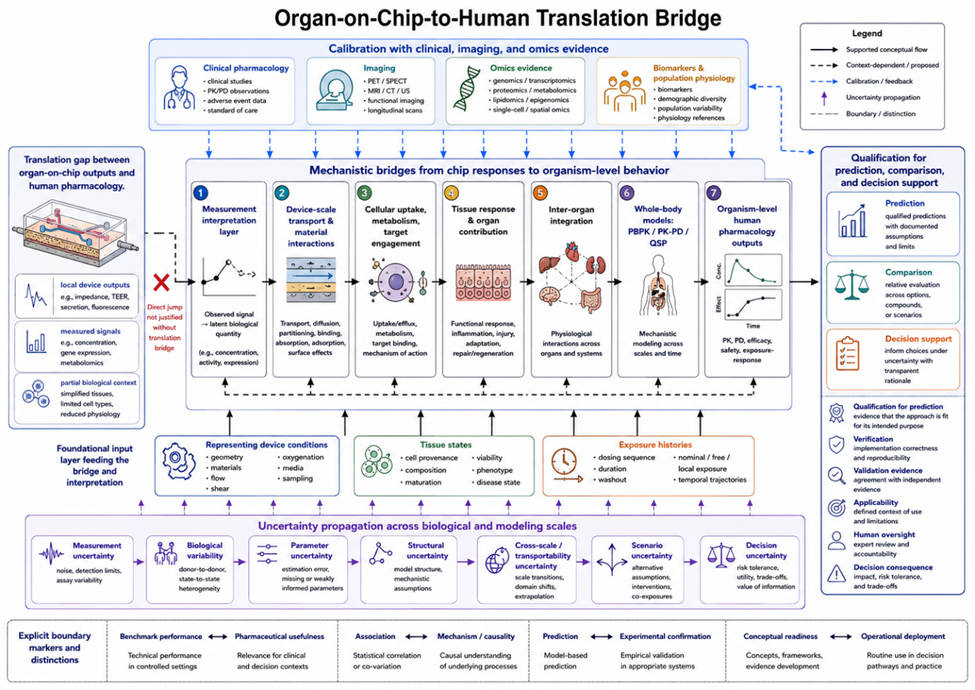
The proposed architecture therefore uses an uncertainty ledger that accompanies each transformation from device signal to human-pharmacology output. The ledger distinguishes measurement uncertainty, biological variability, parameter uncertainty, structural uncertainty, cross-scale uncertainty, transportability uncertainty, scenario uncertainty, and decision uncertainty. Systems-model evaluation frameworks support assessing purpose, structure, data, behavior, and prediction as separate dimensions rather than compressing credibility into one performance statistic [22]. Parameter interpretation must also be conditioned on structural and practical identifiability, because apparently precise estimates may remain nonunique or weakly informed by the available evidence [23]. Figure 1 presents the organ-on-chip-to-human translation bridge, showing how the article’s key components and boundaries are connected within uncertainty propagation across biological and modeling scales.
|
|
|
Figure 1. Organ-on-Chip-to-Human Translation Bridge. |
The figure is an original conceptual synthesis that organizes the article’s central contribution across translation gap between organ-on-chip outputs and human pharmacology, representing device conditions, tissue states, and exposure histories, representing device conditions, tissue states, exposure histories, mechanistic bridges from chip responses to organism-level behavior. Arrows and grouping indicate proposed or evidence-supported relationships rather than measured effect sizes. The figure does not represent a validated predictive model, regulatory determination, clinical recommendation, or deployment-ready system.
The ledger should record both the magnitude and ownership of uncertainty. Measurement uncertainty may belong primarily to an assay model, whereas scale-transfer uncertainty may arise at the interface between an in-vitro rate and a human organ parameter. Structural uncertainty may require alternative models rather than wider parameter distributions, and decision uncertainty may depend on available alternatives and the consequences of error rather than on prediction variance alone. These categories can interact: incomplete tissue-state measurement can create parameter uncertainty, which may then be misinterpreted as biological variability or hidden within an apparently well-calibrated population model. The architecture therefore treats uncertainty propagation as a scientific argument about what is known, assumed, and unresolved, not merely as the numerical production of confidence intervals.
Calibration with Clinical, Imaging, and Omics Evidence
Calibration connects the mechanistic architecture with observations that are closer to the human pharmacological context of interest. Clinical pharmacokinetic and pharmacodynamic data can update parameters, challenge scaling assumptions, and reveal population-specific discrepancies. Translational learning across clinical studies shows how mechanistic models may be revised as evidence accumulates across patient populations rather than being treated as fixed extrapolation devices [24]. In the proposed architecture, clinical calibration is therefore iterative. It can strengthen a chip-informed mechanism, expose missing physiology, or demonstrate that a parameter derived from one experimental state does not transport to the intended population.
Quantitative imaging provides an orthogonal source of information because it can constrain anatomical distribution, tissue exposure, target engagement, or temporal occupancy in vivo. Positron emission tomography has been used in drug development to connect molecular properties, central nervous system exposure, and target-related measurements with clinical pharmacology questions [25]. Imaging signals nevertheless require their own observation models, tracer assumptions, spatial resolution limits, and corrections. They should not be treated automatically as direct measurements of therapeutic drug concentration or pharmacological effect. Their value lies in constraining selected model components that cannot be identified from plasma concentrations or chip measurements alone.
Patient-derived experimental systems, biomarkers, and clinically grounded phenotypes may further improve the relevance of organ-chip interpretation. Human biomimetic liver systems have been discussed as potential bridges between drug development and precision-medicine questions, particularly when biological variability and patient context are represented explicitly [26]. The architecture uses such evidence bidirectionally. Clinical observations can guide the choice of chip phenotype or perturbation, while chip experiments may help interpret why a clinical subgroup differs from an average response. This relationship remains hypothesis-generating unless matched or prospectively aligned evidence demonstrates that the experimental mechanism transports to the human context.
Omics evidence can support mechanistic parameterization when it measures quantities that correspond to model components. Quantitative proteomics, for example, may inform the abundance of drug-metabolizing enzymes and transporters used in absorption, distribution, metabolism, and excretion models [27]. Yet abundance is not equivalent to catalytic activity, membrane localization, regulatory state, or net physiological contribution. Transcriptomic, proteomic, metabolomic, and related measurements must therefore be connected to the model through explicit biological assumptions and observation functions. The architecture treats omics as a constraint on plausible parameter states and mechanisms, not as an automatic substitute for functional evidence or clinical confirmation.
Qualification for Prediction, Comparison, and Decision Support
Qualification asks whether the integrated evidence is adequate for a stated use. It is distinct from calibration, because a model may fit available observations while remaining unsuitable for an external prediction or consequential decision. It is also distinct from general platform validation, because the same chip and modeling system may be adequate for interpreting a controlled experiment but inadequate for predicting human tissue exposure, comparing compounds across devices, or supporting a development decision. The context of use must specify the scientific question, target output, comparator, relevant population, user, decision consequence, and acceptable residual uncertainty.
Credibility assessment in model-informed drug development is risk-informed and context-dependent. It requires consideration of verification, validation evidence, applicability, uncertainty, biological plausibility, and the consequence of an incorrect model-informed conclusion [28-30]. The proposed architecture consequently rejects a binary distinction between “validated” and “unvalidated” models. Qualification is represented instead as a bounded argument linking the intended use to evidence that the device state is adequately characterized, the measurement model is defensible, the mechanistic bridge is appropriate, uncertainty has been propagated, and relevant external evidence has challenged the resulting output.
The depth of evaluation should increase with model influence and decision consequence. A model used to select additional sampling times may require evidence that it reproduces device transport and identifies informative parameters. A model used to compare compounds requires stronger evidence of comparable exposure, tissue state, assay behavior, and rank robustness. A model used to generate human predictions requires external clinical constraints, population-relevant physiology, and calibrated predictive uncertainty. Decision support adds the need to compare the model with existing alternatives and to examine the consequences of false reassurance, false rejection, or incorrect prioritization. Risk and evidentiary cost must therefore be balanced rather than subjected to one universal validation recipe [31].
The proposed qualification gate produces a use-specific credibility statement rather than an approval label. Its output should identify the supported claim, applicable conditions, evaluation evidence, known failure modes, unresolved uncertainties, human-review requirements, and prohibited interpretations. Table 2 organizes the evidence, constructs, and interpretation boundaries needed to develop qualification for prediction, comparison, and decision support within the article’s central argument.
Table 2. Evaluation, implementation, and research priorities arising from From Organ-on-Chip Signals to Human Pharmacology through Mechanistic Translation, Uncertainty Propagation, and Multiscale Modeling
|
Component or layer |
Inputs |
Core function |
Expected output |
Uncertainty or limitation |
Validation requirement |
|
Translational state representation |
Device geometry, materials, operating conditions, tissue provenance, phenotype, exposure history, assay context, and provenance |
Preserves the conditions under which every chip-derived observation was generated |
Structured, traceable state description linked to each measurement and parameter |
Important variables may remain unmeasured or incorrectly assumed constant |
Independent metadata audit, protocol reconstruction, and testing of influential state variables |
|
Measurement interpretation |
Raw assay signals, controls, calibration information, sampling times, detection limits, and normalization rules |
Maps observed signals to latent biological quantities |
Interpreted biological measurements with an explicit observation model |
Assay bias, nonspecificity, censoring, drift, and batch effects |
Orthogonal assays, repeatability studies, calibration checks, and observation-model evaluation |
|
Device-scale physical model |
Material properties, flow, geometry, binding, diffusion, and sampling configuration |
Reconstructs local and time-varying exposure within the device |
Estimates of free, local, or tissue-accessible exposure |
Sorption, spatial gradients, unknown transport properties, and imperfect mass balance |
Physical measurements, mass-balance checks, concentration mapping, and cross-device testing |
|
Tissue-state model |
Cellular composition, maturation, viability, barrier function, metabolism, secretion, and disease state |
Specifies the biological mechanisms available to generate the response |
Purpose-specific tissue characterization and functional state |
Donor variability, phenotypic drift, incomplete tissue complexity, and limited observation |
Functional perturbation tests, longitudinal stability assessment, and comparison with relevant human tissue evidence |
|
Mechanistic multiscale bridge |
Chip-derived rates, physiological knowledge, PBPK structure, PK–PD relationships, and QSP mechanisms |
Connects local processes with organ and whole-body behavior |
Conditional human exposure or response hypotheses |
Parameter non-identifiability, structural discrepancy, and uncertain scale transfer |
Code verification, physiological plausibility checks, identifiability analysis, and external predictive evaluation |
|
Cross-scale interface contracts |
Exchanged variables, units, time scales, conservation assumptions, and parameter provenance |
Ensures coherence between device, cellular, tissue, organ, and organism models |
Traceable transformations between model levels |
Hidden unit conversion, incompatible abstractions, and omitted states |
Dimensional analysis, conservation checks, interface stress testing, and independent implementation review |
|
Multimodal calibration |
Clinical PK–PD, imaging, biomarkers, quantitative proteomics, other omics, and population physiology |
Constrains parameters and tests whether mechanisms remain compatible with human evidence |
Updated model distributions and documented discrepancies |
Data streams may be sparse, biased, nonindependent, or mechanistically ambiguous |
Prespecified observation models, posterior predictive assessment, residual analysis, and external challenge data |
|
Uncertainty ledger |
Measurement error, biological variability, priors, alternative structures, population scenarios, and decision consequences |
Identifies, assigns, and propagates uncertainty through the architecture |
Output distributions accompanied by source-specific uncertainty statements |
Unknown mechanisms and domain shift may remain outside modeled uncertainty |
Coverage assessment, sensitivity analysis, alternative-structure comparison, and prospective uncertainty evaluation |
|
Transportability assessment |
New devices, laboratories, donors, compounds, diseases, and patient populations |
Tests whether modeled relationships persist outside the calibration domain |
Defined applicability domain and detected effect modifiers |
Average performance may hide systematic failure in specific contexts |
Cross-platform, multisite, subgroup, and domain-shift evaluation |
|
Experimental-interpretation qualification |
Complete state representation, local mechanism, controls, and measurement uncertainty |
Determines whether a chip response supports a bounded mechanistic interpretation |
Statement of compatibility with specified mechanisms |
Association may be mistaken for causal confirmation |
Mechanism-discriminating perturbations and independent replication |
|
Compound-comparison qualification |
Harmonized device states, comparable exposure, reference compounds, and rank uncertainty |
Determines whether relative differences are interpretable |
Conditional compound comparison under standardized assumptions |
Differences in free exposure or tissue function may drive apparent ranking |
Replication, robustness analysis, cross-platform assessment, and prespecified comparison criteria |
|
Human-prediction qualification |
Whole-body model, human physiology, external clinical evidence, and population uncertainty |
Determines whether a model can support a defined human prediction |
Bounded exposure or response prediction with applicability conditions |
Calibration-domain similarity may overstate prospective performance |
External human observations, prospective evaluation where feasible, and calibrated predictive uncertainty |
|
Decision-support qualification |
Qualified prediction, explicit alternatives, decision thresholds, consequences, and governance |
Assesses whether model evidence can contribute to a development decision |
Documented recommendation input with human ownership |
A numerical output may acquire authority beyond its evidentiary basis |
Independent scientific review, error-consequence analysis, comparison with existing practice, and auditable decision records |
|
Evidence provenance and governance |
Data lineage, protocol versions, parameter sources, code versions, assumptions, and review records |
Enables reconstruction, challenge, and responsible use |
Auditable evidence chain and version-controlled qualification statement |
Undocumented transformations or changing use cases undermine credibility |
Independent reproducibility audit, change control, and reassessment after material modifications |
Limitations and Boundary Conditions
The proposed Mechanistic Translation and Uncertainty Architecture is a conceptual organization of translational modeling requirements rather than an empirically validated platform. It does not demonstrate that organ-on-chip systems improve compound selection, predict clinical pharmacokinetics, identify effective doses, reduce development failure, or improve patient outcomes. Its components are supported individually by selected organ-chip, pharmacometric, imaging, omics, and credibility literature, but their integration into one architecture remains proposed. The architecture should not be interpreted as evidence that all relevant biology can be represented mathematically or that uncertainty can be reduced to a complete numerical distribution.
The available evidence is heterogeneous across organs, devices, compounds, biological sources, and intended applications. Liver, intestinal, renal, vascular, cardiac, and neural systems differ in maturity, readout quality, scaling requirements, and access to corresponding human observations. Platform reproducibility and standardization remain unresolved in many settings [10]. PBPK and systems models may also contain plausible but non-identifiable structures, and confidence principles developed for established pharmacometric applications cannot be transferred automatically to a new chip-informed use [19]. Identifiability assessment may reveal that existing experiments cannot distinguish the parameters or mechanisms required for the intended translation [23].
Misuse could occur if conceptual completeness is mistaken for prediction readiness. A well-documented state representation does not establish physiological equivalence; a mechanistic model does not establish causality; calibration does not establish external validity; and quantified uncertainty does not guarantee that all important sources of error have been included. Credibility frameworks can organize evidence, but qualification remains case-specific and dependent on decision consequence [29]. The architecture therefore cannot establish regulatory acceptability, clinical utility, individualized treatment suitability, universal platform comparability, or operational deployment readiness. Such determinations require independent evidence and accountable review within the relevant scientific, clinical, and regulatory context.
Research Agenda and Implementation Priorities
The first research priority is to determine the minimum translational state representation required for different pharmacological questions. Prospective studies should vary device materials, flow conditions, tissue maturity, exposure schedules, and measurement strategies to identify which descriptors materially affect translation. Reporting practices should attach machine-readable device, tissue, exposure, assay, and provenance records to every modeled output, extending current guidance on organ-chip development and characterization [12]. Multisite experiments should then examine whether the same state representation enables reconstruction and comparison across laboratories rather than merely improving documentation within one platform.
The second priority is to design experiments around mechanistic discrimination and uncertainty reduction. Simulation should be used before experimentation to identify sampling schedules, perturbations, and measurements capable of distinguishing alternative transport, metabolic, or response mechanisms [18]. Bayesian estimation can represent prior knowledge and update uncertainty as evidence accumulates [20], while global sensitivity analysis can identify influential parameters and interactions [21]. These tools should be combined with identifiability analysis, explicit model-discrepancy terms, and prospective external evaluation. The aim should not be to maximize retrospective fit, but to determine whether chip-derived evidence adds identifiable and transportable information beyond existing in-vitro and clinical sources.
The third priority is staged implementation tied to context of use. Early applications should focus on reconstructing device exposure, interpreting within-chip mechanisms, and improving experimental design. More demanding stages should evaluate compound comparison, cross-platform transportability, and externally tested human predictions. Clinical, imaging, biomarker, and omics evidence should be incorporated through prespecified observation models rather than informal comparison, with translational learning used to update mechanistic assumptions as new human evidence becomes available [24]. Quantitative omics should be connected to functional parameters only when the abundance-to-activity relationship is justified [27]. Progression toward decision support should require a risk-proportionate credibility argument, explicit human oversight, version control, and reassessment whenever the model, device, target population, or intended use changes [28].
Conclusion
The proposed Mechanistic Translation and Uncertainty Architecture reframes organ-on-chip translation as a chain of conditional, testable transformations rather than a direct correspondence between a chip endpoint and human pharmacology. Its contribution is to keep device conditions, tissue states, exposure histories, measurement processes, mechanistic models, calibration evidence, uncertainty, and decision context connected within one traceable structure. The architecture separates biological resemblance from functional adequacy, association from mechanism, model fit from external prediction, and prediction from decision fitness. It is intended to guide theory building, experimental design, model evaluation, reporting, and future validation, not to claim that any chip-informed model is clinically, regulatorily, or operationally qualified. Its value will ultimately depend on prospective evidence showing that explicit state representation, mechanistic interfacing, multimodal calibration, and uncertainty propagation improve the reliability and interpretability of specific translational uses.
Acknowledgments: None
Conflict of interest: None
Financial support: None
Ethics statement: None