Pharmacophore an International Research Journal
Generative artificial intelligence in pharmaceutical science is commonly evaluated through its capacity to create novel molecular structures, yet therapeutic design depends on a wider evidence environment that includes protein sequence and conformation, cellular and multi-omics states, biomedical images, scientific text, target context, and experimental observations. The resulting literature is heterogeneous in terminology, model architecture, generated output, conditioning strategy, and validation depth, making conventional effect synthesis inappropriate and encouraging potentially misleading comparisons between representation learning, prediction, generation, and therapeutic development. This scoping review maps how multimodal generative approaches are defined, implemented, and evaluated across pharmaceutical data modalities. The review uses transparent eligibility, study-selection, data-charting, and terminology-mapping principles to distinguish modality integration from cross-modal generation and to separate demonstrated model capability from benchmark performance, experimental confirmation, translational value, and routine pharmaceutical readiness. The synthesis identifies a field with comparatively mature methods for molecular generation, emerging experimental evidence for protein design, developing applications in perturbational omics, and primarily enabling roles for biomedical images and scientific text. It further distinguishes conditioning, alignment, fusion, and cross-modal decoding as related but non-equivalent operations. An original review-derived taxonomy and evidence-maturity interpretation are proposed to organize these approaches; neither is presented as empirically validated. Major limitations include narrow reference datasets, inconsistent definitions of validation, limited external testing, weak causal grounding, sparse negative evidence, and insufficient connection between computational outputs and prospective therapeutic decisions. Multimodal generative systems may broaden therapeutic design beyond molecule creation, but their scientific value remains conditional on claim-matched evaluation, experimentally grounded validation, transparent provenance, and explicit boundaries between computational plausibility and pharmaceutical usefulness.
Introduction
Artificial intelligence now contributes to numerous stages of pharmaceutical research, including target identification, molecular representation, virtual screening, structure-based analysis, candidate optimization, and development planning. However, the expansion of computational capability has not produced a uniform level of scientific or translational evidence. Drug-design systems operate within workflows in which chemical novelty must be reconciled with biological relevance, experimental tractability, medicinal-chemistry judgment, and downstream development constraints. Computational acceleration therefore cannot be interpreted independently of the evidence used to define the target, condition the design process, and validate the resulting intervention [1-3].
The dominant account of generative pharmaceutical artificial intelligence has nevertheless remained centered on the creation of small-molecule structures. This focus is understandable because chemical representations are comparatively standardized, large molecular datasets are available, and generated outputs can be assessed using established syntax, similarity, property, and docking-based procedures. Yet a therapeutically meaningful design problem begins before a candidate structure is generated. It includes the selection of disease-relevant biological states, the interpretation of target evidence, the identification of context-dependent mechanisms, and the specification of the intervention that should alter those states. AI-supported target discovery illustrates why candidate generation must be connected to disease biology, multi-omics evidence, and the uncertainty surrounding target–phenotype relationships [4].
Multimodal foundation models offer a possible route toward this broader conception by learning across images, language, sequences, structured measurements, and other data types. Their importance lies not merely in accommodating several inputs but in potentially connecting complementary forms of evidence that describe a therapeutic problem at different scales. Nevertheless, cross-modal representation, retrieval, or task transfer does not itself establish that a model can generate a therapeutically useful intervention. Generalist medical models demonstrate the feasibility of broad multimodal learning while also showing that capability is shaped by data availability, task formulation, validation setting, and intended use [5]. These distinctions are especially important in pharmaceutical science, where a plausible generated output may remain unsynthesizable, biologically inactive, unsafe, non-developable, or irrelevant to the decision for which it was produced.
The unresolved problem is therefore both technical and evidentiary: the literature lacks a sufficiently clear synthesis of what “multimodal generation” means across molecular, protein, omics, image, and text domains, how modalities condition or interact within generative systems, and what validation is required before outputs can influence therapeutic research. This scoping review maps the breadth, terminology, methods, application contexts, evidence maturity, and unresolved gaps in multimodal generative therapeutic design. Its central contribution is an evaluative taxonomy that separates modality integration, representation alignment, conditional generation, fusion, and cross-modal decoding while distinguishing computational validity from experimental confirmation and pharmaceutical relevance. The taxonomy is proposed as an organizing synthesis rather than a validated ontology or deployment framework.
Scoping-Review Objectives and Eligibility Framework
The review was structured using PRISMA-ScR-compatible reporting logic, with explicit articulation of the review questions, eligibility concepts, information sources, study-selection principles, charting fields, and synthesis approach [6]. The primary objective was to determine how generative artificial intelligence has been used, or credibly proposed for use, in therapeutic design when more than one pharmaceutical data modality contributes to the representation, conditioning, transformation, or evaluation of an output. Secondary objectives were to map the terminology used for multimodality, identify the therapeutic objects being generated or transformed, characterize the validation attached to those outputs, and locate areas in which representation or prediction has been described as generation without sufficient methodological justification. The review was not designed to estimate a pooled treatment, prediction, or model-performance effect.
A scoping design was selected because the available literature spans heterogeneous scientific objects, model families, data structures, application stages, and validation settings. The relevant questions concern the boundaries and distribution of evidence rather than the comparative effectiveness of a single intervention or method. Guidance distinguishing scoping from conventional systematic reviews supports this approach when the purpose is to clarify concepts, map evidence types, examine how research is conducted, and identify knowledge gaps [7]. Accordingly, eligibility was based on conceptual relevance to multimodal therapeutic generation rather than on the availability of a common outcome measure. Formal meta-analysis, pooled benchmark rankings, and numerical aggregation across incompatible tasks were outside the review scope.
Eligibility was operationalized around three linked concepts: multimodality, generation, and therapeutic design. Multimodality required either the use of distinct data forms—such as molecular graphs, protein sequences, three-dimensional structures, omics measurements, images, or text—or clearly differentiated representational channels that contributed non-redundant information. Generation required the creation, reconstruction, editing, transformation, or counterfactual proposal of an output rather than classification or prediction alone. Therapeutic design required a defensible connection to targets, interventions, candidate properties, biological states, experimental hypotheses, or pharmaceutical decisions. Because scoping-review conduct allows iterative refinement when emerging terminology reveals previously unrecognized evidence categories, definitions could be clarified during charting provided that every refinement remained documented and was applied consistently [8].
Study selection was designed to retain empirical investigations, methodological studies, benchmark analyses, and sufficiently detailed critical or conceptual articles when they directly supported the review questions. Prediction-only studies were charted as contextual evidence only when they clarified a necessary enabling modality, validation boundary, or terminology distinction. Studies were not treated as equivalent merely because they used the label “multimodal,” and quality appraisal was used to calibrate interpretation rather than to impose a single exclusion threshold across incompatible evidence types. Practical scoping-review guidance supports documented screening roles, iterative charting, and transparent resolution of classification uncertainty [9]. The final synthesis therefore maps the nature and boundaries of the evidence rather than claiming comprehensive effect estimation or uniform methodological quality, consistent with the formal definition of scoping reviews as evidence-mapping exercises [10]. Table 1 organizes the evidence, constructs, and interpretation boundaries needed to develop scoping-review objectives and eligibility framework within the article’s central argument.
Table 1. Evidence domains, core questions, scientific requirements, and interpretation boundaries for Scoping-review objectives and eligibility framework
|
Evidence domain |
Eligible evidence or method |
Reported capability or claim |
Strength of support |
Reproducibility or bias concern |
Unresolved gap |
|
Scoping-review methodology |
Reporting guidance, methodological guidance, transparent review procedures, and explicit charting frameworks |
Heterogeneous evidence can be mapped without implying pooled-effect certainty |
Strong methodological support |
Incomplete reporting of eligibility refinement or charting decisions may reduce reproducibility |
Limited consensus on appraisal methods for rapidly evolving generative-model evidence |
|
Multimodal representation |
Models integrating distinct molecular, biological, imaging, or textual data types |
Complementary modalities can be embedded, related, or jointly analyzed |
Moderate to strong for representation tasks |
Paired-data scarcity, batch effects, modality imbalance, and hidden dependence can distort shared representations |
Representation quality is rarely linked prospectively to therapeutic decisions |
|
Generative operation |
Creation, reconstruction, editing, transformation, or counterfactual proposal of an output |
Models can generate candidates or transformed states under stated conditions |
Uneven across output types |
Terminology may conflate generation with prediction, interpolation, retrieval, or imputation |
No generally accepted cross-domain definition of therapeutic generation |
|
Therapeutic relevance |
Target-conditioned design, intervention proposals, perturbational state generation, protein design, or decision-support hypotheses |
Generated outputs may contribute to therapeutic research |
Strongest for bounded molecular and protein tasks; emerging elsewhere |
Proxy objectives may not represent potency, mechanism, safety, developability, or clinical utility |
Few studies connect generated outputs to prospective pharmaceutical decisions |
|
Experimental confirmation |
Synthesis, structural assessment, binding assays, functional experiments, cellular testing, or other physical validation |
Selected generated outputs can exhibit measurable physical or biological properties |
Strong when predefined experiments are reported; otherwise limited |
Positive-result selection, narrow assay contexts, and absence of independent replication |
Sparse experimental validation across image-, text-, and omics-conditioned generation |
|
External validity |
Evaluation on new targets, datasets, cohorts, laboratories, temporal settings, or modality combinations |
Model capability may generalize beyond the development data |
Generally limited and application-specific |
Similarity leakage and non-independent splitting can inflate apparent generalization |
Few locked-model, cross-site, or prospective evaluations |
|
Evidence maturity |
Explicit distinction among conceptual, computational, external, experimental, and prospective evidence |
Studies can be compared according to validation depth rather than a single performance metric |
Proposed review-level synthesis |
Maturity categories may simplify heterogeneous development pathways |
The proposed maturity interpretation requires future testing and refinement |
|
Interpretation boundary |
Claim-matched distinctions between association, prediction, generation, mechanism, experimental confirmation, and therapeutic utility |
Evidence can support bounded conclusions without implying deployment readiness |
Strong conceptual necessity |
Promotional terminology and inconsistent definitions of validation encourage overstatement |
Shared reporting language for multimodal therapeutic generation remains underdeveloped |
Search, Study Selection, Data Charting, and Modality Taxonomy
The search strategy was designed to retrieve literature at the intersections of generative modeling, pharmaceutical or therapeutic design, and heterogeneous data modalities. Search concepts covered molecular and structure-based generation, protein design, perturbational and multi-omics modeling, image–language systems, scientific-text conditioning, multimodal alignment, modality fusion, cross-modal generation, evaluation, reproducibility, and translational boundaries. Information sources, complete search strings, field restrictions, limits, deduplication procedures, and supplementary searching should be reported in sufficient detail for reconstruction, in accordance with PRISMA-S principles [11]. Search sensitivity was prioritized over reliance on the term “multimodal,” because relevant studies frequently describe their methods as target-conditioned, structure-guided, protein-aware, text-guided, multi-view, paired-modal, or joint-representation models.
Study selection proceeded through title-and-abstract assessment followed by full-text eligibility review using the operational definitions of multimodality, generation, and therapeutic design. During charting, each study was assigned separate fields for input modality, generated or transformed output, conditioning variable, alignment mechanism, fusion level, model family, therapeutic context, evaluation endpoint, external-validation status, experimental confirmation, and stated limitation. This structure was necessary because multimodal data integration can involve shared latent factors, modality-specific factors, or adaptive cell-level relationships without generating a therapeutic output. Multi-omics factor models and multimodal single-cell integration methods demonstrate several such representational strategies and therefore provide a basis for distinguishing integration from generation [12-14].
The proposed modality taxonomy contains five primary input domains: molecular representations; protein sequences and structures; omics and cellular states; biomedical images; and scientific or biomedical text. Studies can receive more than one input label and more than one output label, preventing systems that combine modalities from being forced into a single category. A second coding axis distinguishes representation, retrieval, prediction, imputation, editing, unconditional generation, conditional generation, and cross-modal decoding. A third axis records whether modalities are connected through early fusion, intermediate representation alignment, cross-attention or related conditional interaction, late decision fusion, or tool-mediated orchestration. These categories are review-derived analytical devices rather than empirically validated architectural classes. Their purpose is to make heterogeneous evidence comparable while preserving the central boundary that access to multiple modalities does not itself establish multimodal generation, and multimodal generation does not itself establish therapeutic usefulness.
Generative Design Using Molecular, Protein, Omics, Image, and Text Inputs
Molecular generation remains the most technically developed component of the evidence base. Continuous latent chemical representations allow molecular structures to be encoded, sampled, reconstructed, and optimized with respect to learned or externally specified properties [15]. This capability demonstrates that chemical design can be formulated as navigation through a learned representation rather than only enumeration from fixed libraries. Its therapeutic interpretation is nevertheless conditional. Molecular validity, reconstruction accuracy, novelty, or predicted property improvement does not establish target engagement, synthetic accessibility, selectivity, metabolic stability, toxicity, formulation feasibility, or clinical value. Molecular generation should therefore be treated as candidate proposal under bounded computational assumptions rather than as completed therapeutic design.
Protein generation broadens the output space from chemical graphs to macromolecular sequence, conformation, and function. Diffusion-based protein design has demonstrated the capacity to generate three-dimensional structures and selected functional configurations that can be evaluated experimentally [16]. Compared with purely in silico molecular benchmarks, physical expression, structural assessment, or functional testing provides a stronger evidentiary bridge between generated representation and biological object. Even so, success remains design- and assay-specific. A generated protein that adopts an intended structure may still face challenges involving stability, immunogenicity, manufacturability, pharmacokinetics, tissue distribution, or context-dependent activity. The evidence supports experimentally testable protein generation, but not universal therapeutic-protein readiness.
Omics-based generation differs because the generated object may be a biological state rather than a discrete therapeutic candidate. Latent generative models have been used to predict perturbation-associated single-cell states by learning transformations across observed cellular conditions [17]. Such approaches may help organize hypotheses about how cells respond to interventions, identify response heterogeneity, or prioritize experiments. Their interpretation requires particular caution because a generated transcriptomic state may reflect interpolation within correlated data rather than a causal simulation of treatment response. Generalization to new cell types, disease states, doses, combinations, temporal trajectories, or measurement platforms must therefore be assessed separately from reconstruction or held-out prediction performance.
Biomedical images and scientific text currently function more often as contextual, conditioning, or alignment modalities than as independently validated therapeutic generators. Visual–language foundation models in computational pathology show that image and text representations can be aligned and transferred across diagnostic or descriptive tasks [18]. This may support therapeutic design indirectly by linking morphology with disease context, biomarker hypotheses, or response phenotypes. Text can also provide descriptions of targets, desired properties, mechanisms, or constraints. However, neither a shared image–text embedding nor a linguistically plausible design explanation establishes that the corresponding therapeutic hypothesis is experimentally valid. Table 2 organizes the evidence, constructs, and interpretation boundaries needed to develop generative design using molecular, protein, omics, image, and text inputs within the article’s central argument.
Table 2. Components, relationships, uncertainties, and validation needs within Generative design using molecular, protein, omics, image, and text inputs
|
Approach or application |
Data and task context |
Evaluation practice |
Evidence maturity |
Translational limitation |
Review interpretation |
|
Latent molecular generation |
Molecular graphs or strings with property labels or optimization objectives |
Chemical validity, novelty, reconstruction, distribution similarity, and predicted properties |
Established computational benchmark evidence |
Proxy objectives do not establish synthesis, biological activity, safety, or developability |
The most mature generative domain, but still predominantly candidate-proposal technology |
|
Structure-conditioned ligand generation |
Molecular outputs conditioned by target shape, pocket, or structural features |
Structural compatibility, docking-related assessment, chemical filters, and selected assays |
Computationally mature with limited experimental extension |
Scoring functions and structural assumptions may be exploited or incomplete |
More therapeutically contextualized than unconditional generation, but not sufficient evidence of efficacy |
|
Protein structure and function generation |
Protein sequence and three-dimensional design tasks |
Structural prediction, expression, physical characterization, binding, or functional testing |
Computational and experimental evidence in selected settings |
Generalization across therapeutic functions and development constraints remains uncertain |
Strong evidence that generative design can extend beyond small molecules |
|
Omics-state generation |
Single-cell or multi-omics states before and after perturbation |
Reconstruction, held-out condition prediction, latent-state comparison, and biological annotation |
Emerging retrospective evidence |
Confounding, sparse perturbation coverage, batch effects, and weak causal identification |
Useful for hypothesis generation and experiment prioritization, not a validated causal simulator |
|
Image-conditioned therapeutic reasoning |
Histopathology, microscopy, or phenotype images linked to language or molecular context |
Retrieval, classification, representation transfer, and association with downstream labels |
Stronger for representation than direct generation |
Images often provide indirect evidence and may contain site-specific artefacts |
Primarily an enabling modality for context and stratification |
|
Text-guided generation or editing |
Scientific descriptions, property instructions, target information, or conversational prompts |
Instruction following, molecule retrieval, editing success, and computational property checks |
Emerging computational evidence |
Semantic compliance may conceal chemical, biological, or evidentiary errors |
Text is a useful control interface but should not be treated as an authoritative evidence source |
|
Multimodal therapeutic hypothesis generation |
Combined molecular, biological, imaging, omics, and textual evidence |
Coherence, traceability, expert review, and experimental follow-up |
Predominantly conceptual or early-stage |
No common standard links cross-modal coherence to improved pharmaceutical decisions |
Promising review-level category requiring prospective validation |
Conditioning, Alignment, Fusion, and Cross-Modal Generation
Conditioning refers to the use of an auxiliary signal to steer generation toward a desired target, property, structure, phenotype, or design constraint. In structure-based ligand design, three-dimensional target information can guide molecular generation toward candidates compatible with a specified binding environment [19]. Conditioning therefore differs from unconditional sampling because it imposes a task-relevant context on the output distribution. Its scientific value depends on whether the conditioning variable is reliable, sufficiently informative, and linked to the claimed therapeutic objective. A model may comply with a geometric or textual condition while failing to satisfy unmodeled biological, pharmacokinetic, or safety requirements.
Alignment establishes correspondence between modalities without necessarily combining all information into one representation or producing a new therapeutic object. Molecule–text models can place chemical structures and textual descriptions in related spaces, supporting retrieval and text-guided molecular editing [20]. Alignment may facilitate communication between scientific language and chemical representation, but it does not prove that the textual concept has been translated into the intended mechanism. The underlying descriptions may be incomplete, ambiguous, generated from weak annotations, or correlated with superficial structural features. Alignment should consequently be evaluated through bidirectional retrieval, editing fidelity, perturbation tests, and evidence traceability rather than through semantic similarity alone.
Fusion combines information from more than one modality and may occur before encoding, within intermediate representations, or after modality-specific outputs have been produced. Early fusion can expose a model directly to concatenated or jointly tokenized inputs, whereas intermediate fusion allows cross-attention or shared latent interaction after modality-specific encoding. Late fusion combines predictions, rankings, or decisions rather than raw representations. Conversational molecular systems illustrate an additional tool-mediated form in which language instructions coordinate molecular generation, retrieval, or editing operations [21]. Such systems may improve accessibility, but apparent conversational fluency must remain separate from scientific grounding, uncertainty communication, and reproducible control over the generated output.
Cross-modal generation is the most demanding category because one or more input modalities are used to create an output in another representational domain. A target-aware chemical language model, for example, can condition molecular generation on protein information and submit selected candidates to experimental assessment [22]. This provides stronger evidence than text-only or benchmark-only generation, while remaining bounded by the targets, datasets, assays, and candidate-selection procedures studied. The review therefore proposes that cross-modal generation be reported with four separate descriptors: the source modality, the generated modality, the conditioning or fusion mechanism, and the validation level. This proposed reporting structure is intended to prevent a shared embedding, retrieval result, or prediction from being mislabeled as therapeutic generation.
Evaluation of Controllability, Validity, Novelty, and Therapeutic Relevance
Evaluation begins with model-level questions but should not end there. Benchmarking frameworks for molecular generation assess dimensions such as chemical validity, uniqueness, novelty, distribution learning, and optimization against specified objectives. They improve comparability across methods but can also reveal that models exploit benchmark definitions, objective functions, or reference distributions in ways that produce favorable metrics without corresponding therapeutic quality [23-25]. Controllability should therefore mean more than movement in a requested numerical direction. It should include reproducible compliance with explicit constraints, preservation of non-target properties, robustness to prompt or condition variation, and evidence that the control signal relates to the intended scientific objective.
Validity is multidimensional. Representational validity concerns whether an output can be parsed or physically instantiated; chemical validity concerns valence and structural rules; biological validity concerns whether the intervention affects the relevant system; and therapeutic validity concerns whether the effect is useful under realistic disease and development conditions. Evaluation guidance for chemical machine learning emphasizes that test design, splitting strategy, baseline selection, applicability analysis, and reported uncertainty should match the scientific claim and intended use [26]. A model evaluated only on internal benchmark samples should not be described using language that implies external generalization or prospective pharmaceutical usefulness.
Novelty is also an incomplete criterion. Structural dissimilarity from a training set may indicate that a generated candidate is not an exact duplicate, but it does not establish that the candidate occupies a useful or previously inaccessible region of therapeutic space. Excessive novelty may reduce synthesizability, assay compatibility, or confidence in learned property estimates, while low apparent novelty may still yield meaningful optimization within a validated chemical series. The appropriate question is therefore whether novelty contributes to a scientifically justified design objective without moving the output beyond the model’s reliable domain. Similar reasoning applies to proteins, cellular states, images, and text-derived hypotheses, for which novelty must be interpreted relative to modality-specific constraints.
Therapeutic relevance requires a hierarchy of evidence that extends beyond computational scoring. At minimum, evaluation should identify the intended decision, the comparator, the conditioning evidence, the model’s applicability domain, and the consequences of failure. Stronger evidence may include external datasets, temporal or scaffold-aware evaluation, independent experimental confirmation, comparison with established design strategies, and prospective influence on candidate selection. Model confidence should not be treated as calibrated uncertainty, and expert approval of a plausible output should not be treated as validation. Table 3 organizes the evidence, constructs, and interpretation boundaries needed to develop evaluation of controllability, validity, novelty, and therapeutic relevance within the article’s central argument.
Table 3. Components, relationships, uncertainties, and validation needs within Evaluation of controllability, validity, novelty, and therapeutic relevance
|
Claim category |
Supporting evidence type |
Consistency across sources |
Quality concern |
What can be concluded |
What remains uncertain |
|
Generated outputs are computationally valid |
Syntax, valence, reconstruction, structural checks, or model-based plausibility |
Relatively consistent within molecular benchmarks |
Validity definitions differ across modalities and may be permissive |
Outputs can satisfy specified representational rules |
Whether they can be synthesized, expressed, or function biologically |
|
Generation is controllable |
Property conditioning, target conditioning, prompt compliance, or constrained optimization |
Supported in bounded tasks |
Models may exploit proxy objectives or ignore unmeasured constraints |
Outputs can be shifted toward selected computational conditions |
Whether control persists under new targets, datasets, or experimental conditions |
|
Generated sets are novel |
Distance from reference sets, scaffold analysis, or sequence dissimilarity |
Commonly reported for molecular generation |
Novelty depends on representation and reference-set construction |
Outputs may differ from indexed training examples |
Whether novelty is useful, safe, synthesizable, or therapeutically meaningful |
|
Benchmark performance is comparable |
Shared datasets, metrics, baselines, and task definitions |
Improved by benchmark platforms |
Dataset overlap, tuning practices, and metric selection may distort comparison |
Methods can be compared under stated benchmark conditions |
Whether ranking transfers to real discovery programs |
|
Generated candidates are biologically relevant |
Binding, activity, perturbation, functional, or phenotype evidence |
Uneven across domains |
Positive-result selection and narrow assay contexts |
Selected outputs may exhibit reported biological effects |
Generality, mechanism, selectivity, durability, and in vivo relevance |
|
Multimodal integration improves design |
Ablations, retrieval, prediction, editing, or generation with multiple inputs |
Emerging and task-dependent |
Improvements may arise from additional information rather than meaningful cross-modal reasoning |
Multiple modalities can improve selected computational tasks |
Whether multimodality improves prospective therapeutic decisions |
|
Models generalize |
External, temporal, scaffold-aware, target-held-out, or cross-site evaluation |
Limited and inconsistent |
Leakage and hidden similarity can inflate apparent transfer |
Some systems retain capability outside internal random splits |
Reliability under genuine pharmaceutical distribution shift |
|
Systems are therapeutically ready |
Prospective decisions, experimental programs, and development outcomes |
Sparse |
Readiness terminology is inconsistently defined |
Selected systems may support bounded research tasks |
Routine clinical, regulatory, or operational readiness |
Evidence Gaps beyond Small-Molecule Creation
The clearest evidence gap is the imbalance between mature molecular-generation benchmarks and the comparatively limited validation of protein-, omics-, image-, and text-centered generation. Even within chemical modeling, apparent generalization may reflect the similarity structure of established datasets rather than transferable learning. Ligand-based benchmarks can reward memorization when training and test examples remain chemically related [27]. This concern extends to multimodal systems because paired modalities may share hidden identifiers, source-specific artefacts, duplicated entities, or near-neighbor biological contexts. Random splitting is therefore insufficient whenever the intended claim concerns new targets, diseases, scaffolds, cohorts, laboratories, or modality combinations.
A second gap concerns the distance between reported computational capability and actual pharmaceutical decisions. Critical analyses of AI in drug discovery emphasize that retrospective model performance does not establish impact unless outputs are compared with credible alternatives, assessed prospectively, and connected to a decision that matters [28]. Beyond small molecules, this requirement becomes more complex because the output may be a designed protein, predicted cellular state, pathology-grounded hypothesis, or language-mediated intervention proposal. Each object requires a different validation chain. A common readiness label would obscure these differences and encourage false equivalence across modalities.
Data suitability is a third limitation. Chemical and biological datasets vary in assay protocol, measurement quality, missingness, selection bias, temporal relevance, and compatibility with the intended use [29]. Multimodal models may magnify these problems because combining data does not remove uncertainty; it can propagate errors across representations or allow one dominant modality to overwhelm weaker but clinically important evidence. Missing modalities, contradictory signals, and unbalanced pairing are rarely treated as central evaluation conditions. Moreover, published datasets often underrepresent inactive candidates, failed experiments, manufacturing constraints, toxicity findings, and null biological responses, limiting the ability of generative systems to learn realistic failure boundaries.
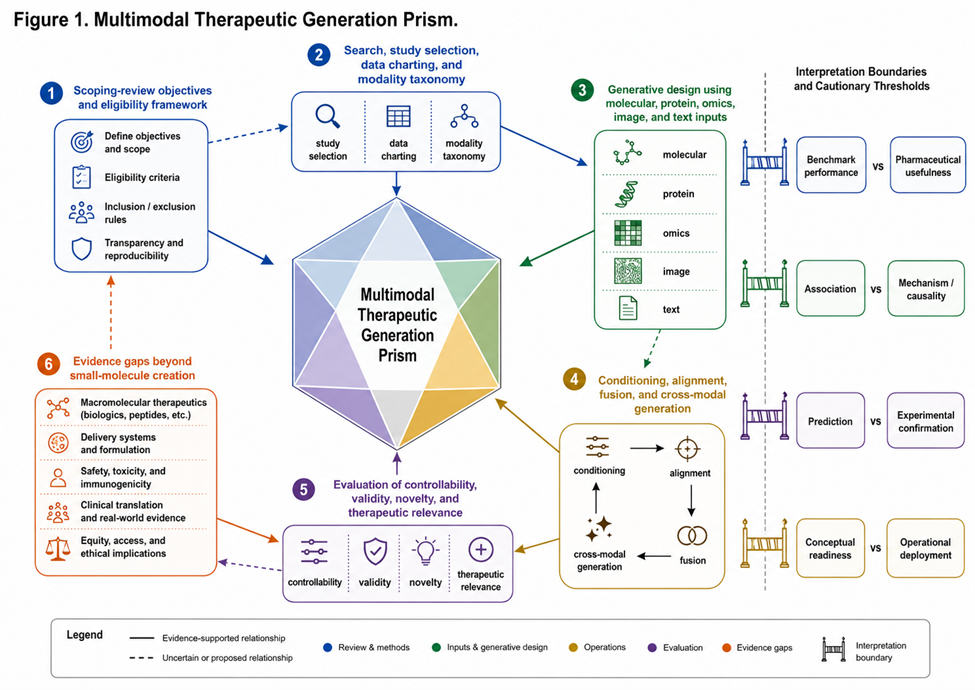
Leakage and reproducibility failures create a fourth cross-cutting gap. Information can pass improperly between training and evaluation through preprocessing, feature selection, duplicated entities, shared experimental batches, target similarity, or post hoc benchmark construction [30]. These risks are especially difficult to detect when multiple encoders, pretrained models, retrieval systems, or external tools contribute to a generated result. Figure 1 presents the multimodal therapeutic generation prism, showing how the article’s key components and boundaries are connected within evidence gaps beyond small-molecule creation.
|
|
|
Figure 1. Multimodal Therapeutic Generation Prism. |
The figure is an original conceptual synthesis that organizes the article’s central contribution across scoping-review objectives and eligibility framework, search, study selection, data charting, and modality taxonomy, study selection, data charting, modality taxonomy, generative design using molecular, protein, omics, image, and text inputs. Arrows and grouping indicate proposed or evidence-supported relationships rather than measured effect sizes. The figure does not represent a validated predictive model, regulatory determination, clinical recommendation, or deployment-ready system.
Priorities for Multimodal Therapeutic Design
The first priority is validation under biologically meaningful distribution shift. Genomic and omics machine learning is vulnerable to confounding, population structure, technical batch effects, dependence among samples, and leakage across related observations [31]. Multimodal generative studies should therefore move beyond random held-out evaluation toward target-held-out, scaffold-aware, cell-type-held-out, temporal, cross-site, and prospectively collected test settings. The selected design should correspond to the intended claim. A system proposed for generating interventions for previously unseen targets requires a stronger evaluation than a system intended to refine candidates within a known series.
The second priority is minimum reporting that enables reconstruction of the evidence chain. Reporting should specify data provenance, preprocessing, modality pairing, missing-data handling, model architecture, pretrained components, split construction, external tools, candidate-selection procedures, validation endpoints, and intended use. Clinical-AI reporting guidance demonstrates the value of explicit documentation of modeling choices, validation, and application context [32]. For generative therapeutic systems, this should be extended to include generated-output lineage, prompt or condition versioning, filtering rules, failed outputs, human interventions, and the evidence used to advance a candidate from computational generation to experimental testing.
The third priority is to separate technical performance from replicability, ethics, scientific effectiveness, and decision benefit. Critical questions developed for health-related artificial intelligence emphasize that high model performance does not resolve whether a system is transparent, reproducible, fair, useful, or effective in practice [33]. Multimodal therapeutic design additionally requires governance of proprietary datasets, sensitive patient-derived modalities, foundation-model provenance, uncertain biological claims, and human authority over experimental escalation. These requirements do not imply that every research prototype needs a clinical governance framework; rather, governance intensity should increase with the consequence of the decision and the proximity of the output to physical or human testing.
The fourth priority is infrastructure that links multimodal data science with experimental discovery. Early-stage drug-discovery roadmaps emphasize governed datasets, shared metadata, interoperable representations, reusable workflows, and integration across scientific teams [34]. Multimodal generation will require these foundations because no model can reliably reconcile molecular, structural, omics, imaging, and textual evidence when identifiers, assay context, version history, and uncertainty are not preserved. Table 4 organizes the evidence, constructs, and interpretation boundaries needed to develop priorities for multimodal therapeutic design within the article’s central argument.
Table 4. Evaluation, implementation, and research priorities arising from Multimodal Generative Artificial Intelligence beyond Molecule Creation A Scoping Review of Therapeutic
|
Research priority |
Evidence gap |
Recommended study or reporting design |
Validation requirement |
Near-term value |
Longer-term significance |
|
Claim-matched external validation |
Internal benchmarks do not establish transfer to new targets, scaffolds, cohorts, or laboratories |
Predefine intended use and use target-held-out, scaffold-aware, temporal, or cross-site evaluation |
Locked-model assessment on genuinely external data |
Reduces exaggerated generalization claims |
Establishes transportable therapeutic-design evidence |
|
Prospective multimodal datasets |
Existing modalities are often weakly paired, retrospectively assembled, or collected under incompatible protocols |
Collect molecular, biological, imaging, omics, textual, and experimental metadata under shared identifiers |
Cross-site replication and missing-modality stress testing |
Improves alignment and fusion quality |
Enables robust cross-modal therapeutic modeling |
|
Perturbational and causal grounding |
Correlated multimodal representations may not predict intervention effects |
Incorporate controlled perturbations, longitudinal measurements, and mechanism-recovery analyses |
Independent experiments testing predicted direction and context of response |
Distinguishes association from intervention-relevant evidence |
Supports causal therapeutic-design models |
|
Experimental validation ladders |
Computational validity is frequently treated as sufficient evidence |
Predefine staged progression from computational checks to synthesis, binding, function, cellular response, and development assessment |
Blinded or independent testing with explicit advancement criteria |
Makes evidence maturity visible |
Links generative systems to reproducible discovery programs |
|
Uncertainty and abstention |
Model scores are often misinterpreted as confidence |
Report calibration, ensemble disagreement, applicability domain, modality conflict, and abstention behavior |
Evaluation under distribution shift and contradictory inputs |
Improves risk-sensitive candidate review |
Supports accountable decision integration |
|
Negative and failed-design data |
Published datasets overrepresent successful or measurable outcomes |
Capture inactive, unsynthesizable, unstable, toxic, and experimentally failed candidates |
Versioned release of negative outcomes and failure reasons |
Improves failure detection |
Produces more realistic generative objectives |
|
Provenance and output lineage |
Generated proposals may depend on opaque pretrained models, prompts, retrieval sources, and filters |
Maintain versioned records of data, models, prompts, tools, selection rules, and human edits |
Independent reproduction from frozen artifacts |
Strengthens auditability |
Enables controlled updating and organizational learning |
|
Human–AI decision studies |
Technical output quality is rarely connected to decision quality |
Compare established workflows with multimodal-assisted workflows using predefined decision tasks |
Prospective assessment of error detection, scientific justification, and decision consequences |
Reveals where models genuinely assist researchers |
Determines practical pharmaceutical value |
|
Contradiction-aware fusion |
Modalities may disagree because of biology, measurement error, or contextual mismatch |
Model modality reliability, discordance, missingness, and context-dependent weighting explicitly |
Stress tests with deliberately incomplete or conflicting inputs |
Prevents unjustified averaging of evidence |
Supports scientifically interpretable multimodal systems |
|
Shared maturity reporting |
“Validation” and “readiness” are used inconsistently |
Report conceptual, computational, external, experimental, and prospective evidence separately |
Independent appraisal against declared maturity criteria |
Improves comparison across studies |
Supports cumulative and defensible field development |
Conclusion
Multimodal generative artificial intelligence expands therapeutic design from the production of chemical structures toward a broader space that includes proteins, cellular states, images, text, targets, and experimentally grounded biological context. The evidence mapped in this scoping review supports distinct capabilities in representation, conditioning, alignment, fusion, editing, and cross-modal generation, but these capabilities are unevenly mature and should not be treated as interchangeable. Molecular generation has the most developed benchmark infrastructure, protein design provides important examples of experimental confirmation, omics generation remains dependent on context and causal assumptions, and image and text modalities currently function primarily as sources of conditioning and evidence. The review’s proposed taxonomy, maturity interpretation, and multimodal therapeutic generation prism are conceptual organizing contributions rather than validated frameworks. Their principal purpose is to separate benchmark success from pharmaceutical usefulness, association from mechanism, prediction from experimental confirmation, and computational plausibility from therapeutic value. Progress will depend less on increasing model scale alone than on prospective multimodal datasets, claim-matched external validation, experimental testing, calibrated uncertainty, transparent provenance, negative evidence, and integration with accountable scientific decisions.
Acknowledgments: None
Conflict of interest: None
Financial support: None
Ethics statement: None