Pharmacophore an International Research Journal
Identifying the proteins that a drug interacts with is essential for understanding its efficacy, selectivity, and safety, yet experimental profiling cannot feasibly screen all possible drug–target pairs across the proteome, highlighting the need for scalable computational prediction. Current in silico models often rely on either ligand-based or protein-based features in isolation, which can overlook complementary information arising from joint modeling of molecular structure and target biology. To address this, we propose a conceptual multimodal deep learning model that learns from molecular graphs on the ligand side and protein sequence embeddings on the target side, enabling prediction of both binding affinity and binary interaction status. The model employs a graph attention network to encode the molecular graph of each compound and a pre-trained protein language model to encode the target sequence, with a bilinear attention mechanism fusing ligand and protein representations into a joint embedding for downstream affinity regression and interaction classification. This approach is expected to deliver strong predictive performance on drug–target interaction benchmarks, generalize to unseen targets through protein language representations, and enhance interpretability via attention maps that highlight pharmacophoric substructures and relevant protein regions. By combining predictive modeling, biological generalization, and interpretable ligand–target reasoning, this multimodal framework has the potential to accelerate drug repurposing, selectivity profiling, and virtual screening.
Introduction
Drug–target interactions define how small molecules influence biological systems, whether by binding orthosteric pockets, modulating allosteric sites, inhibiting catalytic activity, or perturbing signaling pathways. Because experimental screening cannot exhaustively evaluate all possible compound–protein pairs, computational models have become essential for prioritizing candidates before biochemical or cellular validation [1]. Deep learning approaches such as DeepDTA reframed drug–target affinity prediction as a representation learning problem, showing that sequence-derived compound and protein features could be mapped to continuous affinity estimates [1]. Subsequent models extended this direction by incorporating richer molecular and protein encoders to support drug repurposing, selectivity profiling, and virtual screening workflows [2, 3].
The field has evolved from ligand similarity and hand-crafted descriptor methods toward proteochemometric and deep learning models that encode both compound and target information. DeepAffinity introduced a unified neural architecture for compound–protein affinity prediction, emphasizing that both molecular and protein features should contribute to the learned interaction representation [2]. DeepConv-DTI further showed that convolutional modeling over protein sequences could support interaction prediction without requiring experimentally resolved structures [4]. Cross-domain architectures such as DeepCDA then strengthened the idea that ligand and protein encoders should be trained as complementary sources of information rather than as isolated predictors [5].
Graph neural networks and protein language models represent two major advances that motivate the proposed architecture. GraphDTA demonstrated that molecular graphs can improve drug–target binding affinity prediction by learning directly from atom–bond topology rather than relying only on linearized SMILES strings [6]. In parallel, ProtTrans showed that self-supervised protein language models can learn informative sequence representations from large protein corpora, offering a general-purpose alternative to hand-crafted protein descriptors [7]. The remaining architectural challenge is not simply to encode ligands and proteins separately, but to fuse their representations in a way that captures pairwise molecular substructures and protein regions relevant to binding [8, 9].
This manuscript proposes a multimodal deep learning model that combines a graph attention network for ligand encoding with a pre-trained protein transformer for target encoding, followed by cross-modal bilinear attention. Related multimodal models such as MONN, MolTrans, and CoaDTI illustrate the value of modeling local compound–protein interaction patterns rather than relying only on global concatenation [3, 8, 9]. The proposed architecture is therefore model-oriented: it is designed to produce affinity and interaction predictions while also exposing attention maps that can be inspected for medicinal chemistry interpretation. Its intended contribution is a coherent conceptual design for graph-based ligand learning, protein embedding-based target learning, and interpretable multimodal fusion.
Background
Drug–Target Interaction Prediction in Drug Discovery
Drug–target interaction prediction supports several core tasks in computational drug discovery, including target-based lead prioritization, off-target risk assessment, polypharmacology analysis, and drug repurposing. BindingDB, DAVIS, KIBA, DrugBank, BIOSNAP, and related resources are commonly used to train and evaluate models that predict either continuous affinity or binary interaction status [1, 6]. Benchmark-focused studies such as DeepDTA and GraphDTA helped standardize the use of affinity regression settings, while heterogeneous graph frameworks broadened DTI prediction toward network-based drug and target relationships [1, 6, 10]. In practical deployment, a DTI model should therefore be evaluated not only for random-pair prediction, but also for its ability to reason about unfamiliar compounds, under-characterized targets, and clinically relevant off-target interactions [10, 11].
Molecular Graph Representations and Graph Neural Networks
Molecular graph representations treat atoms as nodes and bonds as edges, allowing neural networks to learn from the chemical topology that constrains molecular recognition. Graph neural networks, including graph convolutional networks, graph attention networks, and message-passing neural networks, are well suited to this representation because they aggregate local neighborhood information into atom- and molecule-level embeddings [6]. MGraphDTA showed how multiscale graph modeling can support explainable drug–target affinity prediction, while GraphscoreDTA further emphasized optimized graph learning for protein–ligand binding affinity tasks [12, 13]. These graph-based approaches are especially relevant for ligand encoding because pharmacophoric patterns often emerge from connected substructures rather than from independent molecular descriptors [14].
Protein Sequence Embeddings from Language Models
Protein sequence embeddings derived from pre-trained language models provide contextualized residue representations that can encode evolutionary, structural, and functional regularities from primary sequence alone. ProtTrans demonstrated that large self-supervised protein models can learn representations useful across biological prediction tasks, making them attractive encoders for targets whose structures may be unavailable or incomplete [7]. Models that incorporate protein sequence learning, such as DeepConv-DTI and DeepMHADTA, show that sequence-based encoders can support drug–target prediction without requiring docking-ready protein conformations [4, 15]. More recent contrastive and multimodal approaches further suggest that protein language space can be aligned with compound representations to improve interaction modeling and generalization [11, 16].
Multimodal Fusion Strategies in Deep Learning
Multimodal fusion strategies determine how ligand and protein representations interact inside a predictive model. Early concatenation simply joins global embeddings, while late fusion combines separate prediction streams, but both strategies can underrepresent fine-grained atom–residue dependencies. Attention-based and bilinear mechanisms, as used in MolTrans, FusionDTA, CoaDTI, and MCL-DTI, allow the model to learn cross-modal relationships between molecular substructures and protein sequence regions [8, 9, 17, 18]. These mechanisms are especially important for DTI prediction because binding is not a property of a ligand or target alone, but of their chemically and biologically compatible interaction [19, 20].
Prior DTI Models and the Gap in Interpretable Multimodal Architectures
Prior DTI models provide a foundation for the proposed architecture, but they also reveal a gap between predictive fusion and interpretable biological reasoning. DeepDTA established a sequence-based deep learning baseline, DeepAffinity emphasized interpretability in compound–protein affinity learning, and GraphDTA introduced graph neural networks for ligand representation [1, 2, 6]. Transformer- and attention-based models such as MolTrans, MONN, CoaDTI, and MMDTA advanced multimodal interaction modeling, but many architectures still provide limited residue- and substructure-level interpretability suitable for medicinal chemistry decision-making [3, 8, 9, 21]. The proposed model responds to this gap by centering its design on graph attention, protein language embeddings, and an explicit ligand–protein attention map.
Table 1 compares the major representation strategies used in DTI prediction and clarifies why the proposed model combines molecular graphs, protein embeddings, multimodal attention, and uncertainty-aware reporting.
Table 1. Comparison of Core Representation Strategies for Drug–Target Interaction Prediction
|
Representation strategy |
Drug-side information captured |
Target-side information captured |
Strength |
Main limitation |
|
Sequence-only encoding |
SMILES string patterns |
Amino-acid sequence patterns |
Simple and scalable |
May miss molecular topology and local chemical structure |
|
Descriptor-based encoding |
Hand-crafted molecular descriptors |
Hand-crafted protein descriptors |
Interpretable and computationally light |
Depends heavily on feature engineering |
|
Molecular graph encoding |
Atom–bond topology and substructure relationships |
Usually paired with sequence or structural features |
Captures chemical connectivity directly |
May omit 3D conformation and solvent effects |
|
Protein language-model encoding |
Usually combined with ligand features |
Contextual residue and sequence representations |
Supports transfer to targets without known structures |
Embedding relevance depends on pre-training coverage |
|
Structure-aware encoding |
Molecular geometry or docking-related features |
Protein structure, contact maps, or binding pockets |
Adds spatial interaction context |
Requires reliable structural data and higher computation |
|
Multimodal attention fusion |
Ligand substructures linked to protein regions |
Protein regions linked to ligand features |
Improves interaction-specific reasoning |
Attention must be interpreted cautiously |
|
Uncertainty-aware multimodal encoding |
Drug and target features with reliability estimates |
Confidence-aware target-side predictions |
Helps identify unsupported predictions |
Requires careful calibration and validation |
Model Development Overview
High-Level Model Architecture
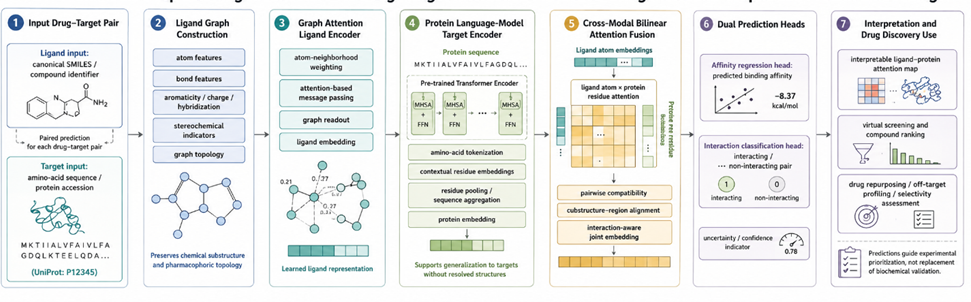
The proposed model accepts a ligand represented by a SMILES string and a target represented by an amino-acid sequence, then transforms each input into a modality-specific neural representation. The ligand branch converts the compound into a molecular graph and applies a graph attention network, following the motivation of GraphDTA and multiscale graph affinity models that learn from chemical topology [6, 12]. The protein branch passes the target sequence through a pre-trained protein transformer, building on the premise that sequence embeddings can encode functional and structural regularities relevant to binding [7, 11]. A bilinear attention fusion module then produces a joint ligand–target embedding that feeds two output heads, one for affinity regression and one for binary interaction classification [17, 18].
Core Input Representations
Ligands are represented as molecular graphs with atom type, degree, formal charge, hybridization, aromaticity, stereochemical indicators, and other chemically meaningful node attributes, while bond type and conjugation define edge features. This design follows graph-based DTI models that treat molecular topology as central to learning ligand representations for affinity and interaction prediction [6, 13]. Proteins are represented as tokenized amino-acid sequences processed by a frozen or fine-tuned transformer encoder, consistent with the use of sequence-based protein representations in DeepConv-DTI, ProtTrans, and contrastive protein language-space modeling [4, 7, 11]. Long or multidomain proteins can be handled through windowing, residue pooling, or hierarchical aggregation so that protein embeddings remain compatible with ligand graph outputs.
Design Principles
The proposed model is multimodal by design, because it explicitly learns from chemical structure and target sequence rather than compressing either modality into hand-crafted descriptors. It is end-to-end trainable, but it can also use frozen protein embeddings when the available DTI labels are limited, a strategy motivated by transfer-oriented protein representation learning [7, 11]. Interpretability is built into the architecture through graph attention and bilinear ligand–protein attention, reflecting the broader movement toward models that expose local interaction signals rather than only final scores [2, 6, 9]. The model is also intended to support cold-start generalization, where unseen drugs or targets must be evaluated using transferable graph and protein representations [14, 22].
Table 2 summarizes the key design priorities that shape the proposed multimodal DTI architecture and explains how each priority contributes to practical drug discovery use.
Table 2. Literature-Informed Design Priorities for the Proposed Multimodal DTI Model
|
Design priority |
Why it matters for DTI prediction |
How the proposed model addresses it |
Added value for drug discovery |
|
Joint ligand–target learning |
Binding depends on compatibility between a molecule and a protein, not either modality alone |
Uses molecular graph encoding and protein sequence embeddings before cross-modal fusion |
Improves prioritization of candidate drug–target pairs |
|
Cold-target generalization |
Many biologically important targets have limited known ligand annotations |
Uses transferable protein language-model embeddings |
Supports screening for under-characterized or orphan targets |
|
Chemical substructure sensitivity |
Pharmacophoric patterns often arise from atom neighborhoods and scaffold-level features |
Uses graph attention over molecular topology |
Helps identify ligand regions relevant to predicted binding |
|
Protein-region sensitivity |
Interaction predictions may depend on specific residues or sequence regions |
Retains residue-level protein embeddings before pooling or attention |
Supports biological interpretation of target-side relevance |
|
Cross-modal interpretability |
Users need more than a final prediction score |
Produces ligand–protein attention maps |
Helps generate medicinal chemistry hypotheses |
|
Uncertainty-aware use |
Predictions outside the training domain can be misleading |
Adds confidence, calibration, or uncertainty reporting |
Prevents overconfident use in experimental prioritization |
|
Deployment readiness |
Practical tools must be usable by non-computational researchers |
Can be implemented as an API or web-service workflow |
Supports scalable virtual screening and repurposing workflows |
Data Sources and Input Representations
Curation of Drug–Target Interaction Data
A conceptual training corpus would combine curated drug–target interaction and affinity records from resources such as BindingDB, DAVIS, KIBA, DrugBank, and related benchmark collections. Models such as DeepDTA and GraphDTA used affinity-oriented benchmarks to frame DTI prediction as a supervised learning task, while heterogeneous graph models incorporated broader drug and target network information [1, 6, 10]. The curation process should standardize chemical identifiers, protein accessions, affinity units, assay types, and duplicate records before assigning pairs to random, cold-drug, cold-target, or cold-pair splits. Such splitting is essential because models may appear effective under random evaluation while struggling when either the ligand or target modality is unseen during training [14, 22].
Ligand Graph Construction
Ligand graph construction begins by converting each canonicalized SMILES string into a two-dimensional molecular graph using cheminformatics software. Atom-level features should include element identity, valence-related descriptors, aromaticity, formal charge, chirality, and hybridization, while bond-level features should encode bond order, conjugation, ring membership, and stereochemical status. This representation is aligned with graph-based DTI models such as GraphDTA, MGraphDTA, and GraphscoreDTA, which use molecular topology to learn affinity-relevant ligand embeddings [6, 12, 13]. Although two-dimensional graphs do not explicitly encode conformation, they provide a computationally efficient ligand representation that can be extended later with conformer-aware features.
Protein Sequence Embedding
Protein sequence embedding can be performed by passing target amino-acid sequences through a pre-trained protein transformer such as ProtBERT or a related sequence language model. ProtTrans established the value of self-supervised protein representation learning, while DTI models using protein sequence encoders showed that sequence information can support interaction prediction even when structures are unavailable [4, 7]. For long proteins, the model can use sequence windowing, residue-level pooling, or domain-aware aggregation to produce embeddings compatible with the ligand encoder. These protein embeddings may be frozen to preserve broad biological priors or fine-tuned when sufficient task-specific DTI data are available [11, 16].
Multimodal Deep Learning Architecture
Ligand Encoder – Graph Attention Network
The ligand encoder uses stacked graph attention layers to update atom embeddings by weighting neighboring atoms according to their learned chemical relevance. This design is consistent with graph-based DTI work showing that molecular graph encoders can capture ligand features more directly than sequence-only compound representations [6, 12]. A global attention readout then aggregates atom embeddings into a fixed-size ligand vector while preserving information about substructures that may act as pharmacophores. Because attention scores remain associated with atoms and neighborhoods, the ligand branch can later contribute to interpretable maps of predicted binding determinants [2, 13].
Protein Encoder – Pre-trained Transformer
The protein encoder tokenizes the target sequence and processes it with a pre-trained transformer to obtain contextual residue-level embeddings. Protein language models such as those described by ProtTrans learn sequence representations that can reflect biological constraints beyond simple amino-acid composition [7]. A lightweight pooling or residue-attention layer converts residue embeddings into a protein-level vector suitable for multimodal fusion, while retaining optional residue-level outputs for interpretability. This approach complements prior DTI models that rely on protein sequence encoders and supports generalization to targets without experimentally resolved structures [4, 15, 11].
Multimodal Fusion and Prediction Heads
The fusion module applies bilinear or cross-attention operations between ligand atom embeddings and protein residue embeddings to construct an interaction-aware joint representation. This strategy follows the motivation of attention-based DTI models such as MolTrans, FusionDTA, CoaDTI, and MCL-DTI, where cross-modal dependencies are modeled more explicitly than in simple concatenation [8, 9, 17, 18]. The resulting ligand–protein interaction map is pooled into a joint embedding and passed to two task-specific heads: one for conceptual binding affinity regression and one for binary interaction classification. This dual-head formulation allows the model to support both affinity-oriented benchmarks and interaction-status prediction without requiring separate architectures [3, 19].
Figure 1 presents the proposed multimodal drug–target interaction architecture, showing how ligand molecular graphs and protein language-model embeddings are fused through bilinear attention to generate affinity predictions, interaction classifications, and interpretable ligand–protein relevance maps.
|
|
|
Figure 1. Multimodal Deep Learning Architecture for Drug–Target Interaction Prediction Using Molecular Graphs and Protein Embeddings |
Table 3 decomposes the proposed multimodal architecture into its ligand, protein, fusion, prediction, and interpretation components, clarifying how each layer contributes distinct computational and drug discovery value.
Table 3. Architecture-Level Mapping of Multimodal Inputs, Encoders, Fusion Logic, and Drug Discovery Outputs
|
Model component |
Primary information captured |
Computational representation |
Function within the proposed DTI model |
Added interpretive value |
Drug discovery relevance |
|
Ligand identity |
Chemical structure of the candidate compound |
Canonical SMILES, compound identifier, standardized molecular record |
Defines the small-molecule entity submitted for prediction |
Ensures traceability between predicted interaction and chemical structure |
Supports virtual screening, analogue prioritization, and compound library triage |
|
Molecular graph construction |
Atom–bond topology and local chemical environment |
Nodes as atoms; edges as bonds; atom features including charge, aromaticity, hybridization, valence, chirality |
Converts ligand input into a learnable graph suitable for message passing |
Preserves chemically meaningful substructures rather than reducing the ligand to global descriptors |
Helps identify pharmacophoric regions and scaffold-level patterns |
|
Graph attention ligand encoder |
Local and global molecular substructure relevance |
Atom embeddings, neighborhood attention weights, graph-level ligand embedding |
Learns ligand representations by weighting chemically informative atom neighborhoods |
Allows atom- or substructure-level attention to be inspected after prediction |
Supports medicinal chemistry reasoning about substituent importance and scaffold modification |
|
Protein sequence input |
Target identity and primary biological sequence |
Amino-acid sequence, protein accession, tokenized residue sequence |
Defines the biological target without requiring experimentally resolved protein structure |
Enables target representation even when structural data are missing or incomplete |
Expands use to under-characterized targets, orphan proteins, and broad proteome screening |
|
Protein language-model encoder |
Contextual residue patterns, evolutionary constraints, and sequence-derived biological regularities |
Pre-trained transformer embeddings, residue-level vectors, pooled protein embedding |
Generates transferable protein representations for interaction prediction |
Allows residue regions or sequence windows to be linked to predicted binding relevance |
Supports cold-target generalization and target-family extrapolation |
|
Cross-modal bilinear attention |
Pairwise compatibility between ligand substructures and protein residues |
Ligand atom × protein residue attention matrix; interaction-aware joint embedding |
Fuses ligand and protein modalities beyond simple concatenation |
Produces an interpretable ligand–target relevance map |
Helps explain why a compound is predicted to interact with a specific protein |
|
Affinity regression head |
Continuous binding-strength estimate |
Predicted affinity score, ranking value, regression output |
Supports quantitative prioritization of drug–target pairs |
Separates relative binding strength from binary interaction presence |
Useful for ranking compounds in target-based screening |
|
Interaction classification head |
Binary interaction status |
Interacting / non-interacting probability or class label |
Supports categorical DTI prediction when affinity labels are unavailable |
Allows model use across heterogeneous datasets with different label types |
Useful for drug repurposing, off-target detection, and interaction discovery |
|
Uncertainty and calibration layer |
Reliability of predicted score or classification |
Confidence value, uncertainty estimate, calibration summary |
Flags predictions requiring caution or experimental confirmation |
Prevents overinterpretation of uncertain or out-of-distribution predictions |
Supports responsible use in experimental prioritization |
Training Strategies and Handling Data Imbalance
Cold-Target and Cold-Drug Split Evaluation
Cold-target and cold-drug evaluation should be treated as a central training and validation principle rather than as an optional robustness check. In these settings, the model is assessed on proteins or ligands that were not observed during training, which better reflects prospective use in orphan target discovery and early-stage screening [14]. Graph co-contrastive and heterogeneous graph learning approaches emphasize that transferable representations are needed when drug or target neighborhoods are sparse or missing [14, 22]. Protein language embeddings can strengthen cold-target evaluation because they provide biologically informed sequence representations even when a target has few annotated ligands [7, 11].
Addressing Highly Imbalanced Interaction Data
Drug–target interaction datasets are often imbalanced because experimentally confirmed interactions are much easier to define than true non-interactions. A conceptual training strategy should therefore combine class-weighted objectives, focal-style losses, calibrated negative sampling, and careful construction of inactive or unknown pairs to reduce bias toward majority labels [10]. Multimodal frameworks such as MGNDTI and MFCADTI support the broader idea that multiple feature sources and attention-based mechanisms can help stabilize learning when interaction evidence is sparse or unevenly distributed [23]. For affinity regression, the same concern appears as uneven coverage across assay types, target families, and chemical scaffolds, so loss functions and sampling procedures should prevent overrepresentation of well-studied kinases or drug classes [24].
Transfer and Few-Shot Learning for Orphan Targets
Transfer learning is particularly important for orphan targets, where only limited ligand annotations may be available. A protein transformer initialized from broad sequence pre-training can provide reusable biological priors, allowing the DTI model to adapt from related proteins rather than learning each target from scratch [7]. Contrastive learning in protein language space further suggests that compound and protein representations can be aligned in a way that may support few-shot interaction prediction for targets with sparse labels [11]. Few-shot DTI settings could also benefit from multimodal contrastive representation learning, where ligand graphs and protein embeddings are encouraged to form interaction-aware neighborhoods before supervised fine-tuning [16].
Model Interpretability and Biological Insights
Attention-Weighted Ligand–Protein Interaction Maps
The bilinear attention matrix can be visualized as a ligand–protein interaction heatmap, where rows correspond to ligand atoms or substructures and columns correspond to protein residues or sequence windows. Interpretable affinity models such as DeepAffinity and MONN motivate this design because they connect prediction with local compound–protein relevance rather than treating the model as an opaque scorer [2, 6]. Cross-attention architectures such as CAT-DTI and CoaDTI further support the idea that attention can reveal which parts of each modality participate in the predicted interaction [9, 20]. These maps should be interpreted cautiously, but they can guide inspection of predicted binding regions, especially when compared with known motifs, residue annotations, or available structural evidence.
Translating Attention into Drug Design Hypotheses
Attention-derived ligand substructures can be translated into medicinal chemistry hypotheses by identifying molecular regions that appear to contribute strongly to predicted binding. For example, an atom-level attention pattern could suggest which substituent should be preserved, modified, or avoided when designing analogues, while residue-level attention may indicate whether a prediction is driven by conserved sequence regions or target-specific features [12]. Evidential DTI modeling also highlights the importance of representing uncertainty, because a chemically plausible attention pattern may still require confidence-aware interpretation before informing design decisions. When combined with counterfactual molecule generation or matched molecular pair analysis, attention maps could support hypothesis generation without replacing experimental validation [21].
Integration Into Drug Discovery Pipelines
Virtual Screening and Drug Repurposing
In a virtual screening workflow, the model could rank candidate compounds against a target of interest using a joint ligand–protein representation instead of relying only on ligand similarity or docking scores. Multimodal DTI models such as MMDTA, AttentionMGT-DTA, and MDNN-DTA illustrate how combining molecular and target information can support broader interaction prediction across drug discovery settings [21, 25]. The same architecture could be reversed for drug repurposing, where an approved or investigational compound is profiled against many proteins to identify plausible new indications or off-target liabilities. Such predictions should be used as prioritization signals for experimental follow-up rather than as definitive evidence of activity.
Deployment as a Web Service or API
Deployment as a web service or application programming interface would allow medicinal chemists and biologists to submit compound structures and protein sequences without directly interacting with model code. A containerized implementation could accept SMILES strings and amino-acid sequences, generate molecular graphs and protein embeddings, and return predicted interaction status, conceptual affinity estimates, uncertainty indicators, and interpretable attention maps [25]. Unified frameworks such as DTIAM suggest the value of serving multiple related prediction tasks, including interaction classification, affinity modeling, and functional mechanism annotation, through a shared representation pipeline. For responsible use, the service should expose model limitations, input validity checks, and documentation describing when predictions are most or least reliable.
Evaluation Strategy
Table 4 provides a deployment-oriented validation framework that separates predictive accuracy, cold-start generalization, interpretability, uncertainty, and practical readiness for multimodal DTI prediction.
Table 4. Validation, Interpretability, and Deployment Readiness Framework for Multimodal DTI Prediction
|
Evaluation domain |
Recommended assessment strategy |
What it tests conceptually |
Key performance or evidence indicators |
Failure mode detected |
Practical implication for drug discovery deployment |
|
Random-pair prediction |
Train and test on randomly split drug–target pairs |
Interpolation among compounds and proteins represented in the training space |
High AUROC, AUPRC, concordance index, low RMSE |
Inflated performance caused by similarity leakage |
Useful as a baseline, but insufficient for prospective claims |
|
Cold-drug evaluation |
Hold out ligands unseen during training |
Ability to generalize to novel chemical scaffolds |
Stable classification and affinity performance on unseen compounds |
Memorization of known ligand neighborhoods |
Indicates whether the model can support new compound screening |
|
Cold-target evaluation |
Hold out proteins unseen during training |
Ability to generalize through protein language-model representations |
Performance retention across unseen targets and target families |
Overfitting to well-studied proteins or kinase-heavy datasets |
Critical for orphan target discovery and target expansion |
|
Cold-pair evaluation |
Hold out both ligand and target combinations |
Prospective utility for unfamiliar compound–protein space |
Robust ranking and classification under the hardest split |
Dependence on known drug–target pair patterns |
Provides the strongest evidence for real-world discovery use |
|
Affinity regression validation |
Compare predicted and measured affinity values |
Quantitative ranking and binding-strength estimation |
Concordance index, RMSE, Pearson/Spearman correlation |
Poor calibration of continuous affinity estimates |
Determines whether model outputs can guide compound prioritization |
|
Interaction classification validation |
Evaluate binary interacting versus non-interacting labels |
Categorical DTI recognition under class imbalance |
AUROC, AUPRC, sensitivity, specificity, calibrated probability |
Majority-class bias or misleading AUROC under imbalance |
Determines usefulness for interaction discovery and off-target screening |
|
Attention-map interpretability |
Compare ligand–protein attention patterns with known motifs, binding residues, pharmacophores, or structural evidence |
Biological plausibility of model explanations |
Alignment with annotated residues, conserved motifs, co-crystal evidence, or known SAR |
Attention patterns that are unstable or chemically implausible |
Supports medicinal chemistry interpretation but should not replace experimental validation |
|
Explanation stability |
Test attention consistency across analogues, homologous proteins, and repeated model initializations |
Robustness of interpretability outputs |
Similar attention patterns for close analogues or related targets |
Explanations that change despite similar inputs |
Determines whether attention maps are reliable enough for hypothesis generation |
|
Dataset bias and imbalance analysis |
Stratify performance by target family, assay type, chemical scaffold, and interaction label density |
Whether the model performs equitably across data-rich and data-poor regions |
Balanced subgroup performance, reduced scaffold or target-family bias |
Dominance of well-studied targets or overrepresented chemical classes |
Prevents misleading deployment in narrow or biased discovery spaces |
|
Uncertainty and out-of-distribution testing |
Estimate confidence for unusual ligands, rare targets, synthetic proteins, or chemically distant compounds |
Reliability of predictions outside the training distribution |
Calibrated uncertainty, abstention behavior, error-confidence alignment |
Overconfident prediction on unsupported inputs |
Enables responsible API or web-service deployment |
|
Experimental prioritization readiness |
Translate model outputs into ranked candidates for biochemical follow-up |
Whether predictions are actionable for laboratory decision-making |
Clear ranking, interpretable rationale, uncertainty flag, input-validity report |
Predictions presented as definitive evidence rather than prioritization signals |
Positions the model as a decision-support tool for screening, repurposing, and selectivity profiling |
|
Deployment governance |
Document model scope, input constraints, update policy, and validation boundaries |
Transparency and reproducibility of model use |
Model card, dataset documentation, version control, validation report |
Unclear limitations or unsupported clinical/pharmaceutical claims |
Supports responsible integration into computational drug discovery platforms |
Predictive Performance Metrics
The model should be evaluated with task-appropriate metrics rather than a single aggregate score. For binding affinity regression, concordance index, root mean squared error, and Pearson or Spearman correlation are commonly used to assess ranking quality, calibration, and association between predicted and measured affinities [1]. For binary interaction classification, area under the receiver operating characteristic curve and area under the precision–recall curve are appropriate, especially because interaction labels are often imbalanced [10]. Evaluation should be repeated under random, cold-drug, cold-target, and cold-pair splits so that reported behavior reflects both interpolation among known entities and extrapolation to new chemical or protein space [14, 22].
Benchmark Comparisons
Benchmarking should compare the proposed model against traditional docking or descriptor-based baselines, single-modality neural models, and published multimodal DTI architectures. DeepDTA and DeepConv-DTI represent sequence-oriented baselines, while GraphDTA and MGraphDTA provide graph-based ligand comparisons [1, 4, 6, 12]. Multimodal and attention-based comparators should include models such as DeepCDA, MONN, MolTrans, FusionDTA, CoaDTI, MCL-DTI, MGNDTI, and MFCADTI because they represent different strategies for combining molecular and protein information [3, 5, 8, 9, 17, 18, 23]. Recent graph, sequence, and knowledge-integrated models such as SaeGraphDTI and multimodal affinity frameworks should also be included to test whether the proposed design remains competitive against contemporary architectures.
Interpretability Assessment
Interpretability should be evaluated separately from predictive accuracy because a model may predict well while producing unstable or biologically uninformative explanations. Qualitative assessment can compare ligand–protein attention maps with known binding-site residues, conserved motifs, pharmacophoric substructures, or co-crystal evidence when such information is available [2]. Quantitative assessment could examine whether attention patterns remain consistent across close analogues, homologous proteins, and repeated model initializations, following the interpretability motivation of attention-based and graph-based affinity models [6, 12]. Uncertainty-aware approaches such as evidential DTI prediction can further help distinguish confident explanations from attention maps produced for uncertain or out-of-distribution pairs.
Limitations
Dependence on Pre-trained Protein Models
The proposed model depends partly on the representational quality of the pre-trained protein encoder. Protein language models trained on broad sequence corpora can encode useful biological patterns, but unusual targets, engineered proteins, synthetic constructs, noncanonical residues, and poorly represented protein families may not be captured with equal fidelity [7]. Fine-tuning may improve task alignment, yet excessive fine-tuning on narrow DTI datasets could weaken generalization by overfitting to well-studied target families [11]. The model should therefore include uncertainty estimation, domain checks, and evaluation on cold-target splits before being applied to under-characterized proteins.
Structural Limitations of 2D Graph Representations
A two-dimensional molecular graph captures connectivity, atom identity, and bond structure, but it does not fully represent conformational ensembles, solvent effects, induced fit, metal coordination, or water-mediated contacts. These limitations are important because binding affinity and selectivity often depend on three-dimensional complementarity between ligand and protein. Structure-aware extensions, such as protein contact maps, molecular conformers, or protein–ligand geometric encoders, could address part of this gap at additional computational cost [26]. The proposed architecture should therefore be viewed as a scalable multimodal screening model rather than a replacement for structure-based modeling and experimental validation.
Conclusion
The proposed manuscript describes a multimodal deep learning model for drug–target interaction prediction using molecular graphs and protein embeddings. The model combines a graph attention network for ligand representation, a pre-trained protein transformer for target representation, and a bilinear attention module for interaction-aware fusion.
Its main strength is joint representation learning across chemical and biological modalities. By pairing molecular graph learning with protein language embeddings, the architecture could generalize beyond memorized drug–target pairs and provide interpretable attention signals for virtual screening, selectivity profiling, and drug repurposing.
Important challenges remain. The model depends on the quality and domain coverage of pre-trained protein encoders, uses ligand graphs that may omit three-dimensional binding effects, and would still require rigorous prospective validation before supporting experimental decisions.
Future work should prioritize transparent implementation, careful benchmarking, uncertainty-aware reporting, and open-source release. Integration into collaborative drug discovery platforms could help make interpretable multimodal DTI prediction more accessible for target-based drug design.
Acknowledgments: None
Conflict of interest: None
Financial support: None
Ethics statement: None