Pharmacophore an International Research Journal
Pharmaceutical companies face the complex challenge of interpreting and applying ICH quality guidelines while translating general principles into product-specific control strategies, a task made cognitively demanding by variations in modality, dosage form, manufacturing process, and lifecycle stage. Current practices rely heavily on manual document searches, individual expertise, and static templates, which are difficult to scale across diverse product portfolios and evolving regulatory expectations. This article presents a retrieval-augmented AI assistant designed to index ICH quality guidelines, regional regulatory guidance, pharmacopoeial materials, and internal control-strategy documents, enabling natural-language queries about pharmaceutical quality expectations with grounded, citation-backed responses. The system integrates a multi-source ingestion pipeline, a vector database with metadata filtering, a domain-adapted language model, a citation-grounding layer, and a human-review dashboard, emphasizing support for expert interpretation rather than automation of regulatory judgment. By facilitating easier retrieval and comparison of relevant regulatory language, the tool can accelerate the development and review of product-specific control strategies, promote consistency across quality, regulatory affairs, analytical development, and manufacturing teams, and enhance submission readiness while preserving expert oversight, ultimately transforming how pharmaceutical professionals interact with quality guidelines.
Introduction
ICH quality guidelines from pharmaceutical development through lifecycle management provide the conceptual backbone for modern quality-by-design practice, including design space, risk-based control, and post-approval change management. Quality-by-design literature has emphasized that development knowledge, process understanding, and control strategy definition must be linked across the product lifecycle [1]. For complex products and evolving manufacturing platforms, the burden is not only knowing the guideline text but applying it consistently to product-specific contexts [2]. Digital quality systems and intelligent information management have therefore become increasingly relevant to how organizations operationalize quality expectations [3].
In many companies, regulatory interpretation still depends on manual review of PDFs, internal expert networks, and inherited templates that may not clearly distinguish general principles from product-specific commitments. Industry 4.0 perspectives on pharmaceutical manufacturing show that smart factories require more connected quality knowledge than static document repositories can provide [4]. Process automation work in continuous and platform manufacturing likewise highlights that control strategies are increasingly embedded in digital workflows rather than isolated narrative documents [5]. When interpretation remains fragmented, teams may face delays, inconsistent justification, and avoidable gaps between development rationale and regulatory submission language.
Retrieval-augmented generation has matured into a practical architecture for grounding language-model answers in retrieved source documents rather than relying only on model memory. Direct applications to drug information, clinical trial protocols, and FDA guidance documents demonstrate how retrieval can support regulatory question answering while retaining traceability to source materials [6, 7]. Pharmaceutical regulatory compliance workflows have also begun to explore RAG-based question-answering systems that combine generative responses with targeted retrieval [8]. Biomedical language models such as BioBERT, PubMedBERT, and SciBERT further indicate that domain adaptation can improve how technical language is represented for downstream text-mining tasks [9-11].
This article proposes a RAG system designed specifically for pharmaceutical quality and regulatory science, with emphasis on ICH quality guidelines and product-specific control strategies. The system would ingest authoritative regulatory documents and internal quality manuals, retrieve relevant passages in response to natural-language questions, and synthesize answers that remain explicitly grounded in the cited text [12]. It is intended to assist regulatory affairs, quality assurance, pharmaceutical development, and manufacturing science professionals rather than replace accountable human decision-making. Its design is therefore aligned with broader expectations for AI-enabled decision support, including transparency, oversight, and careful evaluation before routine use [13-15].
Background
The ICH Quality Guideline Framework
The ICH quality guideline framework links pharmaceutical development, quality risk management, pharmaceutical quality systems, analytical procedure development, and lifecycle management into a shared model for science- and risk-based control. Quality-by-design approaches describe how formulation, process, analytical, and control decisions should be justified through structured knowledge rather than retrospective testing alone [1]. Control strategy studies show that excipient variability, design-space definition, and predictive modeling must be connected when translating quality principles into practical controls [2]. For emerging manufacturing modes, integrated control strategies also need to accommodate automation, continuous processing, and platform-based production [5].
Challenges in Regulatory Interpretation and Implementation
The difficulty in applying ICH principles lies in translating broad regulatory language into concrete decisions for a specific product, process, analytical method, or post-approval change. Regulatory intelligence studies have shown that organizations seek AI support because interpretation often requires synthesis across guidance, precedent, and internal experience [16]. Reviews of AI in regulatory affairs similarly suggest that regulatory work increasingly involves managing complex information flows rather than simply locating individual documents [17]. In this context, divergent interpretations can arise when teams rely on different templates, informal expert judgment, or incomplete searches of the available guidance.
Retrieval-Augmented Generation for Regulatory Text
RAG is attractive for regulatory text because it separates document retrieval from language generation, allowing an answer to be conditioned on specific source passages. In FDA guidance search, generative AI has been used to make large guidance collections more semantically searchable while still returning evidence from the underlying documents [7]. In pharmaceutical regulatory compliance, QA-RAG approaches propose using retrieval to ground responses to compliance questions rather than allowing a model to answer from latent parameters alone [8]. Clinical and biomedical foundation-model studies further show why grounded retrieval is important in high-stakes domains where fluent language can otherwise mask unsupported inference [18, 19].
Prior NLP and AI Applications in Pharmaceutical Quality
Before RAG became prominent, pharmaceutical and biomedical NLP applications included document classification, semantic similarity, labeling summarization, translation, and domain-specific language representation. Regulatory-document question similarity work has shown that recognizing semantically related questions can support more efficient reuse of regulatory knowledge [20]. Drug-labeling summarization research illustrates the potential of large language models to condense complex regulated text, while also implying the need for careful review of generated summaries [21]. Pharmaceutical regulatory translation and chatbot-based drug-label retrieval further show that natural-language interfaces are becoming practical, although interactive control-strategy interpretation remains less developed [12, 22].
Trust, Auditability, and Human Oversight in Regulatory AI
Trustworthy regulatory AI must be auditable, access-controlled, and embedded in human review workflows because GMP decisions carry accountability beyond the software system itself. Reporting guidance for AI interventions emphasizes transparent description of the AI system, its intended use, and its evaluation context [13]. Early-stage AI decision-support guidance similarly stresses human factors, deployment context, and workflow integration before claims of operational value are made [15]. Regulatory discussions of AI-enabled software also highlight governance, validation, monitoring, and accountability as core expectations for systems used in regulated health environments.
System Architecture Overview
High-Level Design
The proposed system is a secure, on-premise RAG platform that ingests regulatory documents and internal quality manuals, builds a searchable index, and exposes a natural-language interface for regulated users. On-premise or otherwise controlled deployment is important because pharmaceutical quality documents may include confidential development rationales, manufacturing parameters, and product-specific commitments, and AI-enabled pharmaceutical workflows have increasingly emphasized privacy, governance, and secure implementation [23]. The answer engine would retrieve source passages before generation, following the same source-grounded principle used in regulatory guidance search and drug-label information retrieval [7, 12]. Each generated answer would include mandatory citations to the retrieved documents so that the user can verify the underlying regulatory basis.
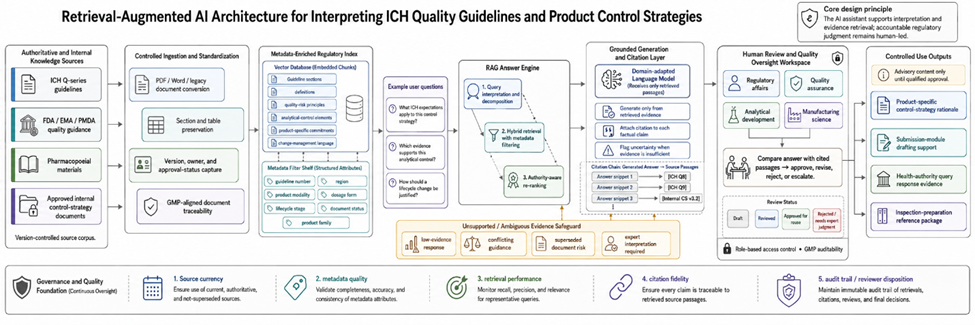
Figure 1 presents the proposed retrieval-augmented AI architecture that connects authoritative regulatory sources, internal control-strategy knowledge, citation-grounded answer generation, and human regulatory review.
|
|
|
Figure 1. Retrieval-Augmented AI Architecture for Interpreting ICH Quality Guidelines and Product Control Strategies |
Core Document Corpus and Data Flow
The core corpus would include ICH Q-series guidelines, regional quality guidance from authorities such as FDA, EMA, and PMDA, relevant pharmacopoeial materials, and internal control-strategy documents. The ingestion workflow would convert source documents into structured, searchable text; attach metadata such as guideline, region, product modality, lifecycle stage, and document owner; and make these units available for retrieval. Intelligent information-management work in pharmaceutical production suggests that quality knowledge becomes more useful when dispersed technical information is organized into reusable digital structures [3]. The output would be a natural-language answer with numbered citations to the relevant document sections, allowing users to move from an answer back to the source evidence.
Design Principles
The system would be designed as an assistive layer rather than an autonomous regulatory decision-maker. It would prioritize source grounding, auditability, privacy preservation, and alignment with GMP data integrity expectations, reflecting broader regulatory concerns around AI transparency and accountability. Human approval would remain necessary before AI-generated language is inserted into a protocol, control-strategy justification, response to a health authority, or submission module. This assistive posture is consistent with clinical and regulatory AI guidance that emphasizes intended use, human oversight, and careful monitoring rather than unrestricted automation [14, 15].
Regulatory Knowledge Base Construction and Indexing
Document Preprocessing and Standardization
Document preprocessing would convert PDFs, Word files, controlled templates, and scanned legacy documents into machine-readable text while preserving section headings, tables, figure captions, and version metadata. Pharmaceutical regulatory translation and labeling summarization studies show that careful preparation of regulated text is essential before language models can reliably operate on it [21, 22]. For quality manuals and control-strategy documents, preprocessing should also preserve document hierarchy so that a retrieved paragraph can be traced to its section, version, owner, and approval status. This standardization would make later retrieval more auditable and reduce the risk that the system answers from superseded or poorly contextualized content.
Chunking and Metadata Enrichment
After preprocessing, the system would split documents into semantically coherent chunks, such as guideline paragraphs, definitions, risk-assessment principles, analytical-control elements, or product-specific commitments. Biomedical language-model work shows that domain terminology benefits from representations trained or adapted to scientific and clinical language, which is relevant when embedding technical regulatory chunks [9, 10, 24, 25]. Each chunk would receive metadata tags for guideline number, topic, dosage form, modality, region, product family, lifecycle phase, and document status. This enriched structure would allow the system to distinguish, for example, a general quality-by-design principle from an approved internal control for a particular biologic, sterile product, or continuous manufacturing process.
Table 1 structures the proposed knowledge base by distinguishing source authority, metadata requirements, retrieval function, and the way each document class supports product-specific control-strategy interpretation.
Table 1. Regulatory knowledge architecture linking source type, metadata logic, retrieval function, and control-strategy use
|
Knowledge source category |
Primary regulatory or quality role |
Required metadata for reliable retrieval |
Retrieval value for user questions |
Control-strategy interpretation contribution |
Main risk if poorly indexed |
Governance requirement |
|
ICH Q-series guidelines |
Establish global quality principles for pharmaceutical development, quality risk management, analytical procedures, lifecycle management, and pharmaceutical quality systems |
Guideline number, section heading, topic, version, effective date, quality concept, lifecycle stage |
Retrieves authoritative language for broad questions about design space, risk management, analytical control, established conditions, and lifecycle change |
Provides the general interpretive foundation for linking development knowledge to quality expectations |
Overgeneralized answers that quote principles without explaining product relevance |
Maintain current guideline versions and retire superseded text from active retrieval |
|
Regional regulatory guidance |
Clarifies jurisdiction-specific expectations from agencies such as FDA, EMA, or PMDA |
Region, agency, guidance type, effective status, product scope, modality, submission context |
Supports questions where regional expectations may affect submission language, comparability strategy, or control expectations |
Helps distinguish global ICH principles from region-specific implementation expectations |
Mixing regional expectations without jurisdictional context |
Require metadata filtering by region and visible source labels in generated answers |
|
Pharmacopoeial materials |
Defines compendial standards, analytical requirements, monograph expectations, and quality test conventions |
Pharmacopoeia, chapter or monograph, dosage form, material type, analytical method, revision status |
Retrieves standardized test expectations and terminology for analytical-control questions |
Supports alignment between product controls and recognized compendial standards |
Inappropriate application of general compendial language to product-specific contexts |
Link each passage to revision status and applicable material or dosage-form scope |
|
Internal quality manuals |
Encodes company-approved quality-system procedures, terminology, and decision pathways |
Document owner, approval status, SOP link, department, effective date, review cycle, supersession history |
Answers questions about how the organization operationalizes external regulatory principles |
Translates regulatory expectations into company-specific procedural expectations |
Retrieval of obsolete procedures or uncontrolled templates |
Enforce document control, access permissions, and periodic content review |
|
Approved control-strategy documents |
Contains product-specific commitments, development rationale, critical quality attributes, process controls, and analytical controls |
Product family, modality, dosage form, lifecycle phase, approval status, market, version, document owner |
Retrieves product-specific evidence for proposed changes, submissions, inspections, or internal review |
Connects general guideline principles to actual control decisions for a product or platform |
Leakage of confidential product commitments or use of unapproved draft content |
Apply role-based access control and clearly mark draft versus approved source material |
|
Prior regulatory responses and assessment packages |
Captures precedent from health-authority questions, company responses, and prior submission rationales |
Product, region, submission type, authority interaction type, response date, commitment status, approval outcome |
Supports consistency when preparing new responses or interpreting similar authority questions |
Provides precedent-based context while preserving the distinction between past response and current decision |
Treating historical precedent as universally applicable |
Require expert review before reuse and tag commitments by product and jurisdiction |
|
User feedback and reviewer dispositions |
Records whether AI-generated answers were accepted, modified, rejected, or escalated |
Reviewer role, decision status, comment category, timestamp, answer version, retrieved evidence set |
Supports controlled improvement of retrieval, ranking, prompt instructions, and interface guidance |
Identifies recurring ambiguity in control-strategy interpretation and evidence gaps |
Informal feedback causing uncontrolled model drift or undocumented changes |
Govern feedback as quality-system improvement input rather than automatic retraining |
Vector Database and Retrieval Strategy
The vector database would store embeddings for each chunk and support hybrid retrieval that combines semantic similarity with keyword matching and metadata filters. Hybrid retrieval is important because regulatory questions often include exact terms such as “design space,” “control strategy,” “established conditions,” or “analytical procedure,” while also requiring conceptual matching to related passages [8]. FDA guidance search and grounded drug-label question answering both illustrate why retrieval must return authoritative source text rather than merely similar-looking language [7, 12]. Metadata filters would allow users to limit the search to ICH guidance, regional guidance, or approved internal documents depending on the regulatory question and the decision context.
Retrieval-Augmented Answer Engine
Query Interpretation and Decomposition
The answer engine would first interpret the user’s natural-language query by identifying the relevant quality concept, product context, regulatory source, and intended use of the answer. A question such as whether an analytical control supports a lifecycle change would be decomposed into concepts related to analytical procedure development, established conditions, control strategy, and change management. Question-entailment methods for regulatory documents suggest that identifying semantic overlap between questions can help route new queries toward prior knowledge and relevant regulatory text [20]. In practice, this layer would convert a broad user question into a retrieval plan while preserving the original phrasing for auditability.
Retrieval and Re-Ranking
The retrieval step would return candidate passages from the indexed corpus, and a re-ranking step would prioritize passages that are authoritative, current, and directly responsive to the user’s question. RAG compliance architectures in the pharmaceutical domain show the value of separating retrieval from generation so that the system can select evidence before drafting an answer [6, 8]. The re-ranker would be expected to favor primary ICH text over secondary summaries when the user asks for a guideline interpretation, while internal approved control-strategy documents may be prioritized when the question concerns a specific product. This design would reduce the chance that the model synthesizes a plausible but weakly supported answer from tangentially related material.
LLM-Based Answer Generation with Inline Citations
The language model would synthesize an answer only from the retrieved passages, using instructions that prohibit unsupported extrapolation and require inline citations for each factual or interpretive statement. Domain-adapted biomedical and clinical language models show that specialized pretraining can improve handling of technical terminology, although source grounding remains necessary for regulatory use [9, 10, 18]. In the proposed system, the answer would explain the relevant guideline principle, identify how it applies to the product or control-strategy question, and clearly state any limits in the retrieved evidence. The generated response would remain draft advisory content until reviewed by qualified regulatory or quality personnel, consistent with human-centered AI decision-support principles [15, 19].
Answer Grounding, Citation, and Traceability
Citation Mechanism and Audit Trail
Every generated answer would be stored with the user query, retrieved passages, source-document identifiers, prompt template, model response, reviewer actions, and final disposition. This audit trail is essential because AI-assisted regulatory interpretation must remain inspectable by quality units, regulatory affairs, and potentially auditors, especially when generated text influences GMP documentation or submission rationale. Citation grounding would allow each claim in the response to be traced back to a specific guideline section, internal manual, or approved control-strategy document, similar to how FDA guidance search and grounded drug-label retrieval systems connect answers to source evidence [7, 12]. The system would therefore treat citation fidelity as a design requirement rather than a presentation feature.
Flagging Unsupported or Ambiguous Statements
When retrieved passages do not provide sufficient evidence to answer a question, the system should explicitly state that the corpus does not contain a clear answer. This behavior is important because large language models can produce fluent responses even when the available evidence is incomplete, and biomedical foundation-model work has underscored the need to constrain generated clinical or regulatory language to reliable evidence [18, 19]. In a pharmaceutical quality setting, an unsupported answer about design space, established conditions, or control strategy could create a misleading basis for development or regulatory decision-making. The system would therefore classify low-evidence responses as requiring expert interpretation rather than attempting to resolve ambiguity through model inference alone.
Feedback and Continuous Improvement
The system would include mechanisms for users to mark answers as helpful, incomplete, unsupported, or incorrectly cited, and these signals would be reviewed through a controlled quality process. Human feedback could be used to refine retrieval settings, metadata tagging, re-ranking logic, prompt instructions, and user-interface guidance without allowing uncontrolled model drift in a regulated environment [15]. Reviews of AI-driven pharmaceutical development and manufacturing suggest that continuous improvement must be balanced with governance, validation, and lifecycle oversight when AI tools affect quality decisions [26]. Feedback would therefore be treated as a governed improvement input rather than an informal training signal.
Human-In-The-Loop Review and Quality Oversight
Collaborative Review Dashboard
A collaborative review dashboard would allow regulatory affairs, quality assurance, analytical development, and manufacturing science users to compare each AI-generated answer with the retrieved source passages before approving, modifying, or rejecting it. Early-stage AI decision-support guidance emphasizes that evaluation must consider the interaction between the system, the user, and the workflow rather than the model output alone [15]. In this design, the dashboard would show the answer, cited passages, document metadata, review comments, and approval status in a single controlled workspace. The approved response could then be reused in a regulatory rationale, internal assessment, or health-authority response only after accountable expert review.
Table 2 shows the key elements and functionalities of a collaborative review dashboard for AI-generated responses in regulatory and quality workflows.
Table 2. Key Elements of a Collaborative Review Dashboard
|
Element |
Description / Functionality |
|
AI-Generated Answer |
The proposed response produced by the AI system for review. |
|
Retrieved Source Passages |
Original document excerpts that support or inform the AI-generated answer. |
|
Document Metadata |
Details such as title, authorship, version, and date of source documents. |
|
Review Comments |
Feedback provided by regulatory, QA, analytical, or manufacturing science experts. |
|
Approval Status |
Indicator showing whether the answer is approved, modified, or rejected. |
|
Workflow Integration |
Ensures the answer undergoes accountable expert review before being reused in regulatory work. |
Governance and Access Control
Governance would require role-based access control so that confidential product-specific control strategies, manufacturing parameters, and regulatory commitments are visible only to authorized users. AI governance discussions in regulated health environments emphasize transparency, accountability, monitoring, and clear responsibility for outputs that may influence regulated decisions. The system would watermark generated content as draft until a qualified reviewer approves it, preventing unreviewed language from being mistaken for an official regulatory position. Access logs, document-version controls, and review records would support GMP data integrity expectations and make the system suitable for controlled quality workflows.
Integration Into Pharmaceutical Development And Regulatory Workflows
Supporting Control-Strategy Development and Review
During product development, the system could help teams retrieve relevant guideline passages and compare proposed control strategies with established regulatory expectations. Quality-by-design research shows that control strategy development requires connecting formulation variables, process parameters, analytical controls, and risk assessments into a coherent product-specific rationale [1, 2]. Digital manufacturing and process automation studies further suggest that control strategies are becoming increasingly integrated with platform technologies and continuous manufacturing workflows [4, 5]. A RAG assistant would therefore support drafting and review by making the regulatory and internal knowledge base easier to query, while preserving human judgment for final control-strategy decisions.
Regulatory Submission Preparation and Health-Authority Query Response
During submission preparation or health-authority query response, the tool could help users identify precise regulatory language, retrieve internal justifications, and align response drafts with approved product knowledge. Regulatory intelligence studies indicate that AI may support the management of complex regulatory information when its outputs remain transparent and reviewable [16, 17]. Drug-label summarization and regulatory-document question-similarity methods also suggest that NLP can help users navigate large bodies of regulated text, although final interpretation must remain expert-led [20, 21]. In this workflow, the system would function as a traceable evidence-retrieval and drafting assistant rather than an autonomous author of regulatory commitments.
Evaluation Strategy
Answer Accuracy and Relevance
Evaluation should focus on expert review of answer correctness, relevance to the query, completeness of regulatory reasoning, and appropriateness of citations. Reporting guidelines for AI interventions emphasize that evaluation should be explicit about intended use, user population, and the context in which the AI output informs decisions [13, 14]. In this setting, regulatory affairs and quality professionals would compare AI-generated draft answers against manually retrieved guideline evidence and internal documentation. Because the proposed article is conceptual, such evaluation would be described as a necessary future activity rather than reported as completed performance testing.
System Usability and Adoption
Usability evaluation should examine whether the system fits naturally into regulatory research, control-strategy review, submission drafting, and inspection-preparation workflows. Decision-support evaluation guidance highlights the importance of human factors, workflow effects, user confidence, and safe adoption before broader deployment [15]. Pharmaceutical AI reviews similarly indicate that successful adoption depends not only on model capability but also on integration with quality systems, documentation practices, and organizational governance [23, 26]. The system should therefore be assessed through structured user review, qualitative feedback, and controlled pilot use rather than assumed to be acceptable because it produces fluent answers.
Impact on Regulatory Outcomes
Longer-term evaluation could examine whether the system improves consistency of regulatory references, supports clearer control-strategy rationales, and helps teams prepare more traceable responses to health-authority questions. AI in pharmaceutical regulatory affairs has been discussed as a way to improve information access and regulatory intelligence, but such impact must be assessed in relation to actual regulated workflows and accountable review processes [16, 17]. Quality-by-design and intelligent information-management work suggests that better organization of product and process knowledge can support more coherent pharmaceutical quality documentation [3, 27]. Any claims about regulatory outcome improvement should therefore be framed cautiously and supported only after governed pilot implementation.
Table 3 defines an evaluation and governance framework that separates retrieval performance, citation fidelity, regulatory reasoning quality, workflow usability, and controlled deployment readiness.
Table 3. Evaluation and governance framework for a citation-grounded RAG assistant in pharmaceutical quality workflows
|
Evaluation domain |
Core evaluation question |
Suggested assessment method |
Evidence standard for acceptable performance |
Failure mode to detect |
Governance response |
|
Retrieval relevance |
Did the system retrieve passages that are directly responsive to the user’s regulatory or control-strategy question? |
Expert comparison between retrieved passages and manually identified source evidence |
Retrieved evidence includes the most relevant authoritative source sections and avoids tangential passages |
Semantically similar but regulatory-irrelevant text is retrieved |
Refine chunking, metadata tags, hybrid search weights, and re-ranking criteria |
|
Source authority prioritization |
Did the system prioritize the correct source hierarchy for the question? |
Scenario-based testing across ICH guidance, regional guidance, pharmacopoeial materials, and internal documents |
Primary authoritative sources are favored when guideline interpretation is requested; approved internal documents are favored for product-specific questions |
Internal template or secondary summary overrides authoritative guidance |
Add authority-ranking rules and visible source-type labels |
|
Citation fidelity |
Does every factual or interpretive claim trace to the cited source passage? |
Claim-level audit of generated answers against retrieved text |
Each claim is supported by a specific cited passage, and unsupported claims are absent or flagged |
Citation exists but does not support the statement it is attached to |
Strengthen citation-grounding prompts and block unsupported answer generation |
|
Regulatory reasoning quality |
Does the answer correctly translate broad regulatory language into product-relevant interpretation without overstating certainty? |
Blinded review by regulatory affairs, quality assurance, analytical development, and manufacturing science experts |
Answer distinguishes general principles, product-specific commitments, regional expectations, and unresolved ambiguity |
Fluent but overconfident interpretation beyond available evidence |
Require uncertainty labeling, expert escalation, and reviewer disposition tracking |
|
Control-strategy usefulness |
Does the response help users connect CQAs, CPPs, analytical controls, risk assessments, and lifecycle decisions? |
Use-case testing on control-strategy development, change assessment, and submission-drafting scenarios |
Output supports clearer rationale development without becoming an unreviewed regulatory commitment |
Answer retrieves guideline language but does not help structure a practical control strategy |
Add control-strategy templates, product-context prompts, and reviewer guidance |
|
Handling of insufficient evidence |
Does the system recognize when the corpus does not contain enough information to answer? |
Low-evidence and conflicting-evidence test cases |
System explicitly states uncertainty and recommends expert interpretation when evidence is incomplete |
Model fabricates a definitive answer from weak evidence |
Implement low-confidence thresholds and mandatory escalation pathways |
|
Usability in regulated workflows |
Does the tool fit existing regulatory research, submission preparation, and quality-review processes? |
Structured user testing, think-aloud sessions, time-on-task comparison, and qualitative feedback |
Users can verify sources, understand answer status, and complete review actions without workflow disruption |
Users trust generated answers without checking citations |
Improve interface design, reviewer prompts, and draft-status labeling |
|
Access control and confidentiality |
Are product-specific documents visible only to authorized users? |
Role-based access testing and audit-log review |
Users retrieve only documents permitted by role, product, region, and document status |
Confidential commitments or manufacturing details are exposed to unauthorized users |
Tighten permissions, document segregation, and access-log monitoring |
|
Auditability and inspection readiness |
Can the organization reconstruct how an answer was generated, reviewed, and reused? |
End-to-end audit trail inspection |
Query, retrieved passages, prompt version, answer version, reviewer action, and final disposition are preserved |
Approved text cannot be traced to source evidence or reviewer decision |
Enforce immutable audit logs and controlled export procedures |
|
Lifecycle monitoring |
Does system performance remain reliable as documents, models, prompts, and regulatory expectations change? |
Periodic validation review, drift checks, document-currency audits, and post-deployment issue review |
Updated documents are indexed correctly, superseded material is retired, and changes are controlled |
Outdated sources remain active or prompt updates change answer behavior unexpectedly |
Establish change control, periodic revalidation, and governed improvement cycles |
Limitations
Dependency on Document Quality and Currency
The proposed system would be only as reliable as the documents it retrieves, the metadata assigned to them, and the governance process used to keep them current. If internal manuals are outdated, inconsistent, or poorly structured, the system could retrieve technically obsolete passages even if the RAG workflow itself functions as designed [3]. Regulatory AI governance literature indicates that monitoring and lifecycle management are essential when AI tools are used in controlled environments. For this reason, deployment would require disciplined document management, version control, periodic review, and clear procedures for retiring superseded content.
Handling of Emergent and Unstructured Regulatory Questions
The system may struggle with questions that lack explicit guidance, require interpretation of emerging technologies, or depend on business policy and regulatory precedent not present in the indexed corpus. Pharmaceutical innovation reviews show that AI is increasingly relevant across discovery, formulation, manufacturing, quality control, and post-market activities, but these broad opportunities also create interpretation challenges for novel contexts [26]. In such cases, the system should retrieve the closest relevant evidence and identify uncertainty rather than presenting a definitive recommendation. Expert review would remain especially important when the question concerns new manufacturing platforms, novel analytical technologies, or strategic regulatory positioning.
Conclusion
A retrieval-augmented AI system for interpreting ICH quality guidelines and product control strategies would provide pharmaceutical professionals with a structured way to query complex regulatory and internal quality knowledge. By combining document ingestion, metadata-enriched retrieval, controlled generation, and citation grounding, the system could transform scattered regulatory text into a usable decision-support resource.
The principal strength of this approach is that it keeps answers tied to authoritative source documents rather than treating the language model as an independent source of regulatory truth. Its value would be greatest where teams need traceable, reviewable, and product-specific explanations that connect guideline principles to practical control-strategy decisions.
Important challenges remain, including maintaining a current knowledge base, preserving metadata quality, preventing unsupported synthesis, and building trust among users who operate under GMP accountability. The system would also need careful governance to ensure that generated content remains advisory until approved through established quality and regulatory review processes.
Pilot implementations within pharmaceutical quality and regulatory affairs departments would be a practical next step. Such pilots should examine whether the system improves consistency, accelerates regulatory research, and supports clearer preparation of development rationales, submissions, and health-authority responses.
Acknowledgments: None
Conflict of interest: None
Financial support: None
Ethics statement: None