Pharmacophore an International Research Journal
Artificial intelligence explanations are increasingly presented in pharmaceutical research as molecular saliency maps, ranked descriptors, pathway-level importance scores, covariate effects, counterfactual examples, and local prediction narratives. Although these outputs can make model behaviour more visible, visibility alone does not establish that an explanation is pharmacologically meaningful, scientifically dependable, or suitable for influencing a development decision. This article addresses the unresolved distinction between visually interpretable model output and pharmacologically useful explanation. It develops a proposed explanation-evaluation theory in which usefulness is defined relationally: an explanation must answer a specified scientific question for an identified user, support a bounded pharmaceutical decision, remain faithful to the model being interpreted, demonstrate context-appropriate stability, align cautiously with relevant chemical, biological, or pharmacometric knowledge, and communicate uncertainty without converting association into mechanism or prediction into experimental confirmation. The central contribution is the proposed Pharmacological Usefulness Test for AI Explanations, a non-compensatory evaluation construct in which visual attractiveness, predictive performance, user satisfaction, or apparent mechanistic plausibility cannot offset failure in a critical evidentiary dimension. The theory is designed to support comparative evaluation across molecular, omics, and pharmacometric models while preserving domain-specific evidence requirements. It also identifies failure modes arising from unstable attribution, inappropriate explanatory questions, mechanistic overinterpretation, uncalibrated confidence, automation bias, and insufficient human contestability. The proposed test is conceptual rather than empirically validated and does not establish clinical utility, regulatory acceptability, universal thresholds, or deployment readiness. Its intended value is to organize future explanation studies around pharmaceutical questions, evidentiary boundaries, and decision consequences rather than the persuasive appearance of explanatory graphics.
Introduction
Artificial intelligence models are now capable of producing visually compelling accounts of why a prediction was generated, including colored molecular substructures, ranked physicochemical descriptors, highlighted omics features, influential patient covariates, and local response surfaces. Such outputs can create an immediate impression of transparency because they replace an opaque numerical prediction with a recognizable scientific representation. Yet post-hoc intelligibility cannot by itself make an opaque model dependable for consequential pharmaceutical decisions; present explanation techniques may also generate unwarranted confidence without establishing scientific validity, and their practical value remains dependent on whether human users can understand and critically assess the relevance of the information presented [1–3]. The unresolved problem is therefore not whether an artificial intelligence system can generate an explanation-like artifact, but whether that artifact supports a defensible pharmacological interpretation within a specified context of use.
This distinction matters because pharmaceutical artificial intelligence does not operate within a single homogeneous problem class. Machine-learning applications span molecular property prediction, virtual screening, target identification, biomarker discovery, image-based phenotyping, formulation analysis, pharmacokinetic prediction, exposure–response modeling, trial enrichment, and other development activities. These applications involve different data-generating processes, scientific assumptions, uncertainty structures, evidentiary standards, and consequences of error [4]. A molecular attribution used to nominate a functional group for analogue design cannot be evaluated in the same manner as a patient-level feature explanation used to interpret an exposure prediction or a covariate ranking used to reconsider a pharmacometric model. Consequently, no undifferentiated explanation metric can determine usefulness across the pharmaceutical sciences.
The translational problem is equally important. An explanation may accurately describe how a model distributes importance while remaining disconnected from the biological or development question that motivated the analysis. Translational usefulness requires an interpretable relationship among the analytical output, the relevant scientific evidence, and the decision that the output is expected to support [5]. For example, identifying a molecular fragment as influential does not establish target engagement, causal activity, synthesizability, safety, or therapeutic value. Similarly, highlighting an omics feature does not demonstrate that it is a modifiable disease mechanism, and ranking a clinical covariate does not show that it should determine dose adjustment. In each case, a representational output must be converted into a bounded explanatory proposition that can be questioned, tested, and interpreted against domain knowledge.
This article develops an original explanation-evaluation theory for determining when an artificial intelligence explanation may be described as pharmacologically useful. Its proposed central construct, the Pharmacological Usefulness Test for AI Explanations, treats usefulness as a conditional relationship among the explanation, the underlying model, the user, the explanatory question, the pharmaceutical decision, the relevant scientific knowledge, and the unresolved uncertainty. The test is deliberately non-compensatory: strong predictive performance, visual clarity, mechanistic familiarity, or favorable user reaction cannot compensate for failed faithfulness, scientifically implausible instability, unsupported mechanism claims, inadequate uncertainty representation, or mismatch with the intended decision. The contribution is not presented as a validated score, regulatory standard, or deployment procedure. Rather, it provides a structured theory for designing, evaluating, comparing, and reporting explanations without confusing attractive visualization with pharmacological evidence.
The Difference between Visual Explanation and Pharmacological Explanation
A visual explanation is best understood as a representation of selected aspects of model behavior. It may show where a neural network attends, which inputs contribute to a prediction, how a response changes over a local feature range, or which examples resemble the case under examination. Explanation, however, is heterogeneous, selective, contrastive, and audience-dependent; heatmaps and feature rankings constitute only a subset of available explanatory forms, and different technical methods expose different properties of a model that require method-appropriate evaluation [6–8]. A saliency image may answer “where did the model concentrate?”, while a feature ranking may answer “which encoded variables most affected this output under this analysis?” Neither automatically answers the pharmacological questions “why should this relationship occur?”, “under what conditions should it persist?”, “what alternative explanation is credible?”, or “what follow-up action is justified?”
A pharmacological explanation must therefore do more than display importance. It must connect model behavior to a scientifically interpretable proposition about a molecular, biological, physiological, pharmacokinetic, pharmacodynamic, or development-relevant relationship. Scholarship on explainable artificial intelligence in drug discovery similarly emphasizes that useful explanation requires connection to chemically and biologically meaningful knowledge rather than termination at feature display [9]. This does not mean that every explanation must reveal a true causal mechanism. It means that the output should be formulated so that its scientific status is explicit. A substructure attribution may be described as a model-sensitive region associated with a prediction; it should not be relabeled as a pharmacophore, toxicophore, binding determinant, or causal structural mechanism without additional evidence. Pharmacological usefulness begins with disciplined claim classification.
The scientific representation used by the model also affects what can reasonably be interpreted. Chemically grounded descriptors can make learned relationships more accessible to chemical analysis, particularly when the representation preserves meaningful spatial or electronic information [10]. Nevertheless, chemically recognizable features are not self-validating. A descriptor may encode a plausible relationship while being correlated with an unobserved confounder, a dataset artifact, or another feature used by the model. Representation-level intelligibility must consequently be separated from explanatory validity. The relevant question is not simply whether a medicinal chemist recognizes the highlighted property, but whether the explanation faithfully characterizes the model, remains sufficiently stable, accords with the applicable scientific evidence, and is used within a claim boundary appropriate to the data and modeling task.
The proposed distinction can be summarized as follows: a visual explanation makes model output perceptible, whereas a pharmacological explanation makes a bounded scientific proposition examinable. The transition requires at least four changes. First, the displayed pattern must be translated into an explicit explanatory claim. Second, the claim must be tied to a user and decision. Third, it must undergo evaluation for faithfulness, stability, mechanism alignment, and uncertainty. Fourth, its permitted inference must be stated, including what the explanation does not establish. This distinction prevents the visual persuasiveness of an output from functioning as a substitute for pharmaceutical evidence. Table 1 organizes the evidence, constructs, and interpretation boundaries needed to develop the difference between visual explanation and pharmacological explanation within the article’s central argument.
Table 1. Evidence domains, core questions, scientific requirements, and interpretation boundaries for the difference between visual explanation and pharmacological explanation
|
Construct or evidence domain |
Core question |
Scientific basis |
Role in the article |
Failure or overclaiming risk |
Boundary statement |
|
Visual attribution |
What inputs, regions, examples, or encoded features does the explanation identify as influential? |
Model-specific or post-hoc attribution, saliency, example-based explanation, or response visualization |
Provides an inspectable representation of model behavior |
Treating visibility, aesthetic clarity, or intuitive resemblance as evidence of validity |
A visible pattern is an explanatory representation, not proof of pharmacological relevance |
|
Explanatory proposition |
What precise scientific statement is being made from the displayed output? |
Explicit translation of model output into a falsifiable or contestable claim |
Converts a graphic or ranking into a claim that can be evaluated |
Allowing ambiguous language to shift between importance, association, mechanism, and causality |
The proposition must state whether it concerns model behavior, association, hypothesis generation, mechanism, or decision support |
|
Chemical or biological interpretability |
Can the output be related to established molecular, biological, physiological, or pharmacological concepts? |
Domain representations, prior knowledge, experimental literature, and mechanistic models |
Supports scientific examination and generation of follow-up questions |
Equating a recognizable feature with a causal determinant or validated mechanism |
Plausibility may support interpretation but does not alone confirm causality or experimental truth |
|
Model faithfulness |
Does the explanation accurately reflect the behavior of the model it claims to explain? |
Perturbation analysis, model-specific checks, counterfactual consistency, or comparison with known model structure |
Establishes whether the representation describes the model rather than merely appearing reasonable |
Producing a plausible narrative that is weakly connected to the actual prediction process |
A pharmacologically plausible explanation that is unfaithful to the model is not a valid explanation of that model |
|
Stability |
Does the explanation remain appropriately consistent under scientifically irrelevant changes and respond to meaningful changes? |
Repeated fitting, input perturbation, representation variation, and sensitivity assessment |
Distinguishes robust explanatory structure from accidental attribution |
Assuming either complete invariance or uncontrolled variability is acceptable |
Stability must be evaluated relative to the scientific invariances and sensitivities expected in the application |
|
Mechanism alignment |
Is the explanatory proposition compatible with relevant chemical, biological, physiological, or pharmacometric knowledge? |
External scientific knowledge and, where available, experimental or mechanistic evidence |
Tests whether the output can be interpreted within a pharmacological knowledge system |
Converting consistency with prior knowledge into confirmation of a mechanism |
Alignment indicates compatibility or hypothesis value, not causal validation |
|
Uncertainty |
What is unknown about the prediction, explanation, data support, and scientific interpretation? |
Predictive uncertainty, attribution variability, domain applicability, and evidentiary uncertainty |
Limits the strength and consequence of the explanatory claim |
Presenting a precise explanation around an uncertain prediction or unsupported extrapolation |
Explanation precision must not exceed the certainty of the model, data, and supporting science |
|
Decision boundary |
What action, if any, may the explanation support? |
Defined context of use, consequence analysis, and available corroborating evidence |
Connects explanation to bounded pharmaceutical usefulness |
Allowing an exploratory explanation to be treated as a recommendation, confirmation, or approval |
Usefulness is conditional on the specified decision and does not establish clinical, regulatory, or deployment readiness |
Users, Decisions, and Explanatory Questions in Pharmaceutical Research
Explanation quality cannot be assessed independently of the person expected to use the explanation and the purpose for which it is requested. Pharmaceutical users may include medicinal chemists, computational chemists, biologists, toxicologists, bioinformaticians, pharmacometricians, clinicians, statisticians, safety scientists, and development decision-makers. Each role brings different prior knowledge, evidentiary expectations, and authority to act. Explanation requirements should therefore be specified through the stakeholder, the intended purpose, and the evaluation objective before an explanation method is selected [11]. An explanation suitable for model debugging may be inappropriate for mechanistic hypothesis generation; an explanation intended to compare candidate compounds may be insufficient for interpreting a patient-level prediction. User-centeredness does not mean tailoring graphics merely to preference. It means defining what the user must understand, challenge, and decide.
The explanatory question provides the link between user and method. Questions may be descriptive, contrastive, counterfactual, mechanistic, uncertainty-focused, or decision-oriented. “Which features contributed?” differs from “Why was compound A ranked above compound B?”, “What minimal structural change would reverse the prediction?”, “Would the explanation persist under an alternative molecular representation?”, or “Which assumption is driving the projected exposure difference?” The form of explanation and the information accompanying it can alter perceived helpfulness and acceptance, particularly when users are informed about model errors [12]. Perceived clarity or satisfaction therefore cannot serve as proof of faithfulness, correctness, or pharmaceutical value. User evaluation must examine whether the explanation enables an appropriate inference and whether users recognize its limitations, not merely whether they report that the explanation is understandable.
Decision consequence adds a further requirement. An exploratory explanation used to select a hypothesis for laboratory testing may tolerate greater uncertainty than an explanation used to exclude a candidate, revise a clinical model, or support an individualized treatment judgment. Evidence from decision studies shows that machine-learning recommendations can influence expert selections, making behavioral effects, reliance, and potential overreliance relevant components of explanation evaluation [13]. The central unit of analysis should consequently be the user–question–decision triad. For every explanation, investigators should specify who receives it, what exact question it addresses, what decision could change because of it, what evidence would justify that change, and what harm could follow from an incorrect interpretation. These specifications determine the required explanatory depth and the intensity of validation.
Method-specific choices must then be made within this triad. In drug-development applications, SHAP-based attribution depends on decisions concerning the background distribution, modeled output, feature dependence, aggregation level, and interpretation of global versus local effects [14]. These choices can materially alter what a ranking appears to say and must therefore be documented as part of the explanation rather than hidden as implementation detail. Pharmacometric contexts impose additional constraints because explanatory claims must respect structural model assumptions, longitudinal and hierarchical data-generating processes, covariate relationships, inferential objectives, and the distinction between predictive flexibility and mechanistic interpretation [15]. A useful explanation in this setting may need to identify whether an apparent covariate effect reflects model structure, data support, extrapolation, or a plausible physiological relationship. Across pharmaceutical domains, the correct explanatory method is thus not the most visually impressive one, but the one capable of answering the specified question without exceeding the evidence appropriate to the decision.
Faithfulness, Stability, Mechanism Alignment, and Uncertainty
Explanation evaluation is inherently multidimensional because different properties answer different validity questions. Faithfulness asks whether an explanation accurately reflects the model process it claims to describe; stability asks whether explanatory conclusions persist under changes that should be scientifically irrelevant and respond appropriately to changes that should matter; mechanism alignment asks whether the interpretation is compatible with relevant chemical, biological, physiological, or pharmacometric knowledge; and uncertainty asks how confidently the prediction and its explanation may be interpreted. These properties are related but not interchangeable. An explanation can be faithful to a model that learned a spurious relationship, stable around an unsupported extrapolation, mechanistically plausible but disconnected from the actual model, or visually uncertain while the underlying uncertainty remains uncharacterized. Explanation evaluation must therefore distinguish fidelity, robustness, comprehensibility, usefulness, and related concepts instead of treating “interpretability” as a single measurable quality [16].
Faithfulness should be tested through deliberate interventions on the model, inputs, representations, or explanatory procedure. Depending on the application, these tests may include feature ablation, controlled perturbation, counterfactual consistency, comparison with transparent reference models, parameter randomization, retraining, or evaluation against known model structure. Stability testing should similarly be conditional rather than absolute. Small changes in an irrelevant formatting variable, equivalent molecular encoding, or resampled training set should not produce arbitrary explanatory reversals, whereas a meaningful structural modification, pathway perturbation, or covariate change may appropriately alter the explanation. The growing evaluation literature shows why illustrative examples and subjective inspection are insufficient: explanation properties require operational definitions, explicit tests, and criteria matched to the claim being made [17]. A stable but systematically wrong explanation is not useful, and a faithful explanation may remain too unstable for the decision under consideration.
Uncertainty introduces at least four analytically distinct concerns: uncertainty in the model prediction, uncertainty produced by limited data support or distributional shift, variability in the explanation itself, and uncertainty in the scientific interpretation assigned to the output. Deep-learning uncertainty is multifaceted and cannot be replaced by a softmax value, confidence score, attribution magnitude, or sharply rendered heatmap [18]. Pharmaceutical explanation reports should therefore distinguish predictive uncertainty from explanation uncertainty and both from evidentiary uncertainty. The consequences of uncertainty must also be related to the proposed use. An uncertain structural attribution may still be useful for generating alternative compounds for testing, but it may be inadequate for excluding a candidate or asserting a toxicity mechanism. Uncertainty communication should be designed around the consequences and limits of the decision rather than appended as a generic warning [19].
Mechanism alignment is the most easily overstated component. It evaluates whether an explanation is consistent with established or reasonably hypothesized pharmacology, not whether the explanation has discovered or verified a mechanism. Alignment may be examined against medicinal-chemistry knowledge, binding evidence, pathway biology, physiological constraints, known pharmacokinetic relationships, experimental perturbations, or mechanistic models. Conflicts may reveal model failure, insufficient evidence, previously unrecognized biology, or limitations in the prior knowledge itself; they should trigger investigation rather than automatic rejection or acceptance. Within model-informed drug development, interpretation is conditioned by model assumptions, qualification evidence, uncertainty, and context of use [20]. The same discipline should govern artificial intelligence explanations. Table 2 organizes the evidence, constructs, and interpretation boundaries needed to develop faithfulness, stability, mechanism alignment, and uncertainty within the article’s central argument.
Table 2. Components, relationships, uncertainties, and validation needs within Faithfulness, stability, mechanism alignment, and uncertainty
|
Component or layer |
Inputs |
Core function |
Expected output |
Uncertainty or limitation |
Validation requirement |
|
Predictive adequacy context |
Model outputs, target definition, validation evidence, applicability domain |
Establish whether the prediction being explained is sufficiently supported for the intended analysis |
A bounded statement of predictive capability and known failure conditions |
Strong aggregate performance may conceal subgroup, scaffold, assay, or temporal failure |
Evaluate performance under conditions relevant to the intended pharmaceutical use |
|
Model faithfulness |
Model architecture, learned parameters, inputs, explanatory method |
Determine whether the explanation tracks the actual behavior of the model |
Evidence that identified features or relationships influence the model as claimed |
A scientifically plausible narrative may be unfaithful to the model |
Use perturbation, ablation, randomization, transparent comparators, or model-specific checks |
|
Input stability |
Equivalent encodings, minor perturbations, measurement variability |
Test invariance to changes that should not alter the scientific conclusion |
Consistent explanatory conclusions under scientifically irrelevant variation |
The definition of “irrelevant” depends on the application and representation |
Predefine plausible invariances and assess explanation sensitivity to each |
|
Training stability |
Resampled data, repeated fitting, alternative seeds, model classes |
Determine whether the explanation reflects reproducible structure or one fitted instance |
Distribution of explanatory conclusions across credible fitted models |
Agreement can be low even when predictive performance is similar |
Repeat model fitting and report explanatory variability, not only a selected example |
|
Mechanism alignment |
External chemical, biological, physiological, or pharmacometric knowledge |
Examine compatibility between the explanation and relevant scientific relationships |
A graded statement of consistency, conflict, or insufficient evidence |
Prior knowledge may be incomplete, context-specific, or itself uncertain |
Compare with independent evidence and state whether the test concerns plausibility or confirmation |
|
Prediction uncertainty |
Data density, model ensemble, posterior or predictive distribution, calibration evidence |
Characterize uncertainty in the model output to which the explanation is attached |
Context-specific uncertainty statement for the prediction |
Confidence scores may be uncalibrated or insensitive to distribution shift |
Assess calibration, applicability, and uncertainty behavior in the intended domain |
|
Explanation uncertainty |
Alternative explanation methods, perturbations, repeated fits, background distributions |
Characterize variability in the explanatory output |
Range or distribution of plausible attributions or relationships |
A single explanation may conceal substantial methodological dependence |
Compare credible analytical choices and report convergence or disagreement |
|
Interpretive uncertainty |
Scientific evidence, alternative hypotheses, confounding structure |
Limit the inference that can be drawn from the explanation |
Explicit statement of competing interpretations and unresolved questions |
Association may be rhetorically converted into mechanism or causality |
Require claim classification and identify the additional evidence needed for stronger inference |
|
Decision-conditioned adequacy |
User role, explanatory question, decision consequence, corroborating evidence |
Determine whether the combined evidence is adequate for the proposed use |
Conditional suitability, revision requirement, or rejection for the specified decision |
Adequacy thresholds are context-dependent and not yet empirically standardized |
Validate thresholds prospectively for defined users and decisions |
Proposed Pharmacological Usefulness Test for AI Explanations
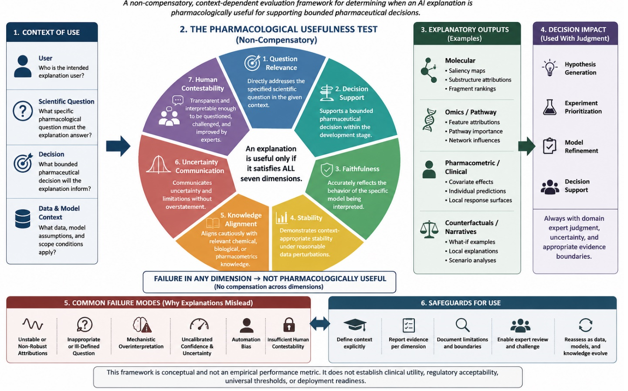
The proposed Pharmacological Usefulness Test for AI Explanations, abbreviated PUT-AI, evaluates whether a particular explanation is suitable for a particular pharmaceutical question and decision. It does not ask whether an explanation method is universally good. Instead, it asks whether the explanation satisfies six non-compensatory dimensions: decision–question fit, model faithfulness, scientifically plausible stability, mechanism alignment, uncertainty adequacy, and human interpretability and contestability. This proposal reflects the need to distinguish interpretation of a molecular prediction model from claims about chemical or causal truth [21]. PUT-AI begins with a written explanatory proposition and ends with a bounded decision-use statement. The test is failed at the outset when no identifiable user, question, decision, or permissible inference has been specified.
The first operational principle is that explanation robustness must be evaluated rather than inferred from graphical smoothness. Atom-coloring and related local structural interpretations can vary with perturbation design, model behavior, molecular context, and analytical implementation [22]. Under PUT-AI, a robustness test must therefore be selected according to the scientific claim. A medicinal-chemistry explanation might be challenged through matched molecular changes, alternative representations, repeated model fitting, or comparison across relevant local neighborhoods. The objective is not to demand identical colors for every representation, but to determine whether the conclusion used for decision-making survives scientifically credible analytical variation. A failure may indicate that the explanation remains exploratory, that the model or question requires revision, or that corroborating evidence is necessary.
The second principle is that mechanism alignment must be externalized. Attribution can support mechanistically informative hypotheses when model-identified features are compared with independent chemical or binding evidence [23]. However, the explanatory output is only one element of that comparison. PUT-AI therefore asks whether the proposed mechanism claim is supported by evidence independent of the explanation, whether alternative mechanisms remain plausible, and whether the claim is phrased at the correct level. An attribution that repeatedly highlights a molecular region may justify a hypothesis about a binding determinant; it does not by itself establish binding mode, target engagement, causal activity, or therapeutic action. Mechanism alignment is passed only relative to the stated claim and evidence level, not because the explanation resembles a familiar pharmacological narrative.
The third principle is that outcomes should be reported as an evaluation profile rather than a composite usefulness score. Human-readable structure–property relationships may facilitate chemical interrogation, but their scientific value remains conditional on validation against model behavior and chemical knowledge [24]. PUT-AI therefore permits three criterion-level judgments: sufficient for the specified bounded use, conditional pending additional evidence or revision, and not sufficient for the specified use. A failure in faithfulness cannot be offset by strong user satisfaction; missing uncertainty cannot be compensated by mechanistic plausibility; and visual appeal cannot override instability. Table 3 organizes the evidence, constructs, and interpretation boundaries needed to develop proposed pharmacological usefulness test for ai explanations within the article’s central argument.
Table 3. Components, relationships, uncertainties, and validation needs within Proposed pharmacological usefulness test for AI explanations
|
Evaluation dimension |
What must be tested |
Suitable evidence or assessment |
Failure signal |
Interpretive limitation |
Decision relevance |
|
Decision–question fit |
Whether the explanation answers the stated pharmaceutical question for the identified user and decision |
Predefined user–question–decision statement; task analysis; comparison between requested and delivered information |
Explanation is understandable but answers a different question or supports no identifiable action |
User preference does not establish scientific or decision validity |
Determines whether further evaluation is meaningful for the proposed use |
|
Model faithfulness |
Whether the explanation accurately represents the behavior of the model |
Perturbation, ablation, randomization, counterfactual testing, transparent comparator, or model-specific analysis |
Highlighted features can be removed or altered without the expected model response; explanation remains unchanged after model disruption |
Faithfulness to a model does not establish that the model learned a valid scientific relationship |
Required before the explanation can be used to interpret the model |
|
Scientifically plausible stability |
Whether the conclusion persists under irrelevant changes and responds to meaningful ones |
Alternative encodings, repeated fitting, local perturbations, measurement variation, background distributions |
Explanatory conclusion reverses under equivalent representations or arbitrary analytical choices |
Complete invariance is neither expected nor desirable when scientific inputs genuinely change |
Determines whether an explanation can reliably support comparison or follow-up |
|
Mechanism alignment |
Whether the proposition is compatible with relevant independent scientific evidence |
Literature, structural biology, assay evidence, pathway knowledge, physiological constraints, mechanistic models |
Mechanistic language is unsupported, contradictory evidence is ignored, or association is presented as causation |
Alignment is compatibility, not confirmation; prior knowledge may be incomplete |
Determines whether the explanation may support hypothesis generation or mechanistic investigation |
|
Uncertainty adequacy |
Whether predictive, explanatory, domain, and interpretive uncertainties are characterized |
Calibration analysis, applicability assessment, explanation ensembles, sensitivity analysis, alternative hypotheses |
Precise recommendation is presented despite extrapolation, unstable attribution, or unresolved interpretation |
No universal uncertainty threshold applies across decisions |
Limits the permissible consequence of action based on the explanation |
|
Human interpretability and contestability |
Whether the intended user can understand, question, reproduce, and override the explanation |
Task-based user study; documentation review; error-detection exercise; challenge and override procedure |
Users cannot identify assumptions, errors, alternatives, or conditions under which the explanation should be rejected |
Satisfaction and perceived clarity are not substitutes for appropriate reasoning |
Supports accountable use and prevents explanation-induced automation bias |
|
Cross-evidence coherence |
Whether model, explanation, experimental, and domain evidence converge without being treated as interchangeable |
Triangulation across independent evidence sources and explicit contradiction analysis |
One evidence source dominates despite material conflict with others |
Convergence strengthens a bounded claim but does not establish universal truth |
Supports prioritization of follow-up rather than final confirmation |
|
Conditional outcome |
Whether all critical requirements are adequate for the specified decision |
Criterion-level evaluation profile with written justification |
One critical failure is hidden by averaging or a composite score |
Proposed categories require future empirical threshold validation |
Produces a bounded conclusion: suitable, conditional, or unsuitable for the specified use |
Figure 1 presents the pharmacological explanation stress test, showing how the article’s key components and boundaries are connected within proposed pharmacological usefulness test for ai explanations.
|
|
|
Figure 1. Pharmacological Explanation Stress Test. |
The figure is an original conceptual synthesis that organizes the article’s central contribution across difference between visual explanation and pharmacological explanation, users, decisions, and explanatory questions in pharmaceutical research, explanatory questions in pharmaceutical research, faithfulness, stability, mechanism alignment, and uncertainty, mechanism alignment, proposed pharmacological usefulness test for AI explanations. Arrows and grouping indicate proposed or evidence-supported relationships rather than measured effect sizes. The figure does not represent a validated predictive model, regulatory determination, clinical recommendation, or deployment-ready system.
Evaluation Across Molecular, Omics, and Pharmacometric Models
PUT-AI contains invariant questions, but its evidence must be adapted to the model class. In molecular property prediction, the representation, learning architecture, task definition, data partitioning strategy, and evaluation setting can alter what relationships a model learns [25]. Molecular explanations should therefore be assessed across chemically meaningful neighborhoods and alternative representations where appropriate. A highlighted atom or fragment should be tested against matched structural changes, known activity cliffs, scaffold transitions, stereochemical distinctions, and applicability boundaries. When the explanation is intended to guide analogue design, it should also distinguish model-sensitive structural features from claims about synthesis, physicochemical suitability, selectivity, metabolism, toxicity, or developability. A molecular explanation can support prioritization of experiments, but it cannot substitute for them.
Omics explanations require a different evidentiary design. High dimensionality, correlated variables, batch effects, data-processing choices, multiple plausible biological levels, and limited external validation can make a feature ranking unstable or biologically ambiguous [26]. A gene, transcript, protein, metabolite, or pathway may appear important because it is a proxy for a correlated process rather than an independent driver. Evaluation should therefore examine stability across preprocessing pipelines, resampling, feature-grouping strategies, cohorts, and biologically coherent aggregation levels. Pathway-level coherence may improve interpretability but still does not establish causal pathway activity. Explanations intended for biomarker discovery should specify whether they support prediction, subgroup description, biological hypothesis generation, or intervention prioritization, because each use requires different corroborating evidence.
Pharmacometric models raise a further distinction between prediction and parameterized scientific interpretation. Machine-learning approaches and conventional pharmacometric approaches may both predict pharmacokinetic observations, but they encode assumptions and expose relationships differently [27]. A feature attribution from a flexible predictor may identify variables associated with an exposure prediction without providing the structural interpretation offered by a parameterized pharmacokinetic model. Conversely, a mechanistic or population model can be interpretable in structure while remaining misspecified or inadequately supported by data. PUT-AI therefore asks whether the explanation concerns a prediction, a parameter, a structural assumption, an individual deviation, or a proposed physiological relationship. It should also determine whether covariate effects are stable across sampling designs, patient distributions, model specifications, and clinically relevant ranges.
Hybrid and scientific machine-learning models combine explicit pharmacokinetic structure with learned components, creating both opportunities and new explanation boundaries. Neural-network terms can add flexibility to established pharmacokinetic models while preserving selected structural relationships [28]. Their explanations must identify which behavior arises from the mechanistic component, which arises from the learned component, and whether interactions between the two remain scientifically interpretable. Evaluation should test whether the learned component corrects a reproducible residual pattern, compensates for structural misspecification, or exploits dataset-specific correlations. Across molecular, omics, and pharmacometric applications, PUT-AI therefore preserves common validity dimensions while rejecting identical metrics or thresholds.
Failure Modes, Misuse, and Requirements For Human Interpretation
Artificial intelligence explanations can create risks that are not captured by predictive performance or visual quality. Machine-learning systems may generate unintended consequences, fail when transferred into real workflows or populations, and produce persuasive explanations that do not justify the confidence placed in them [29–31]. In pharmaceutical research, these risks include using a salient molecular fragment as though it were a validated mechanism, interpreting a correlated omics feature as a causal biomarker, treating an influential covariate as an established dose determinant, or assuming that a mechanistically styled hybrid model is correct because part of its structure is familiar. The explanation may be technically faithful yet operationally harmful when the decision context, alternative evidence, or consequence of error is ignored.
Fairness and representational adequacy create additional boundaries. Technical fairness adjustments cannot resolve all ethical and contextual problems arising from healthcare data, social structure, clinical practice, and unequal consequences [32]. A locally faithful explanation may reveal how a model uses a variable without establishing that using the variable is scientifically appropriate, ethically acceptable, or equitable. In pharmaceutical applications involving patients or population subgroups, explanation evaluation should therefore investigate data coverage, subgroup performance, proxy relationships, missingness, measurement practices, and differential consequences. A feature’s influence may be accurately described while the underlying data-generating process remains biased or unsuitable for the proposed use.
Methodological misuse occurs when explanation settings are selected to produce a preferred narrative, when only visually coherent examples are reported, or when disagreement among explanation methods is concealed. Instability can be hidden by presenting a single fitted model, one background distribution, one molecular representation, or one local example. Uncertainty can be obscured by attaching a definitive narrative to a model operating beyond its applicability domain. Mechanistic overclaiming occurs when consistency with prior knowledge is treated as confirmation, whereas mechanistic underinterpretation occurs when a conflict with prior knowledge is dismissed without investigating model failure or potentially novel science. These failure modes should be treated as reportable evaluation outcomes rather than inconveniences to be removed from the presentation.
Human interpretation remains necessary but must be structured. Domain expertise can identify implausible chemistry, contradictory biology, unrealistic covariate behavior, or inappropriate decision consequences, yet expert intuition is also vulnerable to confirmation bias and automation effects. Human oversight should therefore include an explicit opportunity to challenge the explanation, inspect alternative explanations, review uncertainty, document disagreement, and decline the recommended inference. The responsible user should know what the explanation addresses, how it was generated, where it is unstable, what evidence supports its interpretation, and what additional work is required before action. Table 4 organizes the evidence, constructs, and interpretation boundaries needed to develop failure modes, misuse, and requirements for human interpretation within the article’s central argument.
Table 4. Evaluation, implementation, and research priorities arising from What Makes an Artificial Intelligence Explanation Pharmacologically Useful beyond Attractive Heatmaps and Feature-Importance Rankings?
|
Research or implementation priority |
Unresolved gap |
Required methodological work |
Evidence needed |
Responsible actors |
Expected contribution |
|
Decision-specific explanation protocols |
Explanations are often selected before users, questions, and decisions are defined |
Develop protocols that begin with a user–question–decision specification and permissible inference |
Task analyses, decision studies, consequence mapping, and domain-specific case evaluations |
Pharmaceutical scientists, model developers, decision scientists, intended users |
Prevents mismatch between explanation format and pharmaceutical purpose |
|
Faithfulness benchmarks |
Many explanation methods are demonstrated visually without showing that they track model behavior |
Construct model-specific and model-agnostic faithfulness tests for pharmaceutical tasks |
Perturbation studies, transparent reference models, simulated ground-truth mechanisms where appropriate |
Machine-learning researchers, chemoinformaticians, bioinformaticians, pharmacometricians |
Distinguishes plausible narratives from valid model explanations |
|
Stability and reproducibility testing |
Explanations may depend on model seed, encoding, background sample, preprocessing, or local perturbation |
Define scientifically relevant invariance and sensitivity tests for each domain |
Repeated fitting, alternative representations, preprocessing comparisons, external datasets |
Model developers, data scientists, domain experts |
Reveals whether explanatory conclusions are robust enough for the intended decision |
|
Mechanism-alignment evaluation |
Familiar scientific language can convert association into unsupported mechanism claims |
Develop graded alignment criteria separating compatibility, hypothesis support, experimental confirmation, and causality |
Independent assays, structural evidence, pathway perturbations, physiological constraints, mechanistic models |
Experimental scientists, medicinal chemists, systems pharmacologists, pharmacometricians |
Preserves the distinction between explanation and mechanistic evidence |
|
Explanation-uncertainty reporting |
Predictive uncertainty is frequently reported without uncertainty in attribution or interpretation |
Develop explanation ensembles, sensitivity profiles, and reporting standards for interpretive uncertainty |
Calibration analysis, applicability assessment, repeated explanations, competing scientific hypotheses |
Statisticians, machine-learning researchers, pharmaceutical modelers |
Prevents false precision and supports appropriately bounded use |
|
Cross-domain evaluation studies |
Shared explanation language conceals major differences among molecular, omics, and pharmacometric models |
Compare invariant PUT-AI dimensions using domain-specific tests rather than one universal benchmark |
Multi-domain case studies, preregistered evaluation plans, task-specific external evidence |
Interdisciplinary pharmaceutical research teams |
Determines which components generalize and which require domain-specific adaptation |
|
Human contestability studies |
User satisfaction is often measured without testing error detection, challenge, or override |
Evaluate whether users identify misleading explanations and respond appropriately to uncertainty |
Controlled user studies, error-seeded tasks, override behavior, qualitative reasoning analysis |
Human-factors researchers, domain users, ethicists |
Measures whether explanations improve appropriate reasoning rather than passive acceptance |
|
Documentation and audit infrastructure |
Explanation generation choices and disagreements are often insufficiently recorded |
Create versioned explanation records, model cards, evidence logs, and challenge histories |
Reproducible workflows, metadata standards, audit trails, governance evaluation |
Research institutions, sponsors, software teams, quality and governance groups |
Supports reproducibility, accountability, and post hoc investigation |
|
Staged implementation boundaries |
Conceptual frameworks may be treated as operational tools before validation |
Define exploratory, evaluative, prospective, and decision-influencing stages with explicit transition evidence |
Prospective studies, workflow evaluations, external validation, consequence monitoring |
Sponsors, investigators, governance committees, intended decision owners |
Prevents premature deployment and clarifies readiness requirements |
Limitations and Boundary Conditions
The proposed theory is a conceptual synthesis rather than an empirically validated measurement instrument. PUT-AI does not supply universal thresholds for faithfulness, stability, mechanism alignment, uncertainty adequacy, or human contestability. The relevance and acceptable strength of each dimension depend on the data, model, explanatory question, user, and consequence of the decision. The proposed conditional outcomes should therefore not be interpreted as certification categories. Empirical studies are required to determine whether the dimensions can be measured reliably, whether critical failures can be identified consistently, and whether their use improves scientific reasoning or pharmaceutical decisions.
The available evidence also spans heterogeneous disciplines. General explainable-artificial-intelligence research provides evaluation concepts, pharmaceutical studies provide domain examples, and pharmacometric or translational scholarship supplies context-of-use principles. These literatures do not establish that one evaluation procedure will perform consistently across molecular graphs, high-dimensional omics data, population pharmacokinetic models, or hybrid scientific machine-learning systems. Some proposed relationships are therefore theoretical extensions rather than direct findings from a single source. The article deliberately retains this distinction: evidence supports the need for multidimensional, decision-conditioned evaluation, while the exact integration of the dimensions into PUT-AI remains proposed.
Mechanism alignment presents a particularly important boundary. An explanation may be compatible with known chemistry or biology and still be wrong, while an apparent conflict may reflect model error, incomplete knowledge, context dependence, or a potentially novel observation. PUT-AI cannot adjudicate these possibilities without external investigation. It also cannot establish synthesizability, developability, safety, clinical benefit, regulatory acceptability, or therapeutic value from explanation quality. Human review likewise does not guarantee correctness. The proposed test can structure scrutiny and make assumptions visible, but it cannot eliminate epistemic uncertainty, institutional bias, inadequate data, or misuse by decision-makers.
Research Agenda and Implementation Priorities
The first research priority is to test whether PUT-AI dimensions can be operationalized reproducibly in specific pharmaceutical tasks. Studies should begin with narrow contexts, such as local molecular explanations for analogue prioritization, pathway explanations for biomarker hypothesis generation, or covariate explanations for pharmacometric model review. Investigators should predefine the user, explanatory question, decision, acceptable inference, failure conditions, and external evidence. Comparisons should test whether PUT-AI-based evaluation identifies misleading explanations that would be missed by visual inspection, predictive metrics, or user satisfaction alone. The objective should not be to prove one universal score, but to establish criterion-specific validity and decision consequences.
A second priority is the creation of explanation-evaluation infrastructure. Pharmaceutical artificial intelligence studies should preserve model versions, training data provenance, preprocessing decisions, explanation settings, background distributions, random seeds, alternative representations, uncertainty analyses, and records of domain-expert challenge. Reporting should distinguish the prediction being explained, the explanatory method, the proposition inferred, the supporting evidence, and the prohibited inference. Repositories of failed, unstable, contradictory, or non-actionable explanations would be particularly valuable because publication practices currently favor visually coherent examples. Cross-domain benchmark collections should include explanation failure cases rather than only prediction tasks.
Implementation should proceed in stages. The initial stage should use PUT-AI prospectively as a research-design and reporting aid without allowing explanations to determine consequential actions. A subsequent evaluative stage should examine reproducibility, external validity, user reasoning, and failure detection in realistic pharmaceutical workflows. Only after context-specific evidence is available should an explanation influence bounded decisions, and even then it should remain subject to documentation, independent evidence, human challenge, and post-use monitoring. This staged approach prevents a conceptual theory from being mistaken for an operational standard while creating a pathway for rigorous future assessment.
Conclusion
An artificial intelligence explanation becomes pharmacologically useful not when it is visually attractive, intuitively familiar, or attached to a high-performing model, but when it answers a defined scientific question for an identified user and bounded decision while surviving appropriate tests of faithfulness, stability, mechanism alignment, uncertainty, and human contestability. The proposed Pharmacological Usefulness Test for AI Explanations organizes these requirements as non-compensatory dimensions and distinguishes model interpretation from chemical truth, biological mechanism, causality, experimental confirmation, clinical utility, and regulatory acceptability. Its contribution is a theory of explanation evaluation rather than a validated score or deployment procedure. By requiring explicit explanatory propositions, external evidence boundaries, domain-specific tests, and transparent failure outcomes, the approach may help pharmaceutical researchers replace persuasive explanatory appearance with disciplined scientific interrogation. Its ultimate value depends on future empirical evaluation across molecular, omics, pharmacometric, and hybrid modeling contexts.
Acknowledgments: None
Conflict of interest: None
Financial support: None
Ethics statement: None