Pharmacophore an International Research Journal
Foundation models are increasingly used to encode chemical structures, protein sequences, three-dimensional conformations, cellular states, biomedical knowledge, and clinical narratives. Their shared premise is that large-scale pretraining can produce reusable representations that reduce task-specific data requirements and support adaptation to multiple pharmaceutical problems. The unresolved issue is not whether such representations can improve selected benchmarks, but what information transfers across pharmaceutical scales and which evidence is required before transfer can influence medicine-development decisions. This systematic review evaluates foundation-model evidence using two complementary dimensions: scale distance, extending from molecules through proteins, structures, cells, omics, disease contexts, and development decisions; and evidence distance, extending from internal benchmark capability through external evaluation, experimental confirmation, prospective decision impact, and bounded operational readiness. Protocol-defined searching, eligibility assessment, qualitative risk-of-bias appraisal, structured evidence extraction, and narrative synthesis were used to distinguish demonstrated capability from plausible utility and translational value. The synthesis indicates that transfer is most convincingly demonstrated within individual modalities or between closely adjacent biological scales. Cross-scale claims become less secure when representations must preserve mechanistic relevance across changing assays, biological contexts, populations, or decision environments. Adaptation, grounding, calibration, leakage control, external validation, and experimental confirmation therefore function as evidence gates rather than optional performance refinements. A scale-aware interpretation of foundation models is proposed in which transfer is treated as a validated relationship among a source representation, target task, changed context, and decision consequence. The available evidence remains heterogeneous, frequently benchmark-centred, and insufficient to establish routine pharmaceutical readiness. Progress will require evaluation designs that connect representation reuse to reproducible, externally valid, and experimentally consequential decisions.
Introduction
Foundation models are pretrained on broad data collections to produce representations that can be reused, adapted, or combined across downstream tasks. In pharmaceutical science, the relevant source material may include molecular strings and graphs, protein sequences, three-dimensional structures, gene-expression profiles, biomedical literature, electronic health records, or heterogeneous knowledge networks. This breadth has encouraged claims that a common computational paradigm might connect early molecular design with target biology, disease interpretation, drug repurposing, and clinical reasoning. Yet the reuse of a representation does not itself demonstrate that scientifically relevant information has survived a change in task, biological scale, population, assay, or decision context. Reviews of generalist medical artificial intelligence, machine learning across drug discovery and development, and AI-enabled drug design collectively show that broad computational capability remains conditional on suitable data, meaningful adaptation, rigorous validation, and alignment with pharmaceutical objectives [1-3].
The central problem is therefore one of transfer rather than model size alone. A model may transfer statistically when pretrained weights improve performance on a downstream dataset, but pharmaceutical transfer demands a stronger account of what has moved, between which contexts, and with what validation. Molecular similarity may support a property prediction without establishing target engagement; sequence embeddings may predict protein annotations without demonstrating functional consequences in a disease system; structural prediction may improve access to plausible conformations without establishing ligandability, dynamics, selectivity, or therapeutic value. Biological machine-learning guidance similarly emphasizes that data partitioning, metric selection, interpretation, and independent validation must be aligned with the scientific question rather than chosen only to maximize apparent predictive performance [4]. Consequently, cross-scale transfer should not be inferred merely because one pretrained architecture can accept multiple data types or be fine-tuned for several tasks.
The distinction is particularly important for generative and representation-learning systems positioned near medicinal chemistry. Novelty, validity, or high benchmark scores can be useful technical properties, but they do not determine whether generated or prioritized compounds are synthesizable, experimentally active, selective, developable, or superior to existing decision processes. Expert appraisal of generative chemistry has therefore argued that impact should be evaluated through consequences for medicinal-chemistry practice and experimental programs rather than through computational novelty alone [5]. The same boundary applies beyond molecular generation: predictive confidence is not equivalent to calibrated uncertainty, textual fluency is not factual grounding, association is not mechanism, and retrospective prediction is not prospective decision value.
This review asks what transfers from molecules to medicines and how such transfer should be evaluated across heterogeneous pharmaceutical scales. Rather than presenting a chronology of individual models, the review organizes the evidence along two axes. The first is scale distance, distinguishing within-scale adaptation from transfer between molecules, proteins, structures, cells, omics, disease contexts, and medicine-development decisions. The second is evidence distance, distinguishing internal benchmark capability from domain-shifted evaluation, laboratory confirmation, prospective decision impact, and bounded readiness. The original contribution is a proposed scale-aware synthesis in which transfer is treated as an evidence-bearing relationship among a source representation, a target task, a changed context, and an appropriate validation gate. This synthesis is intended to clarify the evidence; it is not a validated maturity instrument, causal model, regulatory classification, or claim that pharmaceutical development follows a single linear progression.
Systematic-Review Questions and Protocol
The review was structured using protocol-defined questions, eligibility criteria, appraisal domains, extraction fields, and synthesis rules. PRISMA-compatible logic was used to distinguish identification, eligibility assessment, evidence extraction, and interpretation, while avoiding claims about screening quantities that could not be verified from auditable database exports [6]. Seven questions guided the review: how protocol transparency should be operationalized; how searching, screening, appraisal, and extraction influence the conclusions; what capabilities are demonstrated for molecular, sequence, structural, omics, and textual foundation models; what evidence supports within-scale and cross-scale transfer; how adaptation, grounding, calibration, and external validity have been evaluated; what evidence moves beyond benchmarks toward medicine development; and which research priorities are required for scale-aware models. These questions were defined before narrative synthesis so that references were selected for explicit evidentiary roles rather than incorporated retrospectively to support a predetermined technological narrative.
The unit of evidence was a peer-reviewed journal article reporting a model, benchmark, experiment, methodological framework, reporting guideline, or critical analysis relevant to pharmaceutical-scale capability or transfer. Eligible empirical articles required sufficient detail to identify the input modality, representation or pretraining strategy, adaptation procedure, target task, evaluation context, and validation level. Methodological and review articles were eligible when they directly informed search reproducibility, quality appraisal, leakage assessment, external validity, calibration, reporting, or translational interpretation. Complete database-specific strategies were developed for MEDLINE/PubMed, Embase, Scopus, Web of Science Core Collection, and IEEE Xplore with journal filters, using combinations of terms for foundation models, pretrained models, language models, self-supervised learning, transfer learning, pharmaceutical science, drug discovery, molecules, proteins, structures, single-cell data, omics, and biomedical text. Search sources, syntax adaptations, execution dates, limits, deduplication rules, and citation-chaining procedures were documented because reproducibility requires more than naming the databases searched [7].
The appraisal protocol separated reporting completeness from confidence in the methods and conclusions. A well-described study could still have high risk of bias, weak applicability, unsuitable validation, or limited pharmaceutical relevance. Conversely, incomplete reporting was treated as uncertainty rather than automatically interpreted as methodological failure. Review-level appraisal principles were adapted to examine whether objectives, eligibility decisions, search coverage, study overlap, extraction procedures, risk-of-bias judgments, and synthesis claims were sufficiently transparent and supported [8]. For empirical model studies, additional domains included data provenance, train–validation–test dependency, leakage, baseline suitability, task–metric alignment, adaptation transparency, grounding, uncertainty assessment, external testing, experimental confirmation, reproducibility, and applicability to the claimed decision. Table 1 organizes the evidence, constructs, and interpretation boundaries needed to develop systematic-review questions and protocol within the article’s central argument.
Table 1. Evidence domains, core questions, scientific requirements, and interpretation boundaries for Systematic-review questions and protocol
|
Evidence domain |
Eligible evidence or method |
Reported capability or claim |
Strength of support |
Reproducibility or bias concern |
Unresolved gap |
|
Protocol transparency |
Prespecified review questions, eligibility criteria, databases, search strategies, screening stages, extraction fields, and synthesis rules |
The review process can be traced from question formulation to final interpretation |
Strong methodological support when all decisions are documented before synthesis |
Retrospective modification of questions or eligibility criteria may favour a preferred conclusion |
Prospective registration and independent reproduction of the complete review process |
|
Search coverage |
Database searching, journal filtering, backward and forward citation chasing, DOI confirmation, and updated searching |
The selected literature captures relevant model, validation, and translational evidence |
Conditional on database coverage, terminology, indexing, and transparent syntax |
Rapidly changing terminology may omit relevant studies; citation chasing may reinforce influential research clusters |
Validated search filters for foundation models across pharmaceutical modalities |
|
Eligibility and screening |
Dual-stage title–abstract and full-text assessment with explicit inclusion and exclusion reasons |
Included studies directly address scale-specific capability, transfer, reliability, or translation |
Stronger when independent reviewers apply protocol-defined criteria |
Subjective judgments about “foundation model,” pharmaceutical relevance, or evidence maturity may affect inclusion |
Greater consensus on operational definitions and reproducible classification rules |
|
Model capability |
Empirical studies reporting pretraining, downstream adaptation, task evaluation, and comparator methods |
A pretrained representation supports one or more specified downstream tasks |
Usually strongest for internal benchmark capability and adjacent-task transfer |
Shared datasets, dependent splits, unrepresentative baselines, and task-specific tuning may inflate apparent transfer |
Independent replication under changed datasets, assays, scaffolds, populations, or institutions |
|
Cross-scale transfer |
Studies connecting molecular, sequence, structural, cellular, omics, textual, disease, or decision contexts |
Information learned at one scale remains useful at another scale |
Variable and generally weaker as biological and decision distance increases |
Improvements may arise from correlated datasets rather than preserved biological meaning |
Direct tests of what information transfers, what is lost, and which adaptation steps are essential |
|
Reliability and validity |
Leakage analysis, calibration assessment, external validation, robustness testing, and applicability appraisal |
Model outputs remain interpretable and useful beyond the development dataset |
Strong only when evaluation matches the intended use and changed context |
Confidence scores may be uncalibrated; external datasets may not be genuinely independent |
Prospective, multi-context evaluation with predefined failure criteria and uncertainty reporting |
|
Pharmaceutical translation |
Synthesis, biochemical or cellular assays, perturbational studies, preclinical evaluation, or prospective workflow testing |
Selected outputs survive an experimental or decision-relevant evidence gate |
Stronger than benchmark evidence but still bounded by the tested system |
Selective validation, missing comparators, and unsuccessful candidates may distort perceived utility |
Comparative evidence that model use improves decisions, resource allocation, or development outcomes |
|
Review synthesis |
Structured extraction, qualitative appraisal, scale-distance classification, and narrative comparison |
Heterogeneous evidence can be organized without treating unlike benchmarks as equivalent |
Appropriate for explanatory synthesis when statistical pooling is unjustified |
Reviewer interpretation may impose artificial order on diverse tasks and evidence types |
Independent testing of the proposed scale-aware taxonomy and maturity distinctions |
Table note: The categories are original review constructs used to organize heterogeneous evidence. They do not constitute a validated appraisal instrument, formal readiness classification, or quantitative ranking of models.
Search, Screening, Quality Assessment, and Evidence Extraction
Searches were designed to retrieve journal articles addressing foundation or broadly pretrained models in molecular science, protein sequence analysis, structural biology, single-cell and multi-omic analysis, biomedical text, drug repurposing, and pharmaceutical decision support. A complementary reliability search targeted calibration, external validation, transportability, reproducibility, leakage, grounding, and benchmark design. Exact DOI matching was specified as the primary deduplication method, followed by normalized title, first-author, and publication-year comparison. Conference versions and subsequent journal articles were linked, with only eligible peer-reviewed journal versions considered for final inclusion. Screening proceeded through title and abstract relevance, full-text and metadata eligibility, mapping to a predefined manuscript claim, redundancy assessment, and an integrity check requiring each retained article to have a clear evidentiary role. Because prediction studies may appear technically strong while remaining biased or poorly applicable, quality assessment examined the data or participants represented, predictors and inputs, outcomes or target labels, analytical procedures, and correspondence between the evaluated setting and the claimed use [9].
Evidence extraction was designed to preserve the distinction between model description and decision-relevant evidence. For each empirical study, extraction fields included the data and application context, input modality, pretraining objective, model family, adaptation method, target task, comparator, splitting strategy, evaluation metric, uncertainty treatment, external validation, experimental confirmation, intended use, and stated limitations. For studies making prospective or clinically adjacent claims, the review additionally examined whether the protocol specified the intended users, model inputs and outputs, integration with human judgment, handling of unavailable or poor-quality inputs, and procedures for detecting or responding to model failures [10]. Reports of evaluated AI systems were separately assessed for disclosure of model versioning, human–AI interaction, error analysis, exclusions, and analytical procedures, because reproducible interpretation depends on how an intervention was actually used rather than on architecture descriptions alone [11]. These reporting frameworks were applied proportionately: they informed extraction and appraisal but were not treated as proof that pharmaceutical foundation-model systems had achieved clinical effectiveness.
Risk-of-bias coding used the qualitative categories low concern, some concern, high concern, and not clearly reported. The domains comprised data provenance and suitability; dependency among training, validation, and test sets; preprocessing or target leakage; relevance of baselines; alignment among task, metric, and intended use; adaptation transparency; biological or textual grounding; calibration or uncertainty; external validation; experimental confirmation; reproducibility; conflicts of interest; and applicability to the claimed pharmaceutical decision. Leakage received specific attention because information shared across preprocessing, feature construction, related biological entities, temporal boundaries, or dataset partitions can create apparently strong results without valid generalization [12]. The extracted evidence was then organized narratively by modality, scale distance, and validation level rather than pooled statistically across incomparable tasks. Translational interpretation required a meaningful pharmaceutical problem, representative data, independent evaluation, workflow compatibility, and evidence that the model’s output could affect a real scientific or development decision [13]. Where such information was absent, the review records “not clearly reported” and restricts the conclusion rather than imputing missing methods, outcomes, or readiness.
Foundation Models For Molecular, Sequence, Structural, Omics, and Textual Tasks
At the molecular, protein-sequence, and protein-structure scales, large-scale representation learning has demonstrated reusable capability, but the meaning of transfer differs across domains. Chemical language models can encode structural and property regularities for downstream molecular tasks; protein language models can recover signals associated with evolutionary, structural, and functional organization; and structure-prediction systems can infer highly informative three-dimensional models in benchmarked settings [14-16]. These results establish that pretraining can compress domain regularities into adaptable representations. They do not establish that the same information remains sufficient when the target changes from property prediction to synthesis, from sequence annotation to therapeutic function, or from static structure to binding, selectivity, dynamics, and developability.
Single-cell and multi-omic foundation models extend pretraining from individual biological entities to heterogeneous cellular states. Generative modeling across transcriptomic and multi-omic profiles can support annotation, integration, perturbation analysis, and other downstream tasks [17]. The evidence is important because cell-state representations provide a possible bridge between molecular intervention and biological response. That bridge is nevertheless conditional on tissue coverage, assay technology, preprocessing, batch structure, perturbational diversity, and the correspondence between training cells and the biological context of use. A model that reconstructs or classifies cellular profiles may learn stable biological structure, technical regularities, or both; downstream success alone does not identify which information is responsible.
Biomedical language models address a different transfer problem: adapting statistical representations of scientific language to entity recognition, relation extraction, question answering, evidence retrieval, and other text-mining tasks. Domain-adaptive pretraining improves performance across several biomedical-language benchmarks, but the resulting capability remains dependent on source corpora, annotation conventions, task definitions, and evaluation design [18]. Textual transfer is especially vulnerable to category errors in pharmaceutical interpretation. Accurate extraction of a reported association does not verify the association, fluent synthesis does not establish factual completeness, and retrieval of mechanistic language does not demonstrate that a model is grounded in experimental biology.
Across these domains, “foundation model” therefore names a reusable training strategy rather than a uniform level of pharmaceutical evidence. Molecular, sequence, structural, omics, and textual systems differ in their observables, missing information, biological assumptions, and downstream error costs. Their benchmarks are not directly commensurable, and apparent generality may reflect repeated adaptation to related datasets rather than stable transfer across scales. The review synthesis consequently classifies capability by the source representation, target task, adaptation burden, context change, and validation gate. This prevents a strong result in one modality from being interpreted as evidence that the model can support decisions at more distant pharmaceutical scales.
Transfer within and Across Pharmaceutical Scales
Within-scale transfer occurs when pretraining supports a new task without crossing a major biological level, whereas cross-scale transfer requires a representation to remain informative after the target moves from sequence to function, structure to activity, cell state to network behavior, or heterogeneous evidence to a development decision. Protein language models that generate sequences subsequently shown to possess experimentally tested function provide stronger evidence than sequence plausibility or computational scoring alone [19]. Even here, the validated claim remains bounded: functional activity in selected protein families does not establish therapeutic efficacy, manufacturability, immunogenicity, pharmacology, or general transfer to unrelated sequence families.
Transfer from cell-state representation to network-level prediction illustrates a second pathway. Pretraining across large collections of perturbational transcriptomes can support predictions in data-sparse contexts and can help identify biologically relevant network relationships [20]. This is a meaningful advance over training a separate model for every narrowly sampled task. However, prediction in a new cell or perturbation context still depends on whether the pretrained data cover the relevant regulatory programs and whether the downstream labels correspond to the intended biological claim. Network prediction may organize hypotheses, but it does not by itself establish causal control, treatment response, or validity in a disease population.
Adaptation strategy determines how much of a pretrained representation is genuinely reusable. Systematic comparisons of protein language models indicate that task-specific fine-tuning can improve predictions across diverse tasks, while the magnitude and direction of benefit vary with the task, model, data regime, and adaptation method [21]. Transfer should therefore not be treated as an intrinsic scalar property of a model. Frozen embeddings, full fine-tuning, parameter-efficient adaptation, prompting, retrieval, and supervised heads impose different data requirements and may alter previously learned features. Evidence for transfer should report both the baseline from which improvement is measured and the adaptation resources needed to obtain that improvement.
The most distant transfer claims arise when heterogeneous biomedical representations are used to support drug repurposing or clinician-facing prioritization. A pretrained model can integrate drugs, diseases, biomedical knowledge, and patient-related evidence for repurposing tasks, indicating that cross-domain representations may help organize candidate hypotheses [22]. Yet this is not equivalent to transferring molecular knowledge intact into treatment benefit. Each added scale introduces new confounding, missingness, temporal structure, and decision consequences. The review therefore distinguishes representational transfer, predictive transfer, experimentally grounded transfer, and decision transfer. Evidence at one level may justify progression to the next gate, but it cannot substitute for that gate.
Evaluation of Adaptation, Grounding, Calibration, and External Validity
Grounding asks whether model representations correspond to independently meaningful scientific phenomena rather than merely to dataset regularities. In viral-sequence modeling, learned representations were related to experimentally relevant patterns of evolution and immune escape, showing that language-model structure can align with biological constraints in a defined system [23]. Such alignment is stronger than success on an arbitrary proxy task, but it remains system-specific. Grounding should be tested through orthogonal assays, perturbations, structural or mechanistic consistency, temporal prediction, and failure analysis. A representation may be biologically informative without being causal, and a model may capture evolutionary constraints without supporting therapeutic intervention.
Calibration addresses a separate reliability question: whether uncertainty estimates or predicted probabilities correspond to observed frequencies or other decision-relevant uncertainty targets. High discrimination, ranking quality, or retrieval accuracy does not guarantee calibrated uncertainty [24]. This distinction matters because foundation models are often evaluated by aggregate accuracy while downstream users must decide which outputs warrant synthesis, experimentation, escalation, or rejection. Calibration should be examined after adaptation and under relevant domain shifts, not assumed from pretraining scale or confidence scores. For generative and nonprobabilistic outputs, evaluation may require task-specific measures such as selective prediction, abstention behavior, conformal coverage, stability, or empirical success rates.
External validity asks whether performance persists when the institution, assay, scaffold, sequence family, population, time period, or data-generation process changes. Multi-site imaging evidence demonstrates that models can exploit institution-specific signals and show variable performance across settings despite apparently successful internal evaluation [25]. Although the modality differs from molecular and omics modeling, the methodological lesson transfers directly: random internal splits may preserve hidden dependencies and underestimate deployment-relevant shift. Pharmaceutical foundation-model studies should therefore define the intended target population or chemical-biological domain and test changes that challenge the particular invariances the model is claimed to have learned.
Evaluation must also be multidimensional. Benchmarking of single-cell integration methods shows that rankings depend on dataset characteristics and on how biological conservation is balanced against removal of technical variation [26]. A single aggregate score can therefore conceal incompatible strengths and weaknesses. For foundation models, adaptation quality, grounding, calibration, robustness, computational burden, data efficiency, and external validity should be reported separately. The review does not infer superiority across unrelated tasks from a common metric. Instead, evidence is judged against the intended use: a model suitable for exploratory representation may remain unsuitable for candidate exclusion, resource allocation, or safety-sensitive progression.
Evidence for Translation from Benchmark Performance to Medicine Development
Selected model-guided programs have progressed beyond virtual benchmarks to compounds that were synthesized and experimentally tested, including target-focused inhibitor generation, antibacterial discovery, and structure-enabled hit identification [27-29]. These studies demonstrate that computational prioritization can survive at least one laboratory evidence gate and can contribute to integrated discovery workflows. Their importance lies in the connection between model output and physical experiment, not in proving that any one architecture generally accelerates development. Case studies differ in targets, assays, comparator strategies, chemical starting spaces, and follow-up depth, so they cannot establish a universal efficiency advantage or routine medicine-development readiness.
Further evidence comes from model-guided identification of a structurally distinct antibiotic class supported by interpretable substructure analysis and extensive experimental evaluation [30]. This type of work strengthens translational plausibility because the computational model is linked to chemical selection, biological activity, mechanistic investigation, and preclinical testing. Nevertheless, preclinical confirmation remains bounded by the compounds, organisms, assays, and models studied. Explanation methods may help identify features associated with predictions, but they do not automatically provide causal mechanisms. Nor does successful validation of prioritized candidates establish that the model outperforms alternative screening, medicinal-chemistry, or experimental strategies under prospective comparison.
The evidence base therefore supports a graded interpretation rather than a binary judgment of success. Internal benchmarks establish capability within a sampled task. Domain-shifted evaluation tests conditional transportability. Synthesis, biochemical assays, cellular assays, perturbational studies, or animal experiments provide experimental confirmation for selected outputs. Prospective decision impact would require predeclared use of the model in an active workflow, appropriate comparators, documentation of human interaction, and measurement of consequential decisions or outcomes. Routine readiness would require repeated independent validation, monitoring, governance, and evidence that benefits persist without unacceptable scientific or operational harms.
Across the reviewed literature, the main translational gap is not the absence of impressive models but the scarcity of designs that isolate incremental decision value. Many studies show that a model can rank, generate, retrieve, or predict; fewer determine whether its use improves which experiment is performed, which candidate advances, how uncertainty is managed, or how resources are allocated compared with credible alternatives. Negative predictions, failed syntheses, inactive candidates, and unsuccessful replication are also less visible than successful examples. A defensible medicine-development claim therefore requires transparent denominators, prespecified progression rules, appropriate comparators, and reporting of failures as well as successes.
Research Agenda for Scale-Aware Foundation Models
The first priority is to design cross-scale models around explicit scientific interfaces rather than indiscriminate modality accumulation. Integrating molecular, genomic, phenotypic, and clinical data can reveal complementary information, but heterogeneity, missingness, differing resolutions, and incompatible sampling processes must be represented rather than hidden [31]. Scale-aware architectures should specify what each modality observes, how entities are linked, which temporal and causal assumptions are imposed, and where information may be lost. Shared latent spaces are useful only when alignment preserves task-relevant meaning and contradictions between modalities remain visible.
The second priority is evaluation under deliberate challenge. Genomic machine-learning experience shows how confounding, leakage, dependent samples, weak baselines, and inadequate biological validation can overstate performance and interpretation [32]. Future studies should predefine scale-specific domain shifts, maintain independent test resources, separate model selection from final evaluation, and include negative controls and ablations that identify what the pretrained representation contributes. External validation should be chosen to test the claimed transfer pathway—for example, new scaffolds for chemical generalization, remote families for protein transfer, new tissues or perturbations for omics, and later time periods or new institutions for decision support.
The third priority is evidence-bearing data governance. Dataset documentation should describe why data were collected, what they contain, how they were processed, their intended and discouraged uses, known limitations, maintenance, and relevant social or legal considerations [33]. Pharmaceutical foundation models additionally require lineage for assay protocols, molecular standardization, sequence and structure versions, cell and tissue provenance, ontology mappings, temporal cut-offs, and links between training examples and downstream evaluation sets. Documentation does not remove bias, but it makes hidden dependencies and applicability limits more inspectable and supports reproducible updating.
The fourth priority is a minimum reporting and validation standard tied to intended consequence. Biomedical AI studies should disclose essential information about data, model development, evaluation, reproducibility, and limitations [34]. For scale-aware foundation models, this minimum should also include the source and target scales, adaptation resources, grounding evidence, calibration method, domain-shift design, failure criteria, and the strongest validation gate actually crossed. Table 2 organizes the evidence, constructs, and interpretation boundaries needed to develop research agenda for scale-aware foundation models within the article’s central argument.
Table 2. Evaluation, implementation, and research priorities arising from What Transfers from Molecules to Medicines? A Systematic Review of Foundation Models
|
Approach or application |
Data and task context |
Evaluation practice |
Evidence maturity |
Translational limitation |
Review interpretation |
|
Molecular chemical-language modeling |
Molecular strings, graphs, conformations, and property tasks |
Dependency-aware splits, scaffold or temporal tests, relevant baselines, and synthesis-aware assessment |
Predominantly benchmark capability, with selected experimental extensions |
Property prediction or generation does not establish synthesizability, selectivity, exposure, safety, or therapeutic value |
Useful for representation and prioritization when chemical-domain limits and downstream evidence gates are explicit |
|
Protein sequence modeling and generation |
Evolutionary sequence corpora, function prediction, mutation effects, and conditional generation |
Remote-family testing, task-specific adaptation comparisons, orthogonal functional assays, and uncertainty analysis |
Strong within-scale evidence; selected sequence-to-function confirmation |
Functional assays in selected families do not establish therapeutic developability or broad family transfer |
Transfer is credible when task adaptation and experimental function are separately demonstrated |
|
Structure prediction and structure-enabled design |
Protein sequences, alignments, structural templates, target structures, docking, and design |
Confidence assessment, structural comparison, binding assays, and prospective hit evaluation |
Strong structural-prediction evidence; early development-facing proof of concept |
Static structural accuracy does not establish dynamics, ligandability, selectivity, or development success |
Structure is an enabling intermediate, not a surrogate for pharmacological validation |
|
Single-cell and multi-omic foundation modeling |
Transcriptomes, perturbations, cell atlases, tissues, and linked omics |
Cross-dataset and cross-tissue tests, biological-conservation metrics, perturbational validation, and batch-sensitivity analysis |
Multi-task benchmark and retrospective biological evidence |
Technical variation, incomplete cell-state coverage, and causal ambiguity constrain transfer |
Cellular representations may bridge scales when biological context and shift are explicitly tested |
|
Biomedical text and knowledge integration |
Scientific literature, ontologies, relations, drug–disease evidence, and clinical narratives |
Corpus-shift tests, retrieval attribution, factuality checks, evidence tracing, and task-specific external evaluation |
Mature text-mining benchmarks; emerging decision-support evidence |
Linguistic accuracy does not establish factual, mechanistic, or clinical grounding |
Text models can organize evidence but should not replace source verification or experimental confirmation |
|
Cross-scale repurposing and candidate prioritization |
Drugs, targets, diseases, patient-related evidence, and heterogeneous knowledge graphs |
External validation, comparator workflows, uncertainty-based abstention, and expert review |
Retrospective cross-domain evidence with limited prospective testing |
Correlated evidence can mimic biological transfer; treatment benefit remains unproven |
Appropriate for hypothesis prioritization when claims stop at the validation gate actually crossed |
|
Prospective pharmaceutical workflow use |
Live target selection, experiment choice, candidate advancement, or study-design decisions |
Predeclared intended use, human–model interaction logging, credible comparator, failure reporting, and monitored outcomes |
Insufficient evidence for routine readiness |
Implementation may alter behavior, error propagation, resource allocation, and accountability |
Highest-priority validation target; conceptual readiness must not be presented as operational deployment |
Table note: Evidence maturity is classified qualitatively for review synthesis. The categories do not constitute validated readiness levels, regulatory determinations, or proof of clinical utility.
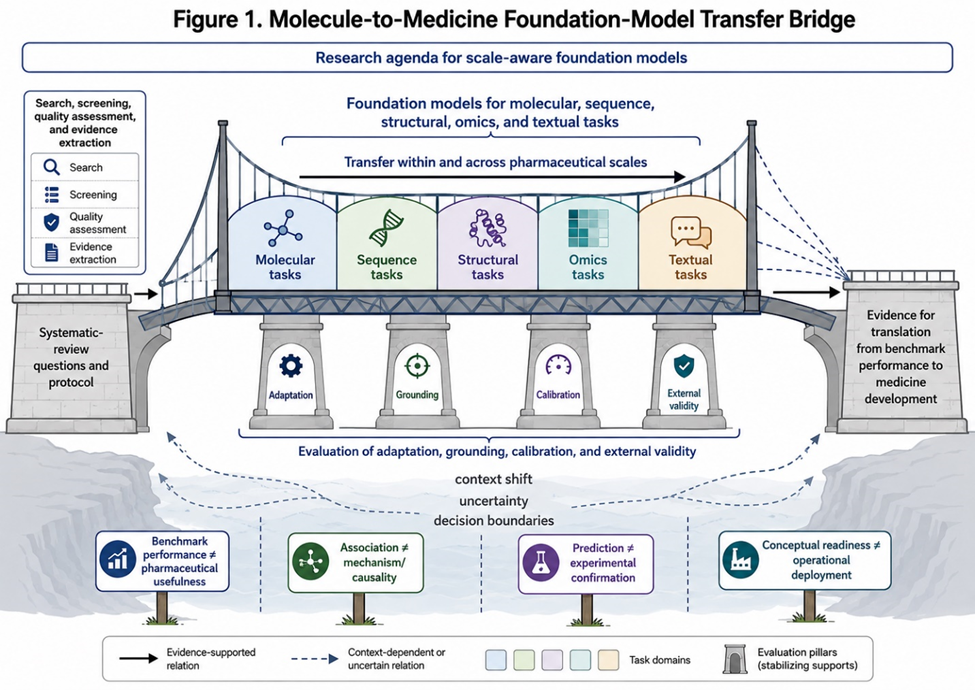
Figure 1 presents the molecule-to-medicine foundation-model transfer bridge, showing how the article’s key components and boundaries are connected within research agenda for scale-aware foundation models.
|
|
|
Figure 1. Molecule-to-Medicine Foundation-Model Transfer Bridge |
The figure is an original conceptual synthesis that organizes the article’s central contribution across systematic-review questions and protocol, search, screening, quality assessment, and evidence extraction, quality assessment, evidence extraction, foundation models for molecular, sequence, structural, omics, and textual tasks, foundation models for molecular. Arrows and grouping indicate proposed or evidence-supported relationships rather than measured effect sizes. The figure does not represent a validated predictive model, regulatory determination, clinical recommendation, or deployment-ready system.
Conclusion
Foundation models have established reusable statistical representations across molecular, protein, structural, cellular, omic, and textual data, but the evidence does not support an unqualified claim that representations transfer seamlessly from molecules to medicines. Transfer is strongest within a modality or between adjacent scales and becomes progressively more conditional as biological context, assay conditions, populations, and decision consequences change. This review proposes that every transfer claim be specified as a relationship among a source representation, target task, changed context, adaptation procedure, and validation gate. Benchmark performance can justify further investigation; it cannot replace grounding, calibrated uncertainty, external validation, experimental confirmation, or prospective decision evaluation. Scale-aware development should therefore prioritize explicit interfaces, challenge-based testing, data lineage, failure reporting, and consequence-matched evidence. The proposed bridge and maturity distinctions organize the current literature but are not validated readiness instruments. Their value lies in preventing capability, utility, experimental success, and routine pharmaceutical use from being treated as equivalent claims.
Acknowledgments: None
Conflict of interest: None
Financial support: None
Ethics statement: None